

图像认得出来,公式也背过,课堂上听的时候也总觉得“这个我会”。可一到自己做题,还是很容易在关键地方犹豫一下——
这里算的是 economic profit 还是只是看起来赚钱的 accounting profit?
企业继续生产,是因为真的有利润,还是只是为了 minimize costs?
题目让你找的是 socially optimal output,还是厂商自己的 profit-maximizing output?
这些概念单看都不陌生,一旦混在同一道题里,就特别容易让人拿不准。出现类似问题的原因往往不在于“学得不够多”,而在于复习没有抓住最该抓的内容。
AP 微观这门课其实很有规律:真正高频、常考、容易拉开差距的考点就那么几类。抓对重点,复习效率会一下子提高;抓不对重点,就很容易陷入“题刷了不少,错题还是那些”的循环。
好在,北京机构AP团队将AP微观经济99.9%的大考重点,整合成这份浓缩版大考精华,啃完它,你离5分就不远啦!赶紧添加老师领取吧
所以今天,我们就来做一次高效复习里的“重点突击”——筛出 5 个 AP 微观必会考点,看看你到底掌握得怎么样。这 5 道题,不只是知识点回顾,更像是一套小型诊断测试。如果你能比较顺利地做出来,说明核心框架已经比较稳定;如果你在其中几题上反复犹豫,往往就说明对应板块还没有真正形成考试中的判断能力。
为什么它们是“必会”?因为它们不是孤立的知识点,而是整门 AP 微观的核心骨架。很多选择题和图像题,表面上在变,底层逻辑其实都绕不开这些内容。换句话说,抓住这 5 个考点,不只是为了做对几道题,更是在帮自己搭起整门课最关键的得分框架。
1.市场图像中
曲线移动对市场均衡的影响
例题:
A decrease in the supply of pencils results in which of the following?
(A) A surplus of pencils in the market
(B) An increase in the demand for erasers, a complement in consumption
(C) An increase in the quantity demanded of pencils
(D) A decrease in the consumer surplus of pencil buyers
(E) A decrease in the demand for pencils
答案:
(D) A decrease in the consumer surplus of pencil buyers
知识点回顾
这道题考查的是 supply decrease 对市场均衡的影响。
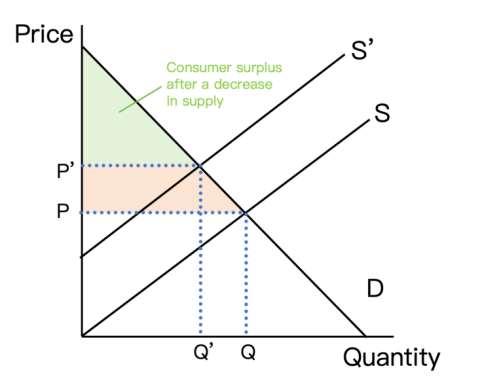
当 pencils 的供给减少时,供给曲线向左移动(leftward shift of supply)。在需求不变的情况下,新的市场均衡会表现为:
equilibrium price increases; equilibrium quantity decreases
也就是说,铅笔变得更贵了、卖得更少了。由于消费者需要以更高的价格购买商品,原本属于消费者的福利空间缩小,所以 consumer surplus decreases。
这里还要特别注意一个很容易混淆的点:
demand 指的是整条需求曲线的移动
quantity demanded 指的是因为价格变化,沿着同一条需求曲线发生的移动
当供给减少导致价格上升时,消费者会沿着原来的需求曲线向上移动,表现为 quantity demanded decreases,而不是 demand decreases。
所以选项 (C) “an increase in the quantity demanded of pencils” 显然不对,
选项 (E) “a decrease in the demand for pencils” 也不对,因为题目里变的是 supply, 不是 demand.
2. Total revenue test
销售额与弹性测试
例题:
Which of the following relationships among the price elasticity of demand, change in price, and change in total revenue is consistent?
答案:
(E) Inelastic — Decrease in Price — Decrease in Total Revenue
知识点回顾
这道题考查的是 price elasticity of demand 和 total revenue 之间的关系。
总收益公式是:
TR=P×Q
Price降低时,Quantity上升
这里的结论有三条:
当 demand is elastic 时,price 和 total revenue 反向变化
当 demand is inelastic 时,price 和 total revenue 同向变化
当 demand is unit elastic 时,price changes do not change total revenue
3. 垄断竞争长期均衡:价格、
边际收益、边际成本和利润怎么判断?
例题:
Which of the following is true about price (P), marginal cost (MC), marginal revenue (MR), and economic profit of a monopolistically competitive firm in long-run equilibrium?
(A) P>MC; Marginal revenue is below demand; Economic profit is zero
(B) P<MC; Marginal revenue is below demand; Economic profit is positive
(C) P>MC; Marginal revenue is above demand; Economic profit is positive
(D) P=MR=MC; Marginal revenue is equal to demand; Economic profit is zero
(E) P=MR=MC; Marginal revenue is above demand; Economic profit is positive
答案:
(A) P>MC; Marginal revenue is below demand; Economic profit is zero

知识点回顾
这道题考查的是 monopolistic competition in long-run equilibrium 的核心特征。
垄断竞争市场有两个关键词:
many firms + differentiated products
MR is below demand
企业依然按照 MR = MC 来决定利润最大化产量
因此可以推导出:
P>MR=MC
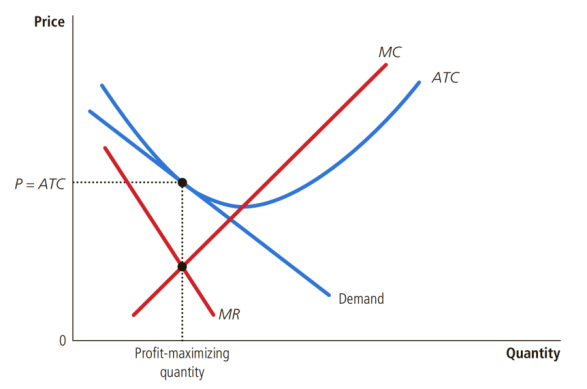
与此同时,在长期中,如果某个企业有经济利润,新企业会进入;如果企业亏损,一些企业会退出。经过进入和退出之后,最终会达到—— economic profit=0,即P=ATC。
4. Factor Market中Supply
and Demand的变化
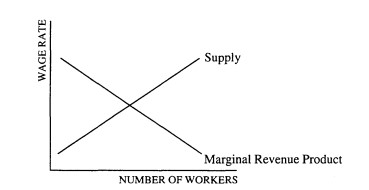
The graph above shows the marginal revenue product curve and supply curve of labor for a firm. The introduction of new management techniques dramatically increases workers productivity. Which of the following changes is most likely to occur?
(A) The supply curve will shift to the left, increasing the wage rate.
(B) The supply curve will shift to the right, increasing employment.
(C) The marginal revenue product curve will shift to the right, increasing wage rate.
(D) The marginal revenue product curve will shift to the left, reducing employment.
(E) Neither the marginal revenue product curve nor the supply curve will shift, but the wage will increase and employment will fall.
答案:
(A) The marginal revenue product curve will shift to the right, increasing wage rate.
知识点回顾:
这道题考查的是 labor market / factor market 中劳动需求的决定因素。
在要素市场里,企业对劳动的需求曲线就是 marginal revenue product of labor (MRP) curve。它表示企业每多雇佣一名工人所带来的额外收益。
MRP=MP×MR
其中:
MP = marginal product of labor
MR = marginal revenue
题目中 “new management techniques dramatically increase workers’ productivity”即工人的 marginal product increases, 所以整条 MRP curve shifts to the right。
在labor supply曲线不变的情况下,新的均衡会表现为:
wage rate increases; employment increases
5. 负外部性的影响
Which of the following is always true about a negative externality?
(A) It can be corrected by the government subsidizing the good or activity that creates the externality.
(B) It results in a market output that is smaller than the socially optimal output.
(C) It results in a market output that is greater than the socially optimal output.
(D) It results in a larger deadweight loss than a positive externality does.
(E) It results in a smaller deadweight loss than a positive externality does.
答案:
(C) It results in a market output that is greater than the socially optimal output.
知识点回顾
以卖方负外部性(negative externality of production)为例:
生产者在生产时,影响到了市场之外的第三方。
Marginal Social Cost > Marginal Private Cost
以卖方负外部性(negative externality of production)为例:
生产者在生产时,影响到了市场之外的第三方。
Marginal Social Cost > Marginal Private Cost
外部性这部分,有一些小技巧可以直接记忆:
(1) 关于负外部性
Negative externality leads to overproduction.
Market output is greater than the socially optimal output.
(2) 关于正外部性
Positive externality leads to underproduction.
Market output is smaller than the socially optimal output.
(3) 关于纠正政策
Negative externality → tax / regulation
Positive externality → subsidy
如果以上 5 题,你做对了 4–5 题,说明你目前对 AP 微观高频核心考点的掌握已经比较扎实,接下来更重要的是通过限时训练和 FRQ 表达练习,把正确率稳定下来,确保考试时能把会的内容顺利转化成分数。
如果做对了 3 题左右,说明基础框架已经有了,但一些关键概念之间还是容易混淆,尤其是在图像判断、概念辨析和计算逻辑这些地方,还需要结合错题进一步查漏补缺。
如果只做对了 0–2 题,就说明目前对核心考点的掌握还不够稳,这时候不能只靠增加刷题数量来提升,而是要尽快回到知识点本身,把高频考点逐个梳理清楚,这种情况就需要引起重视了,否则后面做综合题和 FRQ 时会比较吃力。
从去年同学们的反馈来看,真正影响考试发挥的,往往不是“完全不会”,而是到了考场上节奏乱了、关键词漏了、图像信息没看全。所以在考前这一个月里,比起一味增加题量,更建议大家回头看高频错题,整理常用表达,并练习在限定时间内把答案写完整。把会的题稳稳拿下,把熟悉的考点真正转化成分数,才是考前最有效的冲刺。