

听力
LISTENING
P1
主题:health center
题型:填空
1. Wallis
2. 14 December
3. 84 Station
4. 07284957532
5. Irish
6. father
7. Castle
8. hospital
9. shoulder
10. exercise
P2
主题:网站的make-over服务
题型:多选+匹配
📍多选
11-12 选shopping with stylist 和 give a booklet about fashion
13-14 选save time 和 become confident
📍匹配
15. 选charge of fees
16. 选time limit
17. 选free alteration
18. 选shower available
19. 选for men
20. 选book in advance
P3
主题:去工厂实习
题型:多选+匹配
📍多选
21-22 选learn equipment 和 learn technical terms
23-24 选interactive between staff 和 get employment after graduation
📍匹配
25. 选not referencing
26. 选irrelevant materials
27. 选no space for correction
28. 选no outline of the structure of company
29. 选not related to the course
30. 选too critical
P4
主题:一种农业形式
题型:填空
31. taste
32. competition
33. waste
34. rats
35. seeds
36. tunnels
37. weather
38. soil
39. fruit
40. scientist
阅读
READING
P1
主题:The Tyne Bridge
题型:判断+填空
📍判断
1. TRUE
2. FALSE
3. NOT GIVEN
4. FALSE
5. TRUE
6. NOT GIVEN
📍填空
7. Sydney
8. unemployment
9. ships
10. carriage
11. 59

12. warehouse
13. 162
P2
主题:Synaesthesia
题型:匹配+单选+填空
📍匹配
14. vi
15. v
16. ii
17. i
18. viii
19. ix
20. iv
📍单选
21. B
22. A
23. D
24. C
📍填空
25. overproduction
26. drugs
Synaesthesia
A.
Imagine a page with a square box in the middle. The box is lined with rows of the number 5, repeated over and over. All of the 5s are identical in size, font and colour, and equally distributed across the box. There is, however, a trick: among those 5s, hiding in plain sight is a single, capital letter S. Almost the same in shape, it is impossible to spot without straining your eyes for a good few minutes. Unless that is, you are a grapheme - colour synaesthete - a person who sees each letter and number in dierent colours. With all the 5s painted in one colour and the rogueS painted in another, a grapheme - colour synaesthete will usually only need a split second to identify the latter.
B.
Synaesthesia, loosely translated as "senses coming together" from the Greek words syn ("with") and aesthesis ("sensation"), is an interesting neurological phenomenon that causes dierent senses to be combined. This might mean that words have a particular taste (for example, the word "door" might taste like bacon), or that certain smells produce a particular colour. It might also mean that each letter and number has its own personality-the letter A might be perky, the letter B might be shy and self-conscious, etc. Some synaesthetes might even experience other people's sensations, for example feeling pain in their chest when they witness a film character gets shot. The possibilities are endless: even though synaesthesia is believed to act less than 5% of the general population, at least 60 dierent combinations of senses have been reported so far. What all these sensory associations have in common is that they are all involuntary and impossible to repress and that they usually remain quite stable over time.
C.
Synaesthesia was first documented in the early 19th century by German physician Georg Sachs, who dedicated two pages of his dissertation on his own experience with the condition. It wasn't, however, until the mid-1990s that empirical research proved its existence when Professor Simon Baron-Cohen and his colleagues used MRIs on six synaesthetes and discovered that the parts of the brain associated with vision were active during auditory stimulation, even though the subjects were blindfolded.
D
What makes synaesthesia a particularly interesting condition is that it isn't an illness at all.
If anything, synaesthetes often report feeling sorry for the rest of the population, as they don't have the opportunity to experience the world in a multisensory fashion like they do.
Very few drawbacks have been described, usually minimal: for instance, some words might have an unpleasant taste (imagine the word "hello" tasting like spoilt milk), while some synaesthetes find it distressing when they encounter people with names which don't reflect their personality (imagine meeting a very interesting person named "Lee", when the letter E has a dull or hideous colour for you-or vice versa). Overall, however, synaesthesia is widely considered more of a blessing than a curse and it is often linked to intelligence and creativity, with celebrities such as Lady Gaga and Pharrell Williams claiming to have it.
P3
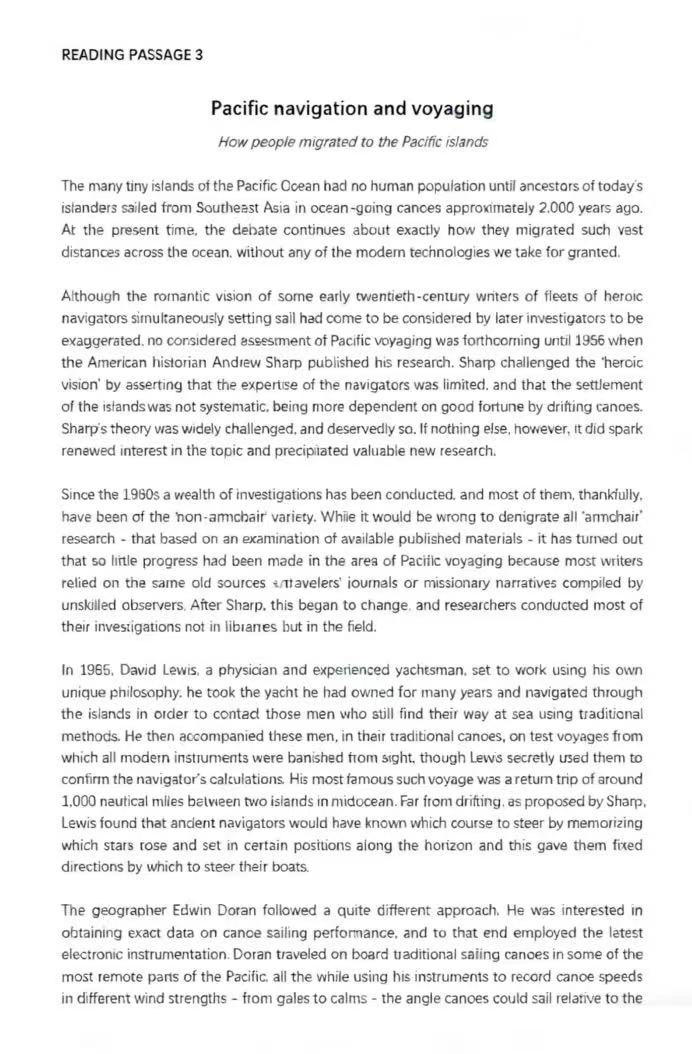
主题:The migration Pacific and voyaging
题型:判断+单选+匹配
📍判断
27. Yes
28. No
29. Yes
30. Not Given
31. Not Given
📍单选
32. A
33. C
34. B
35. D
36. B
📍匹配
37. C
38. A
39. D
40. E
写作
WRITING
小作文
静态饼图:
The charts below give information about the purposes of passengers flying from four different airports in the UK in 2016.
大作文
Research indicates that nowadays some consumers are much less influenced by advertising than in the past.
What do you think are the reasons? Do you think it is a positive or negative development?
参考思路:
造成该现象的原因与信息环境变化、消费者认知提升密切相关,整体而言属于积极发展。
原因分析(Reasons)
1. 信息获取多元化,消费者可通过第三方渠道验证广告真实性。
如今消费者能借助社交媒体、测评平台、用户口碑等了解产品真实情况,不再单一依赖商家广告宣传,有效规避广告夸大成分。
2. 广告泛滥引发审美疲劳与信任危机。日常生活中广告无处不在(短视频、弹窗、线下海报等),长期轰炸让消费者产生抵触心理,同时过往虚假广告案例降低了大众对广告的信任度。
利弊判断(Positive/Negative)
该现象为积极发展,对消费者、市场均有正向意义。
1. 对消费者:减少盲目消费,降低被误导的风险,能根据自身需求理性选择产品,节省时间与金钱成本。
2. 对市场:倒逼商家摒弃虚假宣传、夸大营销,转而聚焦产品质量与服务升级,推动市场良性竞争。
In conclusion:消费者受广告影响减弱,是信息多元化与广告信任度下降共同作用的结果。这一趋势不仅助力消费者理性决策,还能优化市场生态,无疑是积极的发展方向。