

2026年2月的全国考点FCE考试真题已正式出炉!相信关注备考动态的家长们已经发现了:今年的FCE考试依然延续了剑桥考试的“规律性”,大量题目与往年考题高度重合。特别是口语和写作部分,考试真题的循环『复用率稳居70%』以上!
这就是为什么我们反复强调:吃透真题规律,是短期冲刺、实现逆袭的唯一捷径。通过实战演练,考生不仅能精准掌握考试节奏,更能熟练运用高分表达方式,在考场上做到心中有数、游刃有余。
现已收集整理:2026年2月全国FCE考试真题(附标准参考答案),建议立即收藏练习!
012.7 广州、北京、浙江、重庆等全国地区
参考答案:
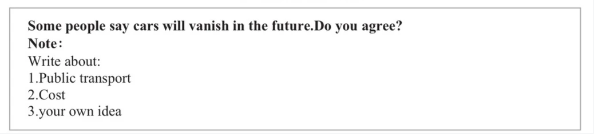
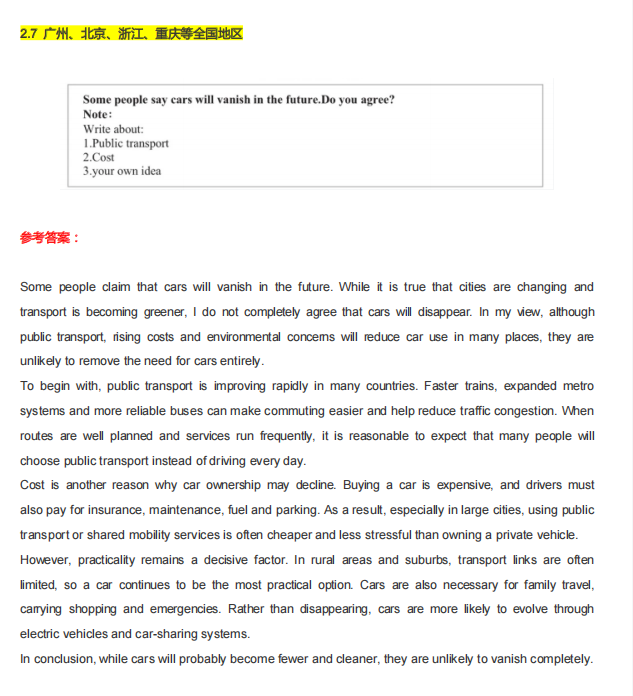
Some people claim that cars will vanish in the future. While it is true that cities are changing and transport is becoming greener, I do not completely agree that cars will disappear. In my view, although public transport, rising costs and environmental concerns will reduce car use in many places, they are unlikely to remove the need for cars entirely.
To begin with, public transport is improving rapidly in many countries. Faster trains, expanded metro systems and more reliable buses can make commuting easier and help reduce traffic congestion. When routes are well planned and services run frequently, it is reasonable to expect that many people will choose public transport instead of driving every day.
Cost is another reason why car ownership may decline. Buying a car is expensive, and drivers must also pay for insurance, maintenance, fuel and parking. As a result, especially in large cities, using public transport or shared mobility services is often cheaper and less stressful than owning a private vehicle.
However, practicality remains a decisive factor. In rural areas and suburbs, transport links are often limited, so a car continues to be the most practical option. Cars are also necessary for family travel, carrying shopping and emergencies. Rather than disappearing, cars are more likely to evolve through electric vehicles and car-sharing systems.
In conclusion, while cars will probably become fewer and cleaner, they are unlikely to vanish completely.
022.7口语考题(北京)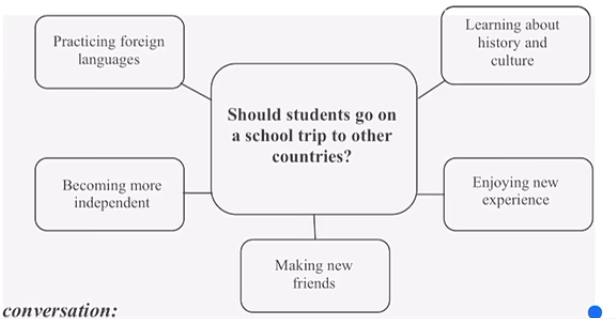
参考答案:
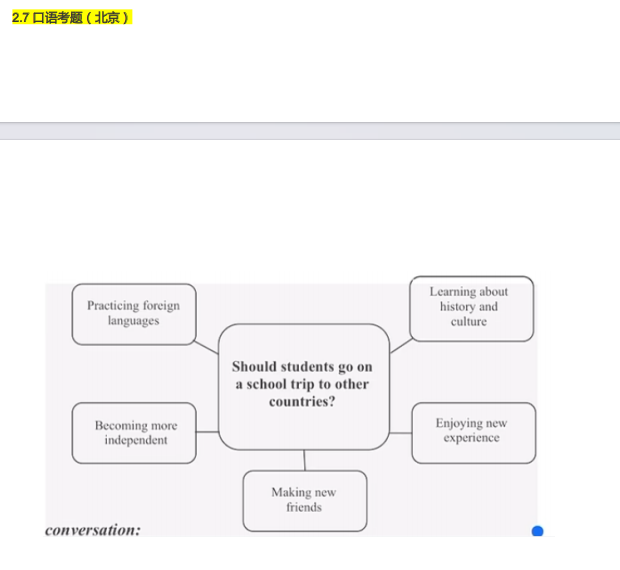
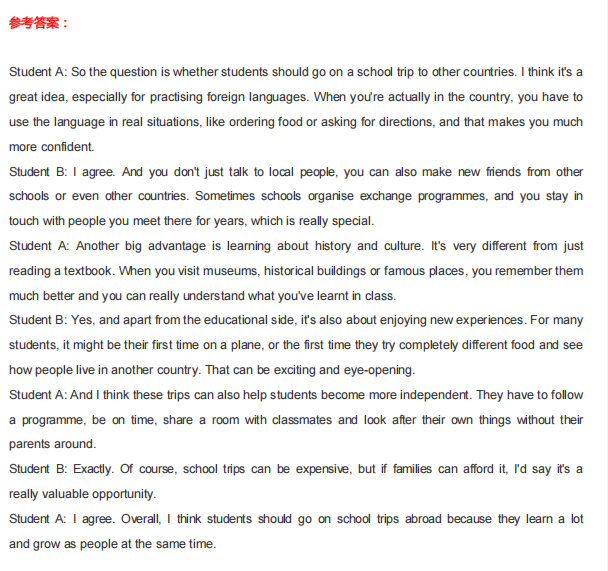
Student A: So the question is whether students should go on a school trip to other countries. I think it's a great idea, especially for practising foreign languages. When you're actually in the country, you have to use the language in real situations, like ordering food or asking for directions, and that makes you much more confident.
Student B: I agree. And you don't just talk to local people, you can also make new friends from other schools or even other countries. Sometimes schools organise exchange programmes, and you stay in touch with people you meet there for years, which is really special.

Student A: Another big advantage is learning about history and culture. It's very different from just reading a textbook. When you visit museums, historical buildings or famous places, you remember them much better and you can really understand what you've learnt in class.
Student B: Yes, and apart from the educational side, it's also about enjoying new experiences. For many students, it might be their first time on a plane, or the first time they try completely different food and see how people live in another country. That can be exciting and eye-opening.
Student A: And I think these trips can also help students become more independent. They have to follow a programme, be on time, share a room with classmates and look after their own things without their parents around.
Student B: Exactly. Of course, school trips can be expensive, but if families can afford it, I'd say it's a really valuable opportunity.
Student A: I agree. Overall, I think students should go on school trips abroad because they learn a lot and grow as people at the same time.
032024.3.23/2026.1.31全国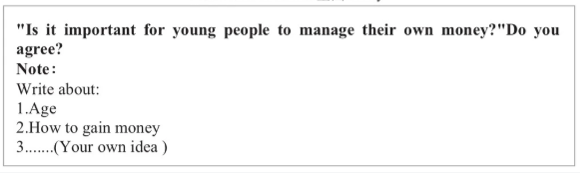
参考答案:
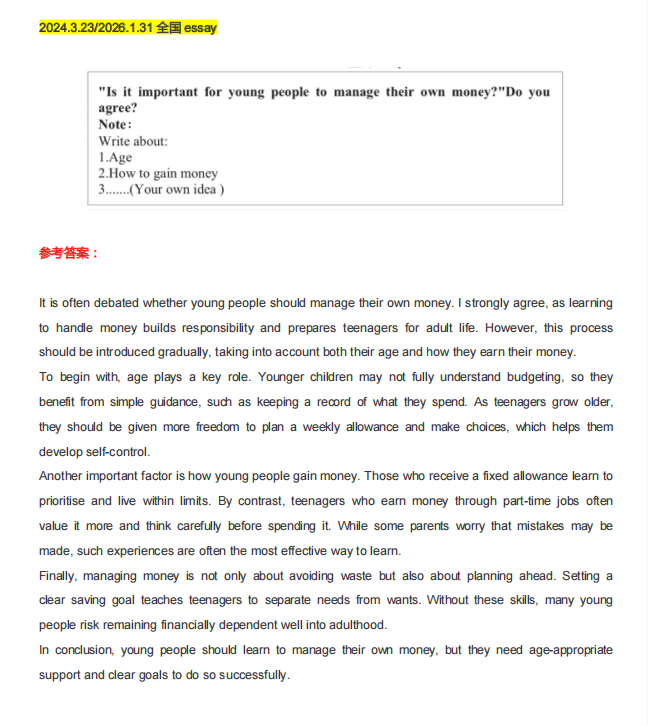
It is often debated whether young people should manage their own money.I strongly agree, as learning to handle money builds responsibility and prepares teenagers for adult life.However, this process should be introduced gradually, taking into account both their age and how they earn their money.
To begin with, age plays a key role.Younger children may not fully understand budgeting, so they benefit from simple guidance, such as keeping a record of what they spend. As teenagers grow older, they should be given more freedom to plan a weekly allowance and make choices, which helps them develop self-control.
Another important factor is how young people gain money.Those who receive a fixed allowance learn to prioritise and live within limits. By contrast, teenagers who earn money through part-time jobs often value it more and think carefully before spending it. While some parents worry that mistakes may be made, such experiences are often the most effective way to learn.
Finally, managing money is not only about avoiding waste but also about planning ahead.Setting a clear saving goal teaches teenagers to separate needs from wants. Without these skills, many young people risk remaining financially dependent well into adulthood.
In conclusion, young people should learn to manage their own money, but they need age-appropriate support and clear goals to do so successfully.
以上仅为2026年2月全国考点FCE考试真题小部分展示。