

1、题目大意
英语现在被广泛用作教育的主要语言,特别是在一些非英语国家的教育系统中。你认为这是积极的还是消极的发展?
2、提纲
3、高分范文示例
The growing prevalence of English as the primary medium of instruction in non-English-speaking countries has sparked considerable debate. While some regard this shift as a gateway to global opportunity, this essay contends that it is fundamentally a negative development, as it erodes cultural identity and compromises the quality of education for the majority of learners.
Firstly, adopting English as the language of instruction poses a serious threat to cultural and linguistic heritage. Language is not merely a communication tool but the vessel through which a society's values, history, and collective wisdom are transmitted across generations. When children are educated primarily in a foreign tongue, their connection to indigenous knowledge and traditions is gradually weakened, distancing an entire generation from its own heritage and accelerating cultural homogenisation. Ultimately, no degree of international competitiveness can compensate for a society's loss of its linguistic roots.
Furthermore, conducting education in a non-native language undermines cognitive efficiency and deepens educational inequality. When students must simultaneously process complex academic content and navigate a foreign language, their cognitive resources are divided, reducing their capacity for deep understanding. This burden falls disproportionately on learners from disadvantaged backgrounds, who lack access to supplementary English support, thereby widening the achievement gap for reasons unrelated to intellectual ability. Such an outcome is fundamentally unjust and contradicts the core purpose of education.
Admittedly, proficiency in English does enhance graduates' competitiveness in an interconnected global economy, broadening access to international networks and employment opportunities. However, this benefit accrues mainly to an already privileged minority, while the wider student population bears a disproportionate cognitive and cultural cost. It is therefore more equitable to teach English as a subject rather than impose it as the sole medium of instruction.
In conclusion, although English-medium education offers certain global advantages, its damage to cultural continuity and educational equity renders it a predominantly negative development. Policymakers should therefore design bilingual frameworks that preserve linguistic heritage while still equipping students with essential international competencies.
4、思路解析
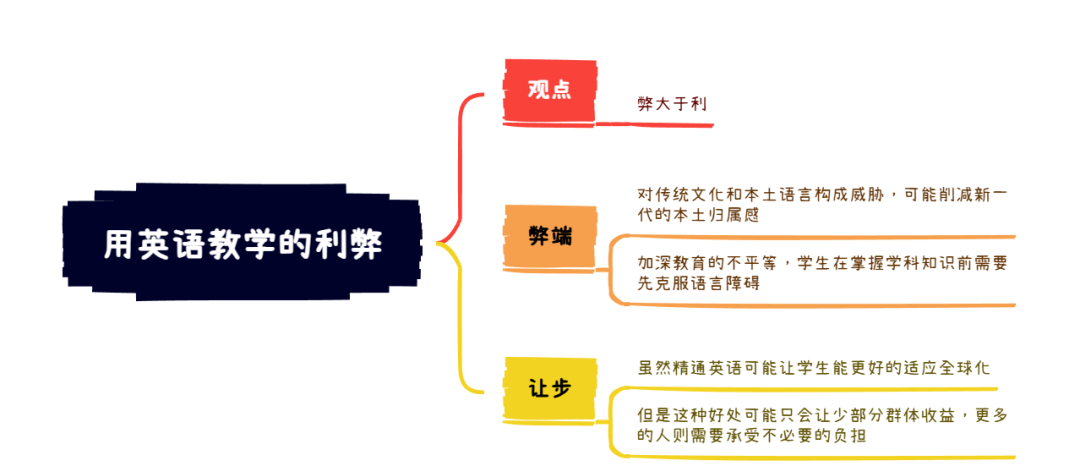
这是一道利弊类大作文,聊的是用英语教学的利弊问题。利弊类的讨论需要明确体现利大于弊、弊大于利或者利弊均等。审题时注意两点,一是注意题目中讨论对象是“non-English speaking countries”,二是题目讨论的不是“英语教学”而是“用英语教各个科目”。下面,老师带大家来看下具体观点。
有利的角度可以有两方面。
一方面英语教育能增强学生的全球竞争力。英语目前仍然是国际学术、商业、科技和外交领域的重要通用语言,如果学生从学校阶段就接受英语授课,他们会更容易适应全球化背景下的学习和工作环境,而不是局限于本国教育和就业体系。
另一方面有助于获取先进学术资源。许多高质量的学术论文和科研成果都以英语出版或传播,如果学生能够直接用英语学习相关知识,就可以减少翻译带来的信息滞后和概念偏差,更及时地接触国际最新研究成果。
再来看弊端,有三方面。
一是英语作为主要授课语言可能削弱文化认同。语言不仅是交流工具,也是历史文化金额和民族身份的重要载体。许多本土历史、文学、哲学等都依赖本国语言传承,一旦教育系统减少母语的使用,年轻一代与自身文化根源之间的联系就可能变得薄弱。
二是外语学习复杂知识会降低学生的理解效率。学生在学习数学、历史等复杂学科时,本来就需要投入大量认知资源去理解抽象概念。如果教学语言变成英语,非英语母语学生就必须额外克服语言障碍,这会显著增加学习负担。
三是英语授课容易扩大教育不平等。来自富裕家庭的学生可以参加英语补习,而来自低收入家庭或农村地区的学生则可能缺乏这些资源。如果学校突然把英语作为主要授课语言,造成的成绩差距并不代表智力差异,而是语言资源和家庭背景差异,因而违背了教育公平的原则。
5、相关词汇和语法结构

the primary medium of instruction 主要授课语言
non-English-speaking countries 非英语国家
spark considerable debate 引发广泛争议
a gateway to global opportunity 通往全球机会的入口
cultural and educational integrity 文化与教育完整性
a negative development 一种负面发展
erode cultural identity 侵蚀文化认同
compromise educational quality 损害教育质量
cultural and linguistic heritage 文化与语言遗产
a communication tool 交流工具
collective wisdom 集体智慧
be transmitted across generations 代际传承
a foreign tongue 外语
indigenous knowledge and traditions 本土知识与传统
accelerate cultural homogenisation 加速文化同质化
linguistic roots 语言根基
undermine cognitive efficiency 削弱认知效率
deepen educational inequality 加深教育不平等
disadvantaged backgrounds 弱势背景
essential international competencies 必要的国际能力