

WSC Weekly
2026世界学者杯
the World Scholar's Cup
2026年度主题
Are We There Yet?
WSC Weekly专栏将精选最新话题内容
助力小学者准备世界学者杯!
让我们怀着
永恒的学术精神与信念
探索未来的无限可能吧!
锁定每周WSC Weekly
上期回顾&Quiz答案揭晓
在2026年世界学者杯第22期WSC Weekly栏目中,我们与小学者一起学习了三百多年前,欧洲贵族青年流行一种特殊的旅行——“壮游”。在上期的趣味Quiz中,你是否找到了正确答案?现在就让我们一起来揭晓吧!
点击查看上期话题
觉得gap year很时髦?其实300多年前就有了
The tradition of grand tour in Europe
第22期Quiz答案揭晓:
Jerry, a young man from a British aristocratic family in the 17th century, is going on a Grand Tour. During his journey, he is least likely to encounter
杰瑞是17世纪英国一个贵族家庭的年轻人,他正准备踏上壮游之旅。在旅途中,他最不可能遇到的是
A) a French tutor helping him improve his language and social manners in Paris. 一位在巴黎帮助他提高语言水平和社交礼仪的法国家教
B) an art dealer selling paintings and other souvenirs to wealthy foreign travelers. 一位向富裕的外国游客兜售画作和其他纪念品的艺术品商人
C) a difficult journey across the Alps on his way from France to Italy. 从法国前往意大利途中穿越阿尔卑斯山的艰险旅程
D) travelers visiting the recently excavated ruins of Pompeii as a major attraction. 前往参观刚发掘出来的庞贝古城遗址的游客
E) British diplomats and aristocrats living abroad whom he could visit through introductions. 旅居海外的英国外交官和贵族,他可以通过介绍去拜访他们
正确答案: D
Key: D
2026年第23期
Weekly Intro
两千多年前,古希腊哲学家芝诺提出了一系列看似荒谬却逻辑严密的悖论。在本期Weekly中,我们将带你穿越时空,看现代数学如何用“极限”思想破解这些困扰人类千年的逻辑谜题。
2026 No.23
博尔特永远追不上一只乌龟?
Zeno's Paradoxes of Motion
芝诺悖论 Zeno's paradoxes
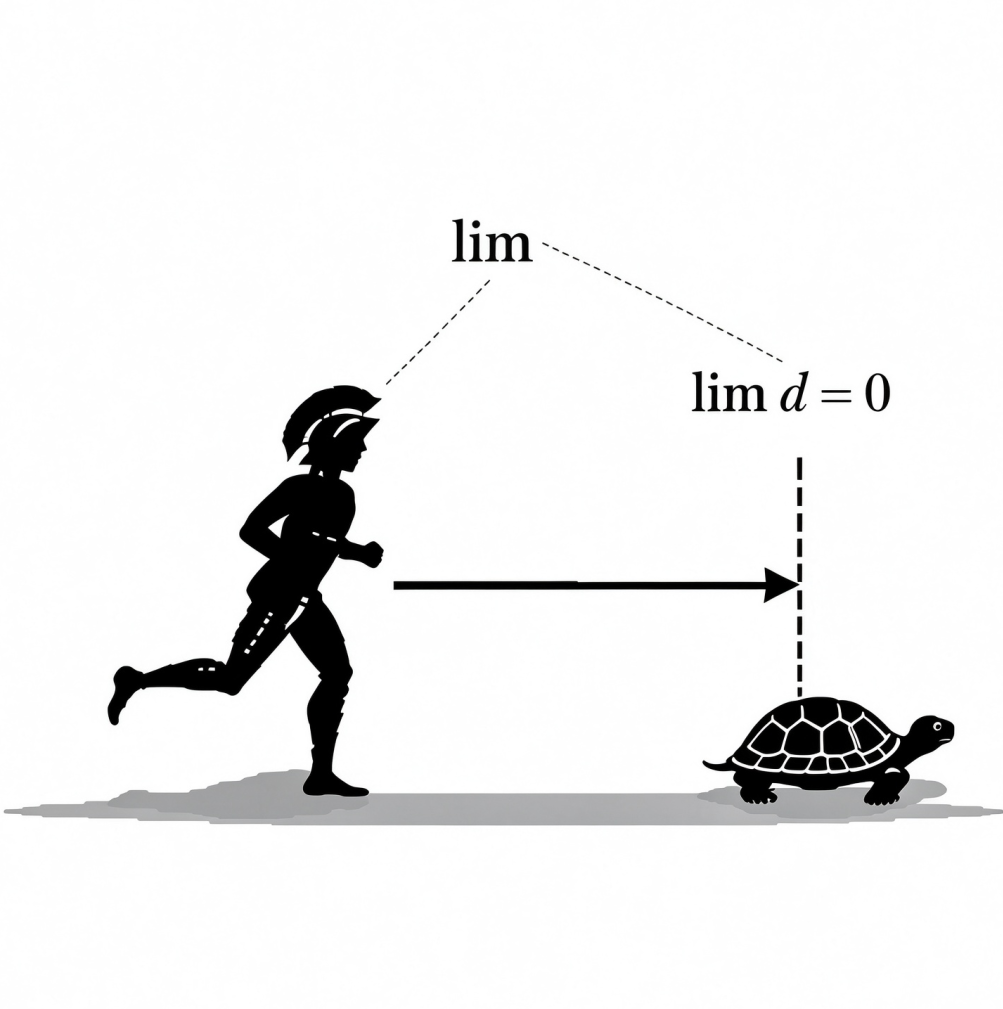
想象一下,世界上跑得最快的短跑运动员——尤塞恩·博尔特正在与一只小乌龟赛跑,而乌龟抢先出发了一段距离。博尔特全力冲刺,乌龟却只能以远不及他的速度慢慢爬行。显然,博尔特迟早会追上对手。然而,早在两千多年前,一位名叫埃利亚的芝诺(Zeno of Elea)的希腊哲学家却提出,这个看似理所当然的结果根本不可能发生。无论跑得多快,博尔特都永远追不上乌龟。芝诺生活在公元前5世纪的古希腊,那时,微积分和现代物理学尚未诞生,甚至连精确的机械钟都还没有出现。芝诺是哲学家巴门尼德的学生。巴门尼德认为,变化与运动远比人们想象的更加难以解释。芝诺的思想深受老师的影响,他提出了一系列论证,旨在证明:虽然日常经验告诉我们,物体总是在运动,世界也一直在变化,但接受这些司空见惯的观念可能会导致逻辑矛盾,因此是运动是不可能的。这些思想实验后来被称为“芝诺悖论”(Zeno's paradoxes)。
Imagine Usain Bolt, the world's fastest sprinter, racing a tiny tortoise that has been given a head start. Bolt sprints forward at full speed, while the tortoise plods along at a fraction of his pace. Surely, it is only a matter of time before Bolt overtakes his rival. But more than 2,000 years ago,a Greek philosopher named Zeno of Elea argued that this seemingly obvious outcome was impossible.No matter how fast the runner moved, he could never catch the tortoise. Zeno lived in ancient Greece during the fifth century BCE, long before calculus, modern physics, or even the invention of accurate mechanical clocks. He was a student of the philosopher Parmenides, who argued that genuine change and motion were more problematic than they appeared. Deeply influenced by his teacher,Zeno put forward a series of arguments aimed at proving that, although everyday experience tells us objects are always in motion and the world is constantly changing, motion is actually impossible because accepting these commonplace notions could lead to logical contradictions.These thought experiments later became known as “Zeno’s paradoxes.”
阿基里斯与乌龟悖论
the Achilles and the Tortoise paradox

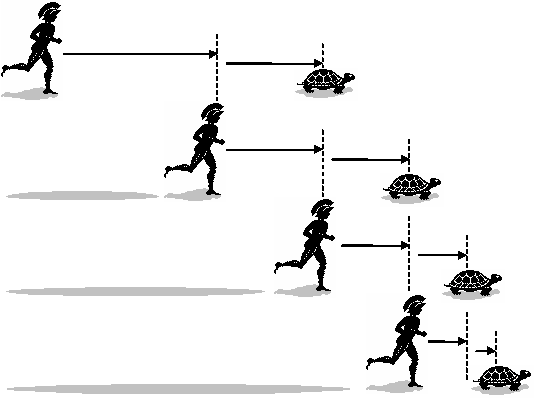
芝诺最著名的悖论之一,被称为“阿基里斯与乌龟悖论”(the Achilles and the Tortoise paradox)。阿基里斯是希腊神话中的英雄,以速度惊人而闻名。他同意与一只乌龟赛跑。为了让比赛公平一些,他让乌龟先跑一段距离。芝诺要求我们思考:阿基里斯究竟需要做些什么才能获胜?首先,他必须跑到乌龟最初出发的位置。但等他抵达那里时,乌龟已经又向前爬了一小段距离。于是,阿基里斯必须继续跑到乌龟新的位置。可等他赶到时,乌龟又往前移动了一些。每当阿基里斯抵达对手刚才所在的地方,乌龟就已经继续前进了。这个过程似乎可以无休止地重复下去。阿基里斯要想追上乌龟,就必须先完成一连串永无止境的短距离追赶。前方总有一个新的位置需要抵达,总有一小段距离需要追上。如果他必须完成无限多个步骤才能超过对手,又怎么可能真正跑完全程呢?当然,只要看过一场赛跑,我们就知道,跑得更快的人完全可以追上并超过跑得较慢的人。这个悖论真正讨论的并不是运动员的竞技能力,而是无穷的概念。芝诺把一个普通的运动过程划分成了看似无穷无尽的多个小过程,并提出了追问:一个过程即使包含无限多个步骤,为什么仍然能够在有限的时间内完成?
Zeno's most famous puzzle is often calledthe Achilles and the Tortoise paradox. Achilles, a hero from Greek mythology renowned for his speed, agrees to race a tortoise. To make the competition fair, he gives the tortoise a head start. Zeno asks us to imagine what Achilles must do to win. First, he has to reach the point where the tortoise began. But by the time he gets there, the tortoise will have moved a little farther ahead. Achilles must then reach that new position, only to discover that the tortoise has moved forward again. Every time Achilles reaches the place where his opponent was, the tortoise has already moved on. This process seems to repeat forever.Before Achilles can catch the tortoise, he must complete an endless sequence of smaller journeys.There will always be another position to reach and another tiny gap to close. If he must complete infinitely many steps before overtaking his rival, how can he ever finish the race? Of course, if you have ever watched a race, you know that faster runners can overtake slower ones.The puzzle is not really about athletic ability. It is about infinity.Zeno has taken an ordinary movement and divided it into an apparently endless series of smaller movements andchallenges us toexplain how something that involves infinitely many steps can still have a definite ending.
二分法悖论
the Dichotomy Paradox
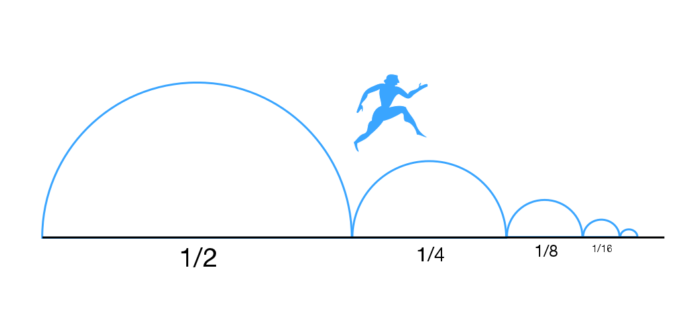
芝诺还有一个表达类似观点的悖论,叫作“二分法悖论”(the Dichotomy Paradox)。这一次,我们暂且忘掉乌龟,想象自己正在穿过一间屋子,准备走到门口。在抵达门口之前,你必须先走完房间一半的距离。接着,你需要走完剩余距离的一半。然后,再走完剩下距离的一半。无论你离门口有多近,总还有下一个中点需要跨越。举个例子,假设门口距离你8米。你必须先走4米,再走2米,然后走1米,接下来是0.5米、0.25米,如此不断继续下去。每一段距离都越来越短,但这个过程永远不会结束。无论你已经走了多远,似乎总还有下一小段路没有走完。如果你必须完成所有前面的步骤,才能开始下一个步骤,那么你似乎永远也无法真正抵达门口。然而,你今天早上很可能就毫不费力地穿过了一间屋子,根本没有想过这个问题。和“阿基里斯与乌龟悖论”相似,解开这个悖论的的关键在于:无限多个步骤,是否必然需要无限长的时间才能完成?
Zeno had another paradox that makes a similar point, known asthe Dichotomy Paradox. This time, forget the tortoise and imagine walking across a room to reach a door. Before you can reach the door, you must first travel halfway across the room. Then you must cover half of the remaining distance. After that, you must travel half of what remains again. No matter how close you get to the door, there is always another halfway point to cross. For example, suppose the door is 8 metres away. You must first walk 4 metres, then 2 metres, then 1 metre, followed by half a metre, then a quarter of a metre, and so on. The distances become smaller and smaller, but the sequence never ends. There is always another fraction of the journey left to complete. If every journey requires completing all the previous stages, it seems that you can never actually reach the door. Yet you probably walked across a room this morning without giving the matter a second thought. Like the Achilles and the Tortoise paradox,the key question in the Dichotomy Paradox is whether an infinite number of stages must require an infinite amount of time.
极限概念如何破解难题
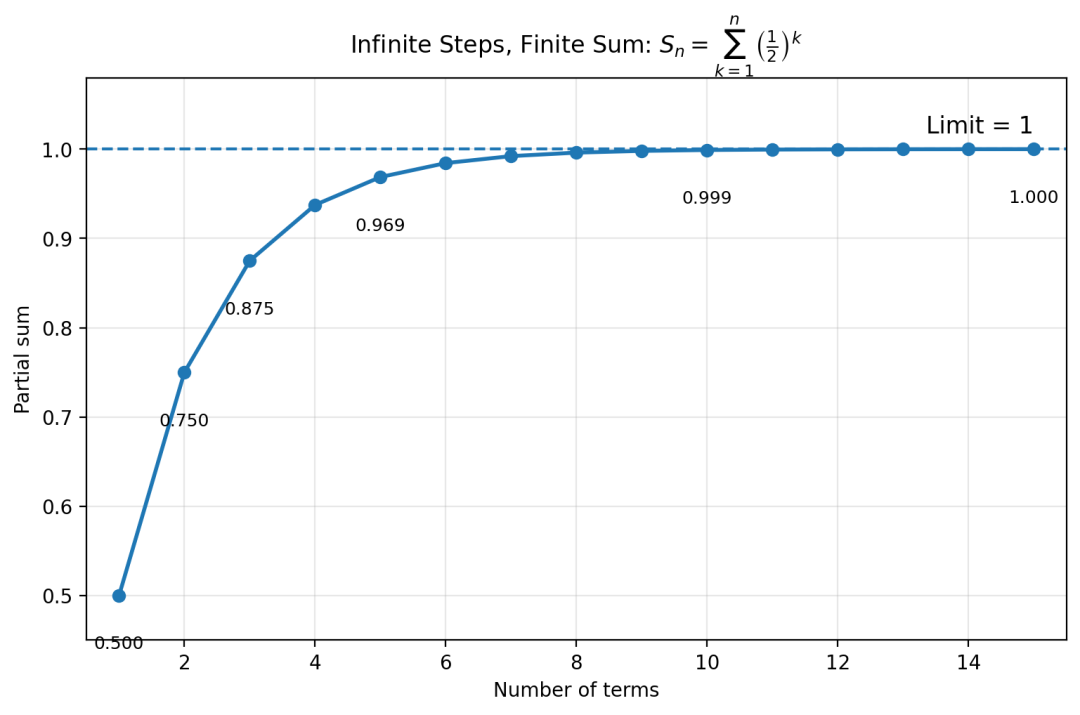
只要考虑每个步骤究竟需要多长时间,这个看似矛盾的问题就容易理解得多了。让我们回到博尔特与乌龟的比赛。假设乌龟领先10米,以每秒1米的速度前进,而博尔特的速度是每秒10米。博尔特跑到乌龟的起跑位置时,已经过去了1秒,而乌龟又向前爬了1米。博尔特只需要再花0.1秒就能跑完这1米,但在这段时间里,乌龟又向前移动了0.1米。随后,博尔特只需0.01秒就能追上这段距离,而乌龟又向前移动了0.01米。这个过程可以无限地继续下去,但每一轮所需的时间都比上一轮更短。所有这些时间加起来,总共约为1.111秒,而不是无穷长。经过这段时间,博尔特就能追上乌龟。这正是数学中“极限”(limit)概念发挥作用的地方。无穷多个不断缩小的量,其总和完全可能是一个有限的数值。类似地,在穿过房间的例子中,4米、2米、1米以及后面所有越来越短的距离加起来,恰好等于8米。一个行程可以被划分成无限多个部分,并不意味着走完它需要永远的时间。换句话说,芝诺的论证把“可以无限次细分”当成了“运动不可能完成”的证据。但数学告诉我们,这样的结论并不成立。无穷可以用来描述一段距离如何被划分,却不意味着走完这段距离必然需要无限长的时间。
The apparent contradiction becomes easier to understand when we consider how much time each stage takes. Return to the race between Bolt and the tortoise. Suppose the tortoise starts 10 metres ahead and runs at 1 metre per second, while Bolt runs at 10 metres per second. By the time Bolt reaches the tortoise's starting point, one second has passed and the tortoise has moved 1 metre farther. Bolt needs another 0.1 seconds to cover that metre, during which the tortoise moves another 0.1 metres. Bolt then needs just 0.01 seconds to cover the next gap, while the tortoise moves another 0.01 metres. The sequence continues indefinitely, but each interval takes less time than the one before it. The total time is approximately 1.111 seconds, not infinity. Bolt catches the tortoise after that time. This is where the mathematical concept of alimitbecomes important. An infinite sequence of shrinking quantities can approach a finite total. In the room example, the distances of 4 metres, 2 metres, 1 metre, and all the remaining fractions add up to exactly 8 metres. The fact that we can divide a journey into infinitely many parts does not mean that the journey must take forever. In other words, Zeno's argument treats the existence of infinitely many subdivisions as if it automatically made motion impossible. Mathematics shows that this conclusion does not follow.Infinity can describe how we divide a distance without requiring an infinite amount of time to travel it.
飞矢不动悖论
the Arrow Paradox
并非所有芝诺悖论都涉及赛跑或行走。另一个著名的悖论叫作“飞矢不动悖论”(the Arrow Paradox),它要求我们思考一支在空中飞行的箭。想象一下,你拍下了一张箭在空中飞行的照片。在照片拍摄的那个精确瞬间,箭占据着空间中的一个特定位置。在这个被冻结的瞬间里,我们看不到箭正在向任何地方移动。芝诺据此提出:在任何一个单独的瞬间,箭都占据着与自身大小相等的空间,因此在那个瞬间,它是静止的。如果时间完全由这样的瞬间组成,那么一连串箭都处于静止状态的瞬间,又怎么能构成运动呢?这个谜题挑战的是我们对时间本身的理解。我们通常认为,运动是连续发生的过程,但照片只能捕捉某一个瞬间。如果把时间想象成一张张静止画面的集合,就很难解释运动究竟是如何从这些画面中产生的。现代数学为理解这一问题提供了一种方法。物体在某一瞬间的速度,可以通过考察它在越来越短的时间间隔内位置发生了怎样的变化来描述。箭不需要在某个被冻结的瞬间内移动一段肉眼可见的距离,才能在那个瞬间拥有速度。描述箭的运动,需要考察位置与时间之间的关系,而不能只看一张照片所呈现的内容。这个悖论揭示了我们直觉的局限。一张照片无法完整呈现运动物体的运动状态,就像一部电影中的单帧画面无法解释连续播放时所呈现的动态效果一样。
Not all of Zeno's paradoxes involve a race or a journey. Another famous puzzle,the Arrow Paradox, asks us to consider an arrow flying through the air. Imagine taking a photograph of an arrow in flight. At the precise instant the photograph is taken, the arrow occupies a particular position in space. It is not visibly travelling anywhere within that frozen instant. Zeno argues that if we consider any single instant, the arrow occupies a space equal to its own size and is therefore at rest at that instant.If time consists entirely of such instants, how can a series of moments in which the arrow is at rest produce movement?This puzzle challenges our understanding of time itself. We usually think of motion as something that happens continuously, but a photograph captures only a single moment. If we imagine time as nothing more than a collection of frozen snapshots, it becomes difficult to explain how movement emerges from them. Modern mathematics offers a way to describe the problem. An object's velocity at a particular instant can be understood through how its position changes over increasingly small intervals of time. The arrow does not need to travel a visible distance within one frozen instant to have a velocity at that instant.Its motion is described by the relationship between position and time, rather than by what a single photograph reveals.The paradox therefore exposes a limitation in our intuition. A snapshot of a moving object cannot tell us everything about its motion, just as a single frame from a film cannot explain the movement we see when the frames are played in sequence.
芝诺悖论引发的哲学讨论
芝诺悖论听起来或许像是巧妙的文字游戏,但它们实际上提出了有关数学、物理学和哲学的重要问题。它们迫使我们重新审视那些看似不言自明、但一旦试图严谨解释就变得复杂的概念。17世纪微积分的发展,为数学家理解连续变化、无穷数列以及趋近某个极限的量提供了强有力的工具。这些工具帮助我们解释,为什么赛跑中的无限次细分并不会阻止阿基里斯追上乌龟。尽管如此,芝诺悖论至今仍在引发有关空间、时间、无穷和连续性的哲学讨论。这些悖论也揭示了人类思维的一个有趣特点:我们的直觉足以应付日常生活中的大多数事情,比如穿过一间屋子,或者观看一场赛跑。但当我们试图用严格的逻辑论证来解释这些经验时,隐藏在直觉背后的假设就可能暴露出来。我们可能想当然地认为,无限多个步骤必然需要无限长的时间,也可能认为,一个物体如果在某个特定瞬间处于静止状态就不可能正在运动。芝诺的悖论迫使我们停下来,重新审视这些假设,而不是不加思考地接受它们。
Zeno's paradoxes may sound like clever word games, but they raise serious questions about mathematics, physics, and philosophy. They challenge us to examine concepts that seem obvious until we try to explain them precisely.The development of calculus in the seventeenth century provided mathematicians with powerful tools for understanding continuous change, infinite sequences, and quantities that approach a limit.These tools help explain why the infinite subdivisions in Zeno's race do not prevent Achilles from catching the tortoise. Nevertheless,the paradoxes continue to inspire philosophical discussionabout the nature of space, time, infinity, and continuity.They also reveal something interesting about human reasoning. Our intuition works well enough for everyday tasks, such as crossing a room or watching a race. But when we try to describe those experiences using strict logical arguments, hidden assumptions can emerge. We might assume that infinitely many steps require infinitely much time, or that something cannot move if it is stationary at a particular instant. Zeno's puzzles force us to question these assumptions instead of accepting them automatically.
Weekly 关键词 Key Words
►
Zeno of Elea 埃利亚的芝诺
the Achilles and the Tortoise paradox 阿基里斯与乌龟悖论
the Dichotomy Paradox 二分法悖论
the Arrow Paradox 飞矢不动悖论
所属话题
Concluding Questions
相关阅读
https://www.thecollector.com/zeno-paradoxes-motion-time/
Weekly FUN Quiz
现在,快来参与本期Weekly FUN Quiz👇,告诉老师你的答案吧!
Quiz
Which of the following lyrics is least relevant to Zeno’s paradoxes of motion?
以下哪句歌词与芝诺的悖论关联最小?
A) “Everything I take for granted just leads me to contradictions.” “我视为理所当然的一切,最终都让我陷入矛盾。”
B) “Each place I reach is only where you used to be.” “我抵达的每个地方,都只是你曾经所在之处。”
C) “Frozen for an instant, I am still somehow in flight.” “虽在瞬间凝固,我却不知为何仍在飞翔。”
D) “The end draws nearer, though the steps between us never run out.” “终点日益临近,尽管我们之间的路程永无止境。”
E) “I follow the same road again, returning to where I began.” “我再次沿着同一条路前行,回到我出发的地方。”
To WSC Scholars:
本期Weekly Quiz正确答案将在专栏下期推文中揭晓!欢迎小学者们关注服务号,进入“WSC Weekly”专栏,此栏目将会持续陪伴小学者们,分享更多WSC趣味学术知识!