

《纽约时报》New York Times(NYT)是美国最大的本地都市报,也是美国三大报纸之一。纽约时报系列写作比赛是《纽约时报》举办的,全年滚动开展。如果学生投稿文章,能够得到评委的青睐乃至获奖,登上该报刊,无论是对申请理工科还是文商类专业的学生,都会起到非常重要的助力作用。2025-2026纽约时报公开信我们的观点大赛备赛报名已开启,你准备好迎接挑战了吗?
01·公开信:我们的观点写作比赛 ·
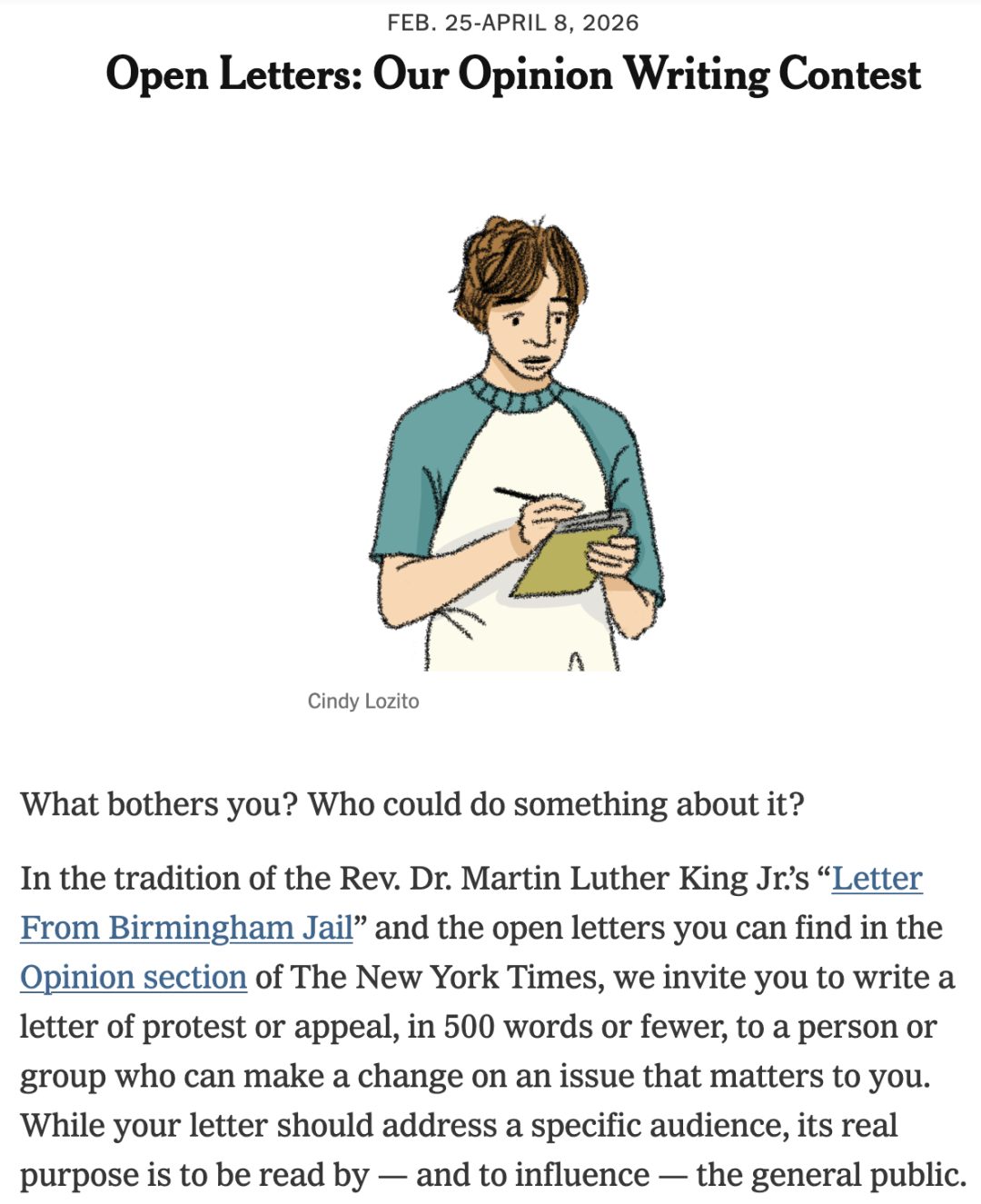
比赛时间:2026.2.25——2026.4.8
适合学生:全球13-19岁初中和高中生均可投稿参加
重点要求:
✔ 必须是公开信形式
面向一个真实存在的收信人,但最终面对大众。
✔ 不超过 500 字
英文写作,短篇表达力非常重要。
✔ 必须是原创作品
不能使用 AI 生成的段落,也不能抄袭新闻。
✔ 内容必须围绕“一个具体问题”
并向能够解决该问题的人发出倡导。
02·内容具体要求 ·
请写一封不超过 500 字 的 公开信(open letter),对象必须是能够对你所关心的议题产生影响的个人或团体。
你的信件应当表达一种“呼吁”、“倡议”或“抗议”
你必须清楚指出你在意的社会问题是什么
你必须向一个特定的“能改变现状的人或组织”发出请求
虽然信件是写给某个对象的,但最终目的是希望“公众阅读并产生共鸣”
这种写作形式源于马丁·路德·金牧师的《伯明翰监狱来信》传统,也深受《纽约时报》署名公开信写作风格的影响。
示例对象包括(但不限于):
你的校长
市长或地方议员
科技公司
社区领导者
学校董事会
某个组织或机构
示例话题包括:
校园健康
公共安全
心理健康

环境与交通
AI与教育
文化现象批判
社交媒体使用
隐私保护
你所在社区的任意真实问题
公开信写作的关键技巧包括:
明确指出收信人是谁
第一段点出现实问题
中间段落用事实论证其重要性
最后一段提出可执行的建议并表达“呼吁”
03·参赛收获 ·
1.提升批判性思维与媒体素养:
比赛鼓励学生通过策展实践,学习如何批判性地消费信息。在信息过剩的时代,学生们需要培养选择、组织、提供背景、引用证据的能力,以便为他们关心的主题辩护。这不仅有助于他们分析和思考,也能提升他们的表达和创造能力。
2.实践创造性表达:
比赛邀请学生在选择和组织内容时展现创造力,帮助他们思考如何用独特和富有想象力的方式进行分组和展示。例如,学生可以通过列出不同主题的清单来表达对所学知识的理解,并通过展示他们的个人观点和创造力来增强学习的乐趣和成就感。
3.跨学科融合尝试:
比赛允许学生根据自己所学的不同学科(如历史、STEM等)选择具体主题来策展。这种跨学科的结合不仅能够加深他们对专业知识的理解,还能激发他们发现学科之间的联系和实际应用的兴趣。例如,历史系学生可以列出反映文艺复兴的艺术作品,STEM学生则可以通过电影或播客来探索物理或数学概念。
4.助力升学,提升申请竞争力:
参加这项比赛不仅有助于学生拓宽视野,提升综合能力,还能在申请本科时为他们加分。通过策展实践,学生能够展示他们的批判性思维、创新能力和跨学科的知识应用,这些都是大学录取委员会十分看重的素质。特别是在众多申请者中,拥有独特经历和实际项目的学生将更具竞争力。比赛的参与过程和成果可以成为申请材料中的亮点,帮助学生在升学过程中脱颖而出,提升他们的申请优势。
04· 评分标准 ·
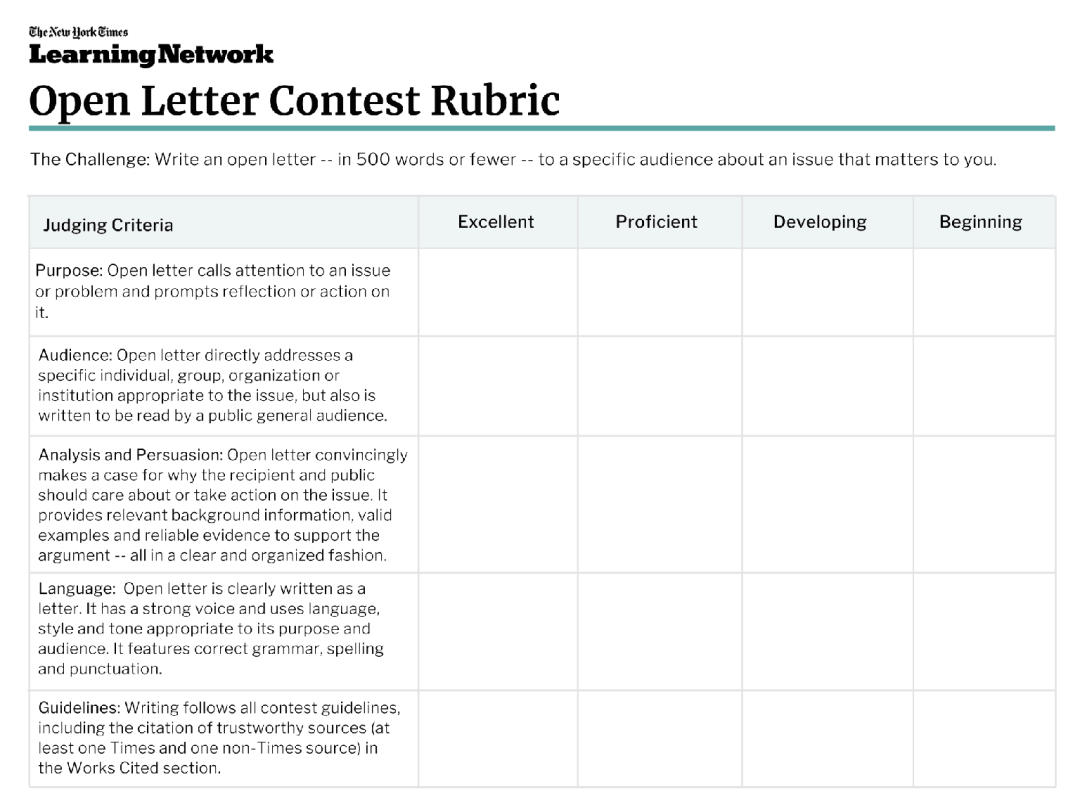
获奖者将在 2026 年 6 月左右宣布
05· 获奖作品展示 ·
Dear Teachers,
Last week in class, I raised my hand once. It took everything I had. When you finally called on me, you didn’t say my name. Just a flat “yes,” to my question before moving on. I made my comment, waited for a chance to add more, but it never came. I didn’t get a second chance to speak. You probably didn’t even notice. Maybe you were scanning the room for more enthusiastic hands or louder voices. But to me, that one comment felt like a risk, a stretch, a decision to participate. You said you value student voices, but only one kind of voice seems to be rewarded. For students like me, who tend to process before we speak, who lead by listening, and find strength in observation rather than being under the spotlight, there is little space for growth.
As students, our school tells us to “Think, Act, Lead, Serve.” We’re taught to lead with distinction and think boldly. But somewhere in between the mission statements and the participation rubrics, it feels like leadership is mistaken with being the loudest voice in the room.
In class, my silence is seen as disengagement. But I am always thinking and always present. I’m the student who follows along, takes meticulous notes, makes annotations, and who stays after class to ask a thoughtful question. Still, I was marked down for low participation. “Participation” is a grade I cannot achieve without pretending to be someone I’m not. When thoughtful engagement is constantly overlooked, it really starts to mess with my confidence. It makes me wonder if my way of showing up in class even matters.
Outside the classroom, it is no different. When leadership roles are announced, the spotlight usually falls on the students who can take charge loudly in meetings. The titles tend to go to those who know how to perform leadership, not always to those who practice it. I’ve seen my quiet friends mentor their peers, lead projects efficiently and hold their values with moral courage all without recognition. We lead with distinction, too. Just not with a microphone. When opportunities arise, be it recommendations or leadership role selections, we are not the student you think of first, even if we have quietly done the work.
This goes beyond our school. Studies have shown that introverted students are often perceived as less engaged by teachers, even when they are participating in a different way. Teachers commonly assume quieter students are less involved, impacting how they grade and interact with those students. In fact, introverts actually make strong leaders. They often excel in empathy, listening, and strategic thinking, but they are frequently hidden in the systems that reward charisma over competence.
If you truly want to “transform students’ lives,” as our school’s mission promises, then that transformation must include the quiet ones too. Redefine participation. Redefine leadership. Allow for thinking before speaking and notice action without performance.
We are here, and we are leading, you just haven’t learned how to see it yet.
Sincerely,
Anna Xu