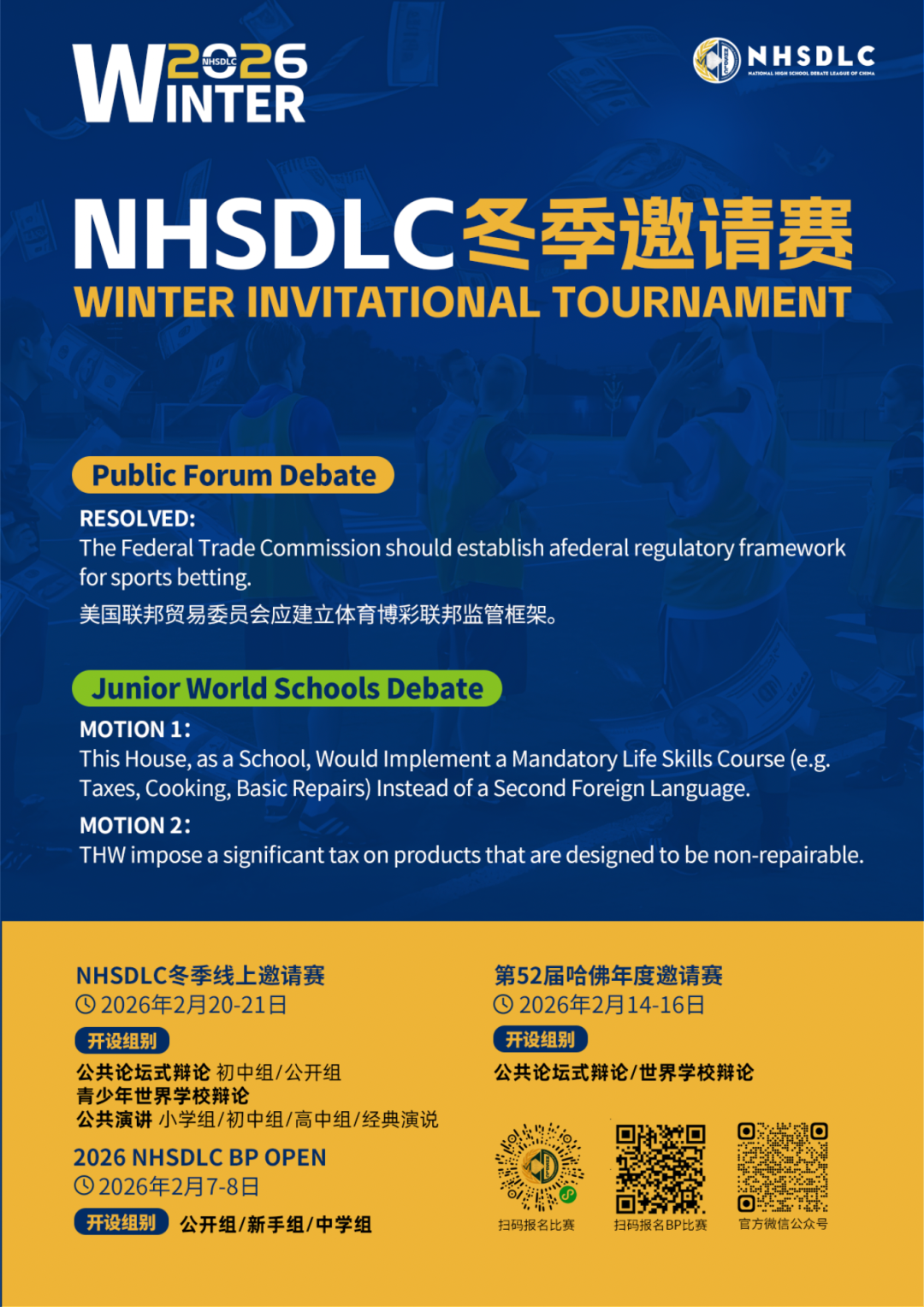


2026 NHSDLC冬季邀请赛
2026 哈佛 / 斯坦福年度邀请赛
辩题聚焦政治领域
深入探讨美国联邦贸易委员会
是否应在联邦层面监管体育博彩?
监管政策对消费者、市场和政府当局又意味着什么?
今天就为大家带来2026 NHSDLC冬季邀请赛同2026 哈佛 / 斯坦福年度邀请赛
辩题解析
希望能帮助大家更好地了解
辩题背景及核心争议
为赛事做好充分的准备~
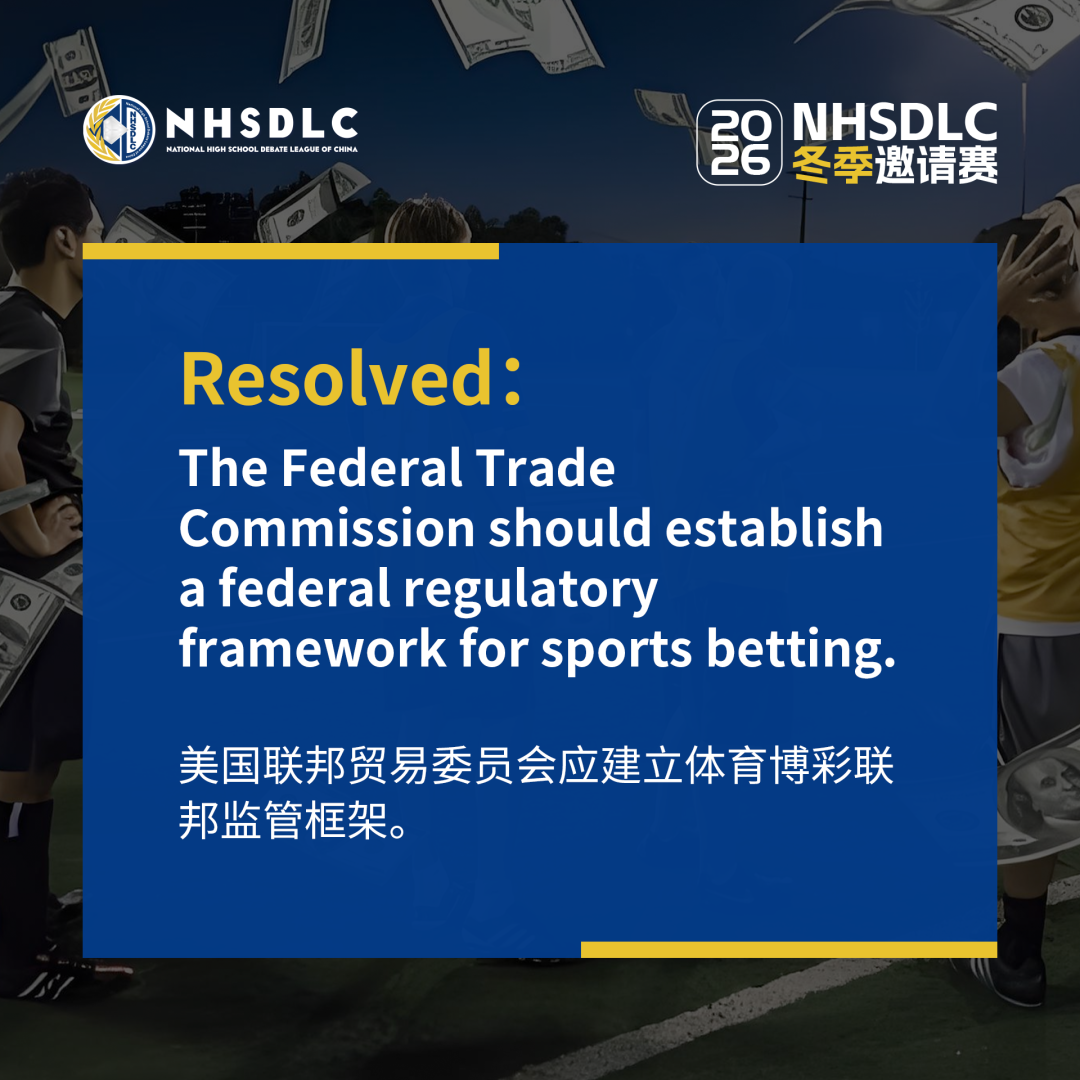
Over the last 7 years, sports betting has emerged from the outer edges of American life and into the mainstream of its culture and economy. What was once confined to a handful of jurisdictions is now legally practiced in a majority of U.S. states, deeply embedded within professional leagues, advertised during prime-time broadcasts, and part of the everyday routine of millions of fans across the country. The lightning-fast growth has seen enormous revenue, innovation, and consumer interest-but also deep regulatory fragmentation and growing public concerns. It is against this backdrop that our Winter Public Forum topic asks a particularly timely and consequential question: should the Federal Trade Commission step in to create a unified federal regulatory framework for sports betting?

图源@NHSDLC
The resolution focuses on the age-old tension between federal oversight and state autonomy. Since the Supreme Court struck down the Professional and Amateur Sports Protection Act or PASPA, in 2018 (Murphy v. National Collegiate Athletic Association), states have been largely free to legalize and regulate sports betting as they wish. The result has been a patchwork system: different rules on advertising, consumer protections, data privacy, age verification, problem gambling safeguards, and enforcement mechanisms (American Gaming Association, 2023), depending on where one lives.
Supporters contend that such inconsistency is poorly suited to the digital nature of the interstate industry and thus leaves customers exposed to uneven, and sometimes insufficient protections. And Opponents would argue that the regulation of gambling ought to be, and has historically been left to the states as local governments are better suited to reflect the community norms and policy priorities.
图源@NHSDLC
The factor that adds an extra degree of analytical complexity to this debate is that it involves the Federal Trade Commission. Contrary to other organizations that have been related to betting or financial regulation. The FTCs core mandate remains consumer protection, competition, including preventing unfair or deceptive acts or practices in commerce (Federal Trade Commission Act, 15 U.S.C. §45). The Pro and Con teams must then consider whether sports betting should be treated as a consumer market place that requires a National Standard, or as a social activity that should be left to local governments. That distinction will help answer questions about institutional competence, regulatory scope on the issue and the limits of administrative authority.
Looking beyond the questions on how an optimal regulatory structure might be created, there are plenty of other issues that can be discussed. For example, those in favor of a federal regulatory framework, may have valid points regarding high degrees of problem gambling in America, predatory forms of gambling in advertising, as well as the misuse of behavioral data on gambling platforms to target customers especially young adults with personalized incentives (Centers for Disease Control and Prevention, 2022 and Pew Research Center 2023). They argue that a national regulatory baseline could stop predatory practices, protect minors, and ensure transparency across state lines.

图源@NHSDLC
On the other hand, there might be points against a federal approach, like an increase in compliance costs, turning the market into one that only favors larger corporate operators, or the reduction of states ability to experiment with tailored policy solutions.
Notably, this resolution does not consider whether sports betting should be legalized. That question was largely settled in the post-PASPA era and has, for most practical purposes, become a fait accompli. shifting the debate toward questions of regulation rather than permissibility. It considers how a rapidly changing industry can be regulated and by which level of Government, how we can balance consumer protection, economic innovation, and public welfare.
As we enter the Winter season, we invite debaters to approach the topic with a careful mix of technical argumentation skills and ethical considerations. The strongest debaters will not merely recite facts regarding revenue or addiction rates, but will seek to question underlying presuppositions concerning federalism, economic regulation, or the appropriate role for government in managing risk in the modern economy. In this regard, the topic offers students the opportunity to explore live policy questions on law, economics, and consumer protection. Precisely the kind of inquiry and curiosity that lies at the heart of PF debates.
Reference:
- https://www.census.gov/library/stories/2025/12/sports-betting.html?hl=en-US
- https://www.goldmansachs.com/insights/articles/why-us-sports-betting-could-become-a-45-billion?hl=en-US
- https://www.ftc.gov/legal-library/browse/statutes/federal-trade-commission-act
- https://stacks.cdc.gov/view/cdc/129874
- https://behavioralhealthnews.org/the-impacts-of-problem-gambling/
- https://www.maine.gov/dhhs/mecdc/healthy-living/substance-use-and-behavioral-health/problem-gambling
- https://www.pewresearch.org/short-reads/2025/10/02/americans-increasingly-see-legal-sports-betting-as-a-bad-thing-for-society-and-sports/
- https://www.theregreview.org/2024/02/24/saturday-seminar-betting-on-improvements-to-sports-gambling-regulations/?hl=en-US
- https://thevarsity.ca/2026/01/05/opinion-gambling-culture-is-ruining-sports/?hl=en-US
2026 NHSDLC冬季邀请赛
报名火热进行中!
可扫描下图了解详情&报名