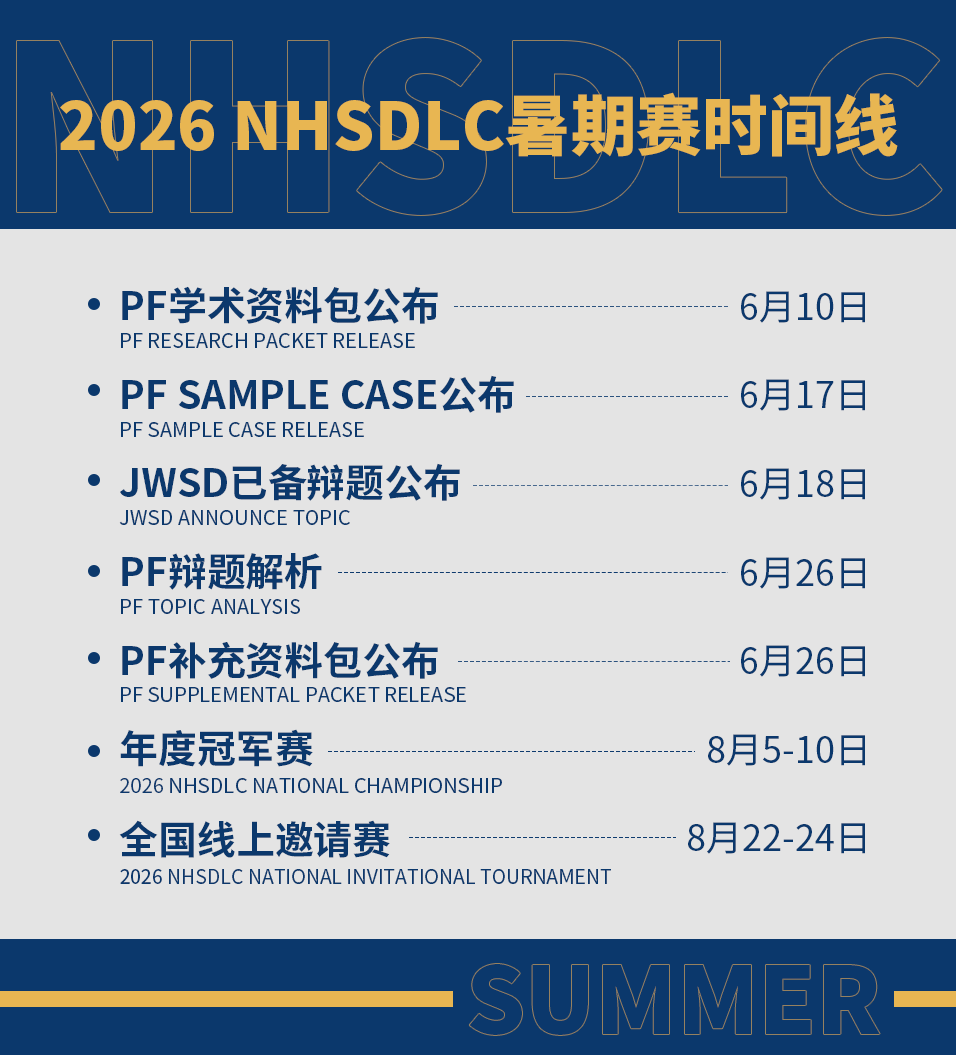


上周,我们公布了PF辩题学术资料包
还没下载的同学
点击此处即可获取资料包哦!
今天,我们继续为大家带来备赛补给——
2026年度冠军赛
PF辩题 Sample Case
从正反双方提供视角和思路
帮助大家更好地理解辩题
希望大家能够从中得到启发
让我们一起看看
Sample Case的具体内容吧~
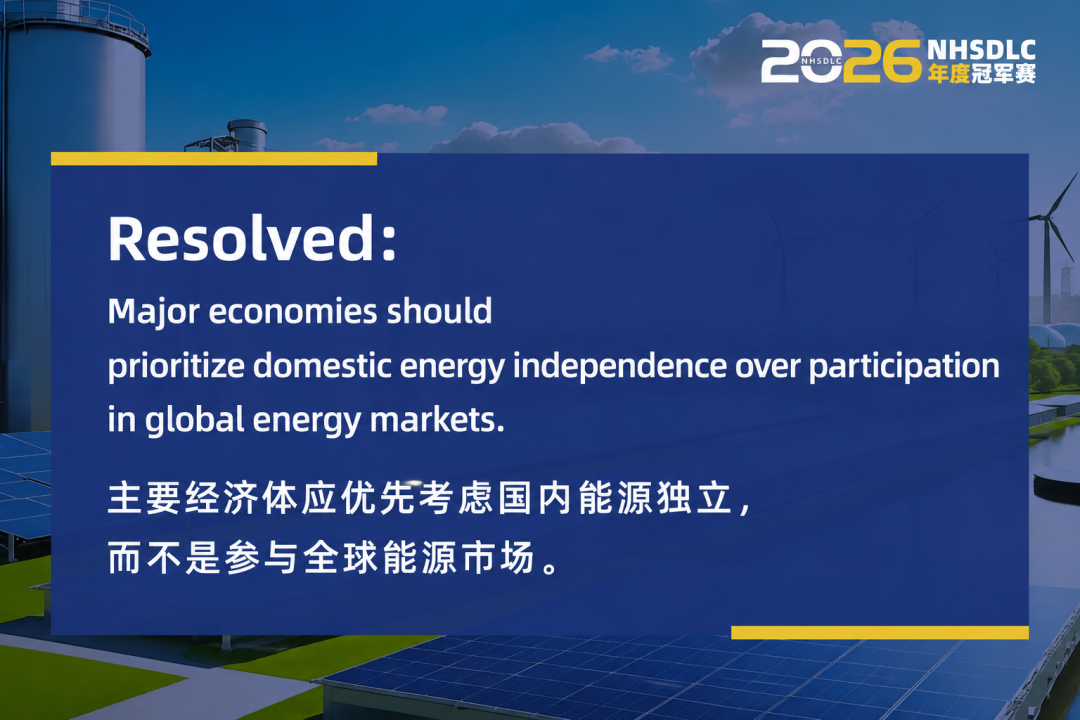
*线上全国邀请赛与年度冠军赛同辩题
Sample Case
PRO
Resolved: Major economies should prioritize domestic energy independence over participation in global energy markets.
We affirm. Our framework is utilitarianism: whichever side creates more security, stability, innovation, and sustainability wins. Domestic energy independence does not mean banning trade. It means major economies should first build enough domestic production, storage, grids, and reserves that foreign suppliers cannot hold them hostage.
Contention 1 - Geopolitical security
Subpoint A: Domestic independence prevents energy blackmail.
Energy is not a normal product; it keeps homes warm, factories open, and food affordable. The IEA says the 2022-2023 EU gas crisis was the most severe gas supply shock in history, with record high prices and heavy costs to governments. That proves foreign energy dependence becomes political leverage during conflict.
Subpoint B: Global markets fail when rivals control the supply.
The 1973 oil crisis and the post-2022 European shock show the same pattern, once fuel becomes scarce, every part of society pays bitterly, from electricity bills to transport, food, and industrial production. Domestic independence does not stop every price change, but it makes a state harder to coerce because basic energy needs are controlled at home.
Impact:Households and sovereignty are protected.
The IMF estimated that Europe's fossil fuel price surge in 2022 raised household cost of living by close to 7%, hurting poorer families most. Pro reduces those shocks and lets governments make foreign policy without fearing punishment from energy suppliers.
Contention 2 - Resilience to supply shocks
Subpoint A: Import dependence is fragile.
Energy crosses pipelines, ports, shipping lanes, and financial contracts, so war, weather, or sanctions, can disrupt this flow at any time. The IEA says the gas crisis exposed the vulnerability of import-dependent regions. Trade can help, but it should not be a major economy's first line of defense.
Subpoint B: Domestic diversity spreads risk.
Our stance is not one fuel. It is a domestic mix of renewables, nuclear, storage, local gas where available, transmission, and reserves. If one source fails, another can cover it. An import-dependent system can be crippled by one supplier, one pipeline, or one chokepoint.
Impact:The economy becomes more predictable.
The U.S. Energy Information Administration reports that the U.S. became a net exporter of natural gas in 2017 and had near-record-low net gas imports in 2024. That does not make it immune to global prices, but it gives more supply options, bargaining power, and stability for businesses and consumers. France proves the same lesson: the World Nuclear Association says France gets about 70% of its electricity from nuclear power and is a major electricity exporter because of long-term energy security planning.
Contention 3 - Innovation and environmental progress
Prioritizing local production boosts technological innovation and jobs in key sectors. Local manufacturing drives innovation in automation, materials science, and process efficiency. Germany's manufacturing strength, for example, was built on sustained domestic investment in precision engineering and chemicals.
Impact:Pro accelerates clean technology.

BloombergNEF reported in 2025 that wind, solar, and battery costs were expected to fall another 2-11% that year, because of China's manufacturing lead. France shows domestic nuclear can produce large-scale low-carbon electricity, while China shows domestic clean-tech scale can lower global costs. Pro creates security and protects the environment at the exact same time.
Energy dependence turns your survival into leverage. Pro protects households from price shocks, reduces foreign blackmail, stabilizes industries, creates skilled jobs, and accelerates cleaner technology.
For these reasons, we are proud to stand pro.
Reference:
1.Surging Energy Prices in Europe in the Aftermath of the War, from: https://www.imf.org/en/publications/wp/issues/2022/07/28/surging-energy-prices-in-europe-in-the-aftermath-of-the-war-how-to-support-the-vulnerable-521457
2.Gas Market Lessons from the 2022-2023 Energy Crisis, from: https://www.iea.org/reports/gas-market-lessons-from-the-2022-2023-energy-crisis
3.World Nuclear Association, France, from: https://world-nuclear.org/information-library/country-profiles/countries-a-f/france
4.Global Cost of Renewables to Continue Falling in 2025 as China Extends Manufacturing Lead, from: https://about.bnef.com/insights/clean-energy/global-cost-of-renewables-to-continue-falling-in-2025-as-china-extends-manufacturing-lead-bloombergnef/
5.U.S. Net Natural Gas Exports, U.S. Energy Information Administration (EIA), from: https://www.eia.gov/todayinenergy
6.Germany's Manufacturing History, from: https://china-cee.eu/2025/04/08/from-prosperity-to-decline-what-did-german-industry-go-through/
Sample Case
CON
Resolved: Major economies should prioritize domestic energy independence over participation in global energy markets.
We believe that the round should be evaluated by which side better promotes long-term energy security and sustainable prosperity for major economies. These two standards are the most important because energy security requires stable, affordable, and resilient access to energy, while sustainable prosperity requires economic growth, technological advancement, and environmental health. Any energy policy must be judged by how well it advances both goals.
Contention 1 - Costs and Resilience
Domestic energy independence artificially inflates prices and concentrates systemic risk, while global market participation achieves both lower costs and higher operational resilience.
Protectionist policies fundamentally bottleneck the transition by raising the cost of clean technologies. Gerarden et al. (2026) study on U.S. solar tariffs since 2012 found that even after manufacturing relocated to Southeast Asia, domestic solar prices rose significantly relative to non-tariff markets. Their structural modeling reveals massive declines in consumer surplus and overall domestic welfare once environmental externalities are included, proving that the installation sector lost far more jobs than manufacturing gained.
Domestic self-sufficiency creates severe concentrated risk. The WTO Global Value Chain Development Report (2025) shows that global value chains still account for 46.3% of global trade and are adapting dynamically through reglobalization rather than collapsing. This market integration is vital to prevent localized system failures, a point strongly proven by Ito’s (2026) empirical research on Chile. Before interconnection, solar-rich regions suffered from extreme price collapses and chronic underinvestment; however, deep market integration boosted solar generation by 178% via investment responses, allowing transmission outlays to be fully recouped in just 7.2 years with a 19.7% internal rate of return. In stark contrast, isolated domestic systems choke on their own supply. Ito (2026) also documents that localized transmission bottlenecks forced California to curtail over 4% of its utility-scale solar, while the Southwest Power Pool curtailed more than 10% of its wind generation.
Impact: Domestic energy independence directly increases costs and risk.
Gerarden et al. (2026) show that tariffs caused net domestic welfare to decline and installation jobs to be lost at a higher rate than manufacturing jobs gained. At the same time, Ito (2026) demonstrates that without market integration, solar generation would be 178% lower and transmission investments would take significantly longer to recover. These concrete losses in welfare, jobs, and generation capacity directly damage both energy security and sustainable prosperity — the two standards established in our framework.
Contention 2 - Environment
Finally, domestic energy independence directly undermines environmental progress by making clean technologies prohibitively expensive and dangerously slow to deploy.
Protectionist measures operate at cross-purposes with global decarbonization goals. Gerarden et al. (2026) explicitly state that tariffs artificially raise the private cost of renewable deployment while failing to reward environmental benefits. This creates a clear trade-off: higher upfront prices slow the rollout of clean energy at the exact moment rapid deployment is ecologically necessary.
Conversely, global integration acts as a force multiplier for green deployment. Ito’s (2026) research on Chile shows that cross-border market integration boosted solar generation by 178% once dynamic investment effects are included. The same study finds that this integration simultaneously reduced average generation costs by 18% during peak hours. The WTO Global Value Chain Development Report (2025) reinforces this conclusion, proving that green investment and sustainability metrics improve most rapidly through reconfigured global value chains rather than isolationist policies.
Impact:
Ito (2026) shows that market integration boosted solar generation by 178% and reduced peak-hour generation costs by 18%. The IEA’s Renewables 2025 report warns that global renewable capacity is still projected to fall short of the COP28 tripling goal by 2030. If major economies choose isolation, tariffs, and domestic-only supply chains, they slow clean energy deployment when speed matters most. That means more fossil fuel use, higher emissions, worse air pollution, and weaker chance of meeting our climate targets. Con wins because the global market lets clean energy scale at the speed the climate crisis requires.
For all these reasons above, we are proud to negate.
Reference:
1.Gerarden, T. D., B. K. Bollinger, K. Gillingham, and D. Xu (2026). “Beyond tariffs: A better approach to green industrial policy.” VoxEU Column, CEPR, 30 January 2026.
2.Ito, K. (2026). “Renewable Energy Expansion: Key Challenges and Emerging Opportunities.” Becker Friedman Institute Working Paper No. 2026-03, University of Chicago.
3.World Trade Organization et al. (2025). Global Value Chain Development Report 2025: Rewiring GVCs in a Changing Global Economy. Geneva: WTO.
暑期赛时间线