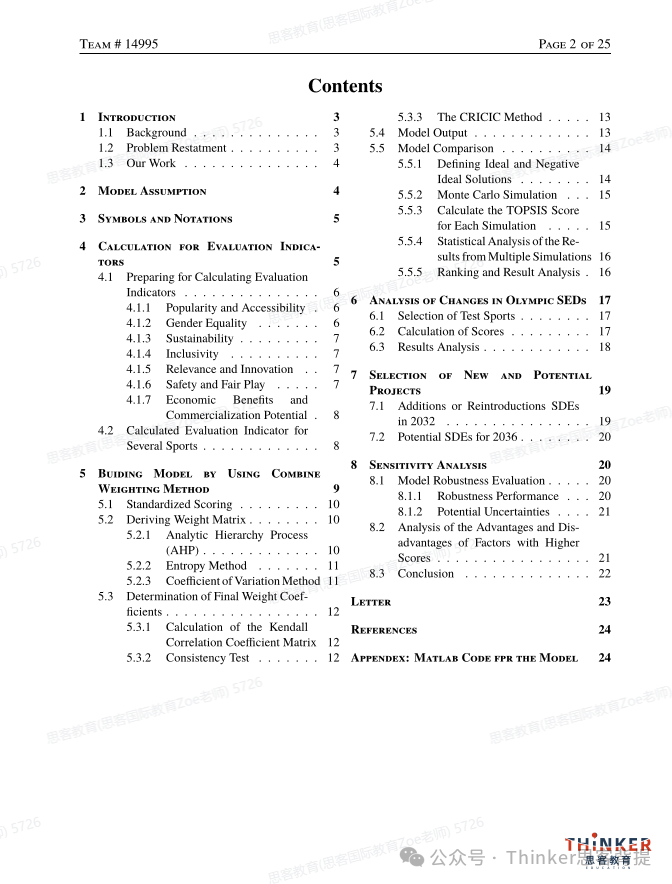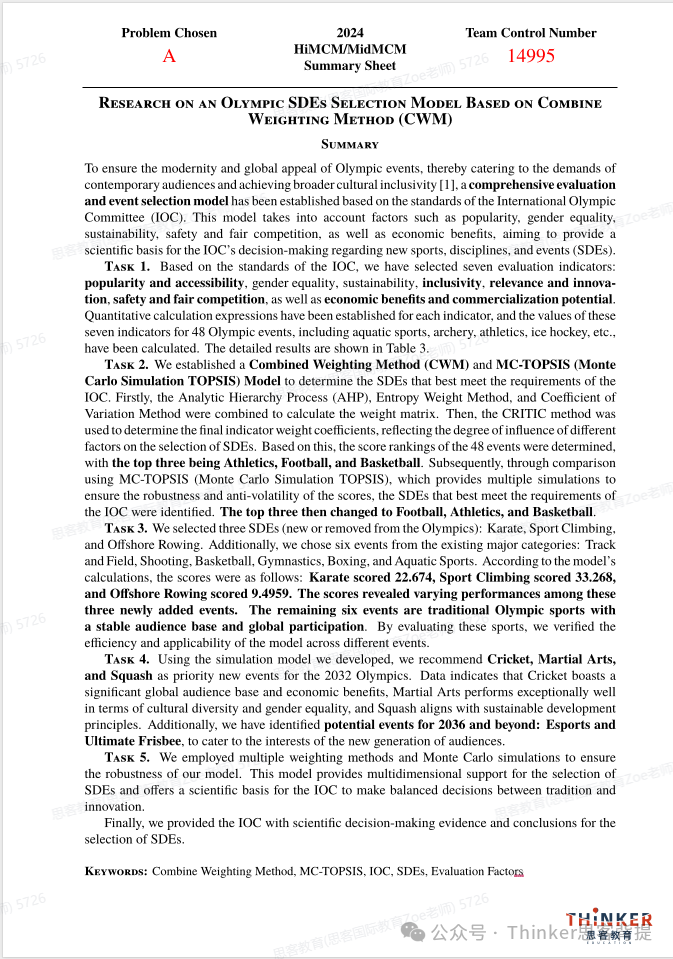


2026年HiMCM竞赛题目公布!
美国中学生数学建模竞赛(HiMCM) 是由美国数学及其应用联合会(COMAP)主办的一项国际性权威赛事,旨在鼓励学生团队运用数学建模解决现实世界问题。
HiMCM2026 Problem A
2026 HiMCM
Problem A: The City Showdown: Modeling the Best City to Live In
Image credit: Adobe Express
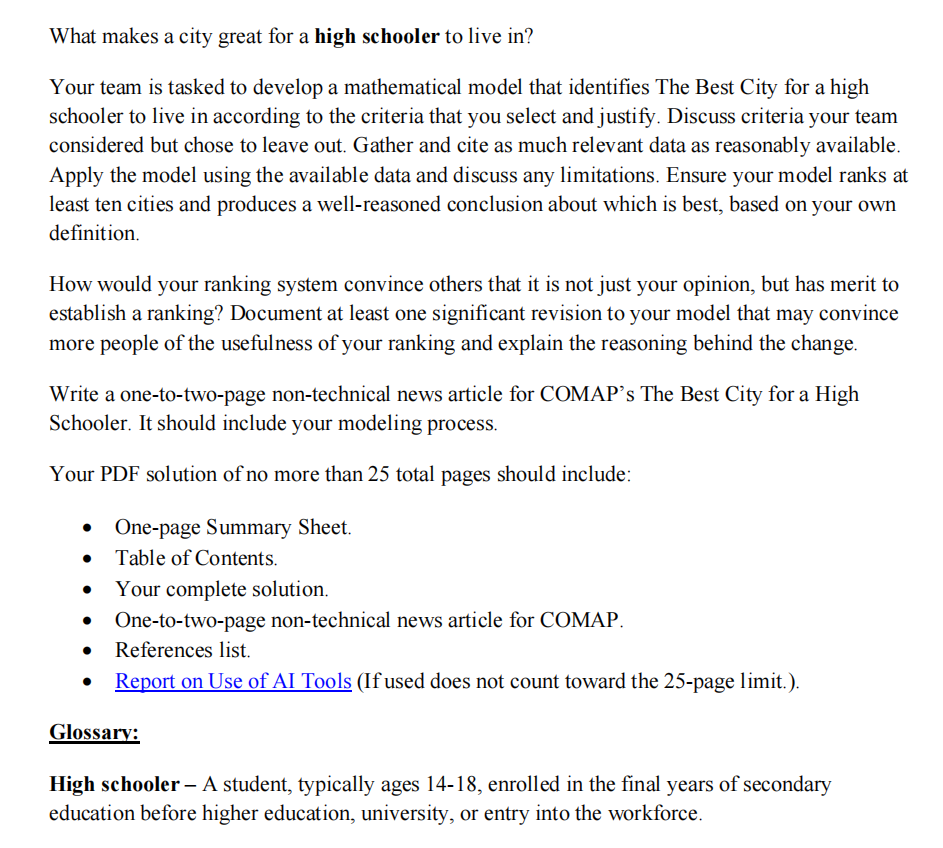
What makes a city great for ahigh schoolerto live in?
Your team is tasked to develop a mathematical model that identifies The Best City for a highschooler to live in according to the criteria that you select and justify . Discuss criteria your teamconsidered but chose to leave out . Gather and cite as much relevant data as reasonably available .Apply the model using the available data and discuss any limitations. Ensure your model ranks atleast ten cities and produces a well -reasoned conclusion about which is best,based on your owndefinition .
How would your ranking system convince others that it is not just your opinion,but has merit toestablish a ranking? Document at least one significant revision to your model that may convincemore people of the usefulness of your ranking and explain the reasoning behind the change .
Write a one-to-two-page non-technical news article for COMAP’s The Best City for a HighSchooler . It should include your modeling process .
Your PDF solution of no more than 25 total pages should include:
• One -page Summary Sheet .
• Table of Contents .
• Your complete solution .
• One-to-two-page non-technical news article for COMAP .
• References list .
•Report on Use of AI Tools(If used does not count toward the 25 -page limit.).
Glossary:
High schooler–A student, typically ages 14-18, enrolled in the final years of secondaryeducation before higher education, university, or entry into the workforce .
| ©2026 by COMAP, Inc. | www.comap.org | www.contest.comap.com | info@comap.org |
A题 简要破题分析
题目核心:建立一套城市评价体系,从至少10座城市中选出最适合高中生生活的城市,并证明排名具有合理性。
破题思路:
-
确定评价指标: 从教育资源、生活安全、交通便利、生活成本、课外活动等方面设计评价体系。
-
收集城市数据: 选择至少10座城市,收集对应指标的数据,并统一处理。
-
建立排名模型: 可以采用AHP层次分析法、熵权法、TOPSIS等方法,对城市进行综合评分和排序。
-
验证并优化模型: 通过调整权重、敏感性分析等方式检验排名是否稳定,并对原模型进行至少一次重大修改。
-
形成结论: 解释排名靠前的城市有哪些优势,并撰写1—2页的非技术性新闻报道。
HiMCM2026 Problem B
2026 HiMCM
Problem B:Air Conditioning the Environment: Modeling Energy Waste in Public Cooling
Image Credit:Adobe Express
Background
Everyone knows it is wasteful to leave the door of the freezer open .As cold air escapes andwarm air enters, the freezer must use additional energy to maintain the desired temperature .Yetmany modern public spaces do not follow this principle, as they intentionally expend energy tocool areas that are not fully enclosed .Open-air venues, like stadium concourses or concertamphitheaters, and,semi-open public spaces, like transit stations, airport terminals, and publicwaiting areas, use cooling systems to keep customers comfortable and safe, despite constantexposure to the surrounding environment . In these settings, some of the cooling reaches itsintended audience, while some dissipates into the atmosphere .
As cities become warmer, energy costs increase, and extreme heat events become more frequent,venue operators face a difficult challenge trying to provide comfortable and safe environmentswhile using energy responsibly. Determining whether a cooling strategy is effective requiresmore than measuring temperature alone. Factors such as facility design, crowd size, weatherconditions, airflow, operating costs, and visitor comfort and safety all play a role .
The Heat impact Mitigation through Cooling Management (HiMCM) team that manages bothopen-air venues and semi-open public spaces is reevaluating its cooling practices and wants tounderstand how efficiently its systems deliver useful cooling to visitors . Because conditions varyacross facilities and climates, the company seeks a general framework that can be used tocompare different cooling approaches and identify opportunities for improvement .
Your team has been hired by HiMCM to investigate the problem. Develop a mathematical modelto evaluate the effectiveness of cooling systems in both open-air venues and semi-open publicspaces and provide recommendations for balancing comfort, safety, energy consumption, andcost .
| ©2026 by COMAP, Inc. | www.comap.org | www.contest.comap.com | info@comap.org |
Requirements.
1. Understand the Problem.Open freezer casesin grocery stores continuously use energyto remove heat from food and the surrounding air. What aspects of a freezer case shouldbe considered when measuring cooling efficiency? Should efficiency depend only onenergy use? Justify the quantities that should be included in a measure of coolingefficiency. Use your response to motivate the design of your cooling efficiency modelsbelow.
2. Create Your Model.A city is looking for ways to keep people comfortable while theywait for public transportation by bus or rail on hot summer days .
a . For the bus, one proposal is to install a cooling system in an open -sidedbus stopshelter.City planners want to determine which system is the most efficient,but at this time, onlyknow the following:
|
Cooling System |
Effect on Shelter |
Energy Use |
|
A . Fan System |
Makes space feel up to 3°C cooler |
0.25 kW/hr |
|
B .Evaporative Cooler |
Lowers air temperature up to 5°C |
1.2 kW/hr |
|
C . Large Evaporative Cooler |
Lowers air temperature up to 8°C |
2.5 kW/hr |
Develop a measure of cooling efficiency for the bus stop .You may want to considerfactors, including,but not limited to, the size of the cooled area,climate conditions,energy use, and the number of people benefiting from the cooling .
b . For a semi -open rail -station waiting area, revise and improve your model as necessary tomeasure cooling efficiency. Clearly explaining what changed, why the change wasnecessary, and how the revision improved the model’s usefulness or accuracy.

3. Apply Your Model.Does your cooling efficiency model scale?Apply your model to atleast two specific venues . Ensure these venues are in different climates or that they usedifferent types of cooling systems to demonstrate the robustness of your model . Possiblecase studies include:
• Stadium concourses,
• Concert amphitheaters,
• Outdoor restaurant patios,
• Open-air airport terminals in warm climates,
• Open walkways in outdoor malls, or
• Other open -air venues or semi -open public spaces .
| ©2026 by COMAP, Inc. | www.comap.org | www.contest.comap.com | info@comap.org |
You may use real-world data or reasonable estimates with assumptions when real-world datais not available . Use your model to compare the efficiency of cooling strategies across venuesand identify the characteristics that contribute most to efficient cooling .
4. Expand Your Model and Reflect on Your Analysis.A cooling solution that is highlyefficient may not be the most effective overall. Extend your model to evaluate coolingeffectiveness by balancing cooling performance, visitor experience, energy consumption andcost . Clearly describe how your model accounts for these competing objectives .
5. Share Your Model and its Results.Propose guidelines for the use of cooling systems inyour venues . Discuss strategies for how operators can balance visitor comfort, sustainability,and cost while maintaining safe and effective environments during periods of extreme heat .
a . Prepare a one-to-two-page memorandum to the Chief Operations Officer of HiMCMabout one of your chosen venues . In your memorandum, summarize your major findingsand provide actionable recommendations regarding the use of cooling systems for thatvenue.Your recommendations should address balancing the trade-offs of coolingeffectiveness .
b . Create ablog postthat HiMCM can use to explain these results to the public . HiMCMwants to educate the public surrounding the question of“How much cooling are wegetting for the energy we use in these open-air venue or semi-open public spaces?”.
Your PDF solution of no more than 25 total pages should include:
• One -page Summary Sheet .
• Table of Contents .
• Your complete solution .
• One-to-two-page memorandum to the Chief Operations Officer.
• References list .
•Report on Use of AI Tools(If used does not count toward the 25-page limit.).
Glossary:
Open-air venue–a place where events are held primarily outdoors and are exposed to thesurrounding environment rather than being enclosed by walls and a roof.
Semi-open public space–a publicly accessible area that is partially enclosed by roofs, walls orother structures while still allowing for a significant air exchange with the outdoors .
| ©2026 by COMAP, Inc. | www.comap.org | www.contest.comap.com | info@comap.org |
Open freezer case–a refrigerated display used in grocery or convenient stores that keepsproducts cold while remaining open to the surrounding air, allowing customers to easily viewand access items without opening a door.
Bus Stop–A designated roadside location where a bus briefly halts to let passengers get on oroff.
Evaporative cooler–cooling device that lowers air temperature by passing warm air throughwater-soaked pads .As the water evaporates, it absorbs heat for the air,producing cooler air thatis then circulated by a fan, using less energy than traditional air conditioners .
Climate conditions–could include latitude or location, temperature, humidity, solar exposure orwind .
Blog post–an article or piece of written content published on a website .
| ©2026 by COMAP, Inc. | www.comap.org | www.contest.comap.com | info@comap.org |
B题简要破题分析
题目核心:建立数学模型,比较不同公共场所的降温设备,研究如何在舒适度、安全性、能源消耗和成本之间取得平衡。
破题思路:
-
定义降温效率: 不能只看降温幅度,还要考虑实际受益人数、覆盖面积、能耗及人体舒适度。
-
建立基础模型: 比较公交站的风扇、蒸发式冷风机、大型蒸发式冷风机三种方案。
-
扩展模型: 将公交站模型应用到半开放轨道交通站,增加空间规模、空气流动及人流变化等因素。
-
实际场景验证: 选择至少两个不同气候或降温方式的公共场所,比较模型结果。
-
综合优化: 可以采用多目标优化方法,寻找兼顾降温效果、人员安全、能耗与成本的方案,并提出运营建议。
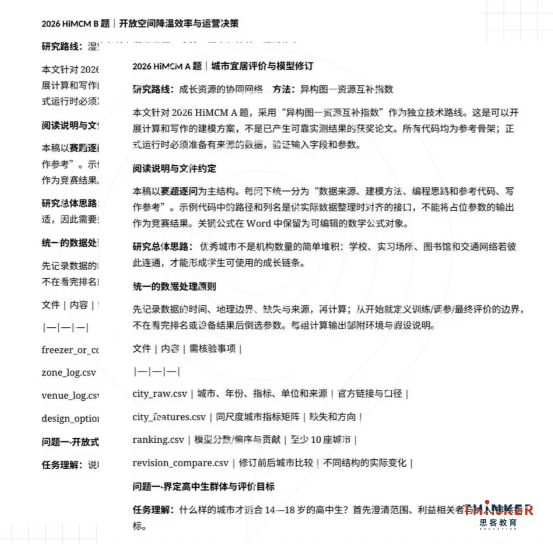
HiMCM题目深度解析
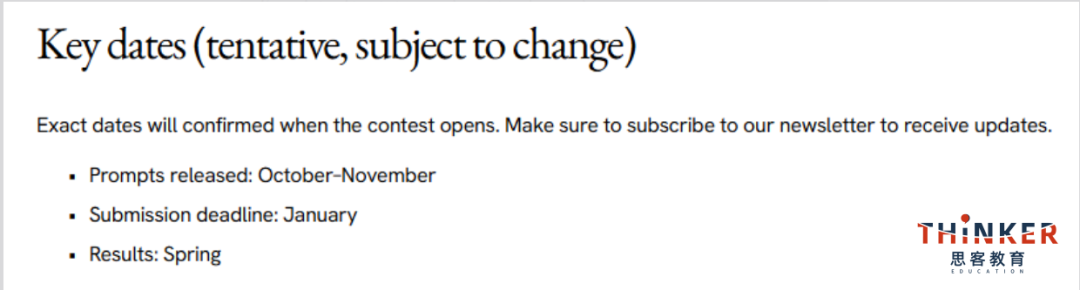
2026年HiMCM竞赛时间
🕝比赛开启时间:2026年11月4日星期三下午15:00
🕝比赛截止时间:2026年11月17日星期二晚上20:00
🕝论文提交截止日期:2026年11月17日星期二晚上21:00
🕝成绩公布时间:2027年1月31日或之前公布
*以下时间均为美国东部时间
论文格式与提交步骤
HiMCM 论文格式
-
每页页眉须含控制号和页码,例如“Team# 1234, Page6of13”。
-
✅全部内容合并为一个PDF文件,英文书写,正文字号至少12磅。
-
首页为摘要页,正文最多24页(总计25页);目录、参考文献、备注页、附录均计入页数;AI使用报告不计入。
-
不要附带程序、软件、数据库等文件,评审不使用这些材料。
HiMCM 提交步骤
-
11月17日20:00(EST)前停止一切修改;
-
准备好PDF,命名为“控制号.pdf”,确认小于 20MB;
-
打开新在线提交页(forms.comap.org/242386224483964),填入控制号、顾问ID号、选题;
-
提交后不要重复发送,官方提示“不要等到最后一刻,完成后尽快提交,只发一份”;
-
赛后1–2天,用顾问登录入口核实COMAP是否收到论文(通常赛窗结束后24小时内可查)。
-
提交时机的建议:与其在21:00截止前最后10分钟卡点上传,不如提前半天完成——若遇网络波动或文件问题,还有时间处理。