

Task one:pie charts 2015年和2019年上学的交通出行
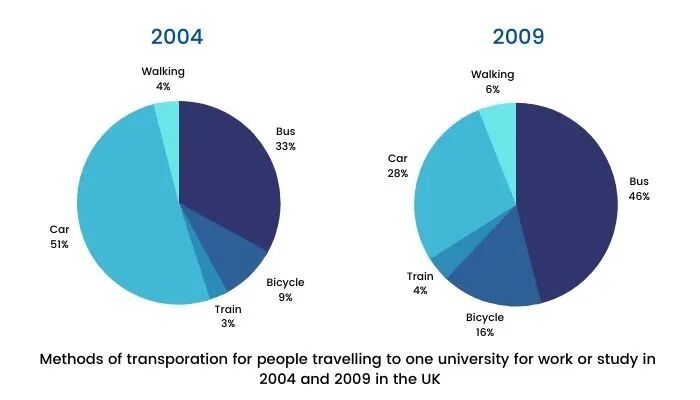
The pie charts set out how people commuted to a UK university for work or study in 2004 and 2009.
Overall, the share of private transportion means (car) decreased, while public transport (bus) and active travel (bicycle) became more popular over the 5-year period.

In 2004, car travel was the most used transport means (51%), while bus use accounted for 33%. Bicycle (9%), walking (4%) and train (3%) were less common in the UK.
By 2009, bus travel had become the dominant method (46%), and bicycle use nearly doubled to 16%. Car use dropped sharply to 28%, while walking slightly rose to 6%. Train use remained low at 4%.
大作文:Companies introduce new products regularly and encourage consumers to replace old products with these new models. Do you think this is a positive or negative development?
Regular product innovation brings specific advantages. Newer models often boast improved functionality【提升实用性】, energy efficiency, or user-friendliness【使用者友好】, enhancing consumer experience and driving technological progress. For example, upgraded home appliances may consume less electricity【省电】, and updated smartphones can offer faster processors and better cameras, catering to 【迎合】people’s growing demand for convenience and performance. Additionally, frequent product releases stimulate market competition【刺激市场竞争】, pushing brands to refine their technologies 【优化科技】and lower prices, which can benefit budget-conscious【价格敏感】 buyers in the short term.
However, the downsides are far more pronounced【显著的】. The biggest issue is the surge in electronic waste and resource depletion【资源消耗】. Many old products are discarded prematurely despite remaining functional【功能仍旧完好】, overburdening landfills and straining raw material supplies. Financially, this culture of “planned obsolescence” 【有计划淘汰】pressures consumers into constant spending【持续消费】, creating financial stress for households, especially low-income groups who may feel compelled to keep up with trends. Moreover, it fosters a throwaway mindset, eroding the value of sustainability and frugality in society.