


近年来,随着人工智能、数据科学与生命健康科技的快速发展,全球顶尖大学也在不断调整本科专业布局,以回应新的科技趋势与人才需求。作为世界顶尖理工院校之一,Imperial College London近期也对本科专业体系进行了更新,推出了全新的本科培养方向。这些新项目不仅体现了学校在前沿科技领域的布局,也释放出未来学科交叉与人才培养的重要信号。
今天,我们请到机构学院导师为大家讲解帝国理工新增本科专业的培养方向、课程设置以及适合申请的学生类型~
PART ONE
--人工智能与计算机--
01IC人工智能的数学与计算机科学专业概况
人工智能的数学与计算机科学专业所属数学系和计算机系,位于南肯辛顿。2027年10月入学的学生专业3-4年全日制,三年本科UCAS学科代号是GG02,四年本硕连读UCAS学科代号是GG03。人工智能的数学与计算机科学专业聚焦于机器学习与人工智能背后的核心数学理论与工程实践,融合计算机科学的编程与算法能力,以及数学的分析与统计方法,培养具备跨学科能力的复合型人才。
在学习过程中,学生将系统掌握支撑人工智能与机器学习发展的定量模型与计算方法,并通过逐步进阶的项目实践,提升专业的软件工程与编程能力,将理论知识应用于实际问题。在高年级阶段,学生可以从高级数学与计算机科学的多样化选修课程中选择方向,进一步深化专业领域。同时,课程还提供企业实习机会和毕业研究项目,帮助学生积累行业经验并参与前沿研究。
毕业生既可进入数学或计算机相关领域继续深造或就业,也将在建模、数据科学和定量分析等交叉领域具备显著竞争优势。
02IC人工智能的数学与计算机科学专业课程设置是什么?

 【课程设置来自IC官网】
第一年
第一年将为你提供后续课程所需的编程、计算及数学基础。你将学习九个核心模块。
核心模块
Principled Programming
Introduction to University Mathematics
Logic and Reasoning
Analysis
Calculus and Applications
Linear Algebra and Groups
Graphs and Algorithms
Probability and Statistics
Machine Learning in Action
第二年
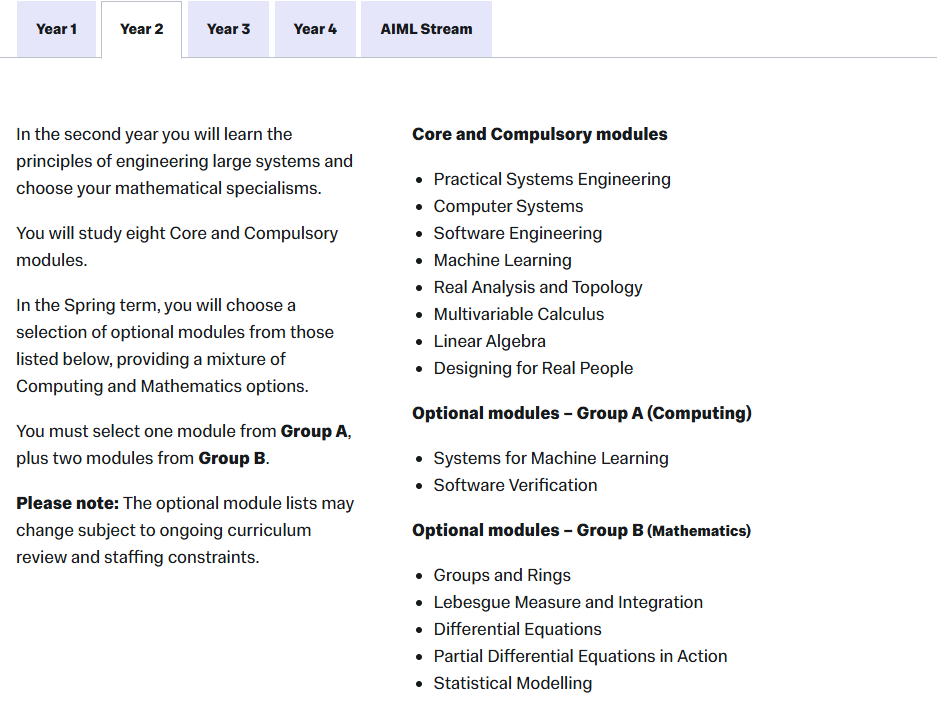
你将学习大型系统工程原理,并选择数学专业方向。你将学习八个核心模块和必修模块。你必须从A组中选择一个模块,并从B组中选择两个模块。
核心模块
Practical Systems Engineering
Computer Systems
Software Engineering
Machine Learning
Real Analysis and Topology
Multivariable Calculus
Linear Algebra
Designing for Real People
可选模块A(计算机)
Systems for Machine Learning
Software Verification
可选模块B(数学)
Groups and Rings
Lebesgue Measure and Integration
Differential Equations
Partial Differential Equations in Action
Statistical Modelling
第三年
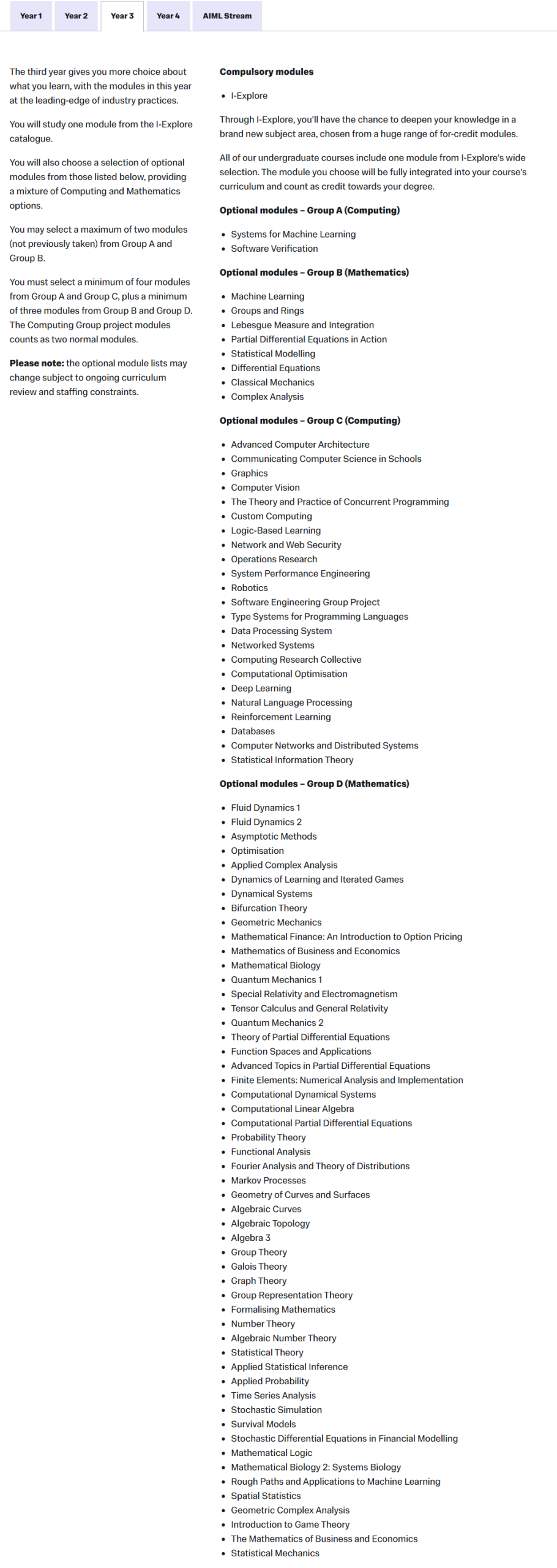
第三年为你提供了更多自主学习的选择,你将从I-Explore课程目录中学习一个模块。还可从下方列出的可选模块中进行选择,最多可从A组和B组中选择两个未修读过的模块。你必须从A组和C组中至少选择四个模块,同时从B组和D组中至少选择三个模块。计算组项目模块可折算为两个常规模块。
核心模块
I-Engage
可选模块A(计算机)
Systems for Machine Learning
Software Verification
可选模块B(数学)
Machine Learning
Groups and Rings
Lebesgue Measure and Integration
Partial Differential Equations in Action
Statistical Modelling
Differential Equations
Classical Mechanics
Complex Analysis
可选模块C(计算机)
Advanced Computer Architecture
Communicating Computer Science in Schools
Graphics
Computer Vision
The Theory and Practice of Concurrent Programming
Custom Computing
Logic-Based Learning
Network and Web Security
Operations Research
System Performance Engineering
Robotics
Software Engineering Group Project
Type Systems for Programming Languages
Data Processing System
Networked Systems
Computing Research Collective
Computational Optimisation
Deep Learning
Natural Language Processing
Reinforcement Learning
Databases
Computer Networks and Distributed Systems
Statistical Information Theory
可选模块D(数学)
Fluid Dynamics 1
Fluid Dynamics 2
Asymptotic Methods
Optimisation
Applied Complex Analysis
Dynamics of Learning and Iterated Games
Dynamical Systems
Bifurcation Theory
Geometric Mechanics
Mathematical Finance: An Introduction to Option Pricing
Mathematics of Business and Economics
Mathematical Biology
Quantum Mechanics 1
Special Relativity and Electromagnetism
Tensor Calculus and General Relativity
Quantum Mechanics 2
Theory of Partial Differential Equations
Function Spaces and Applications
Advanced Topics in Partial Differential Equations
Finite Elements: Numerical Analysis and Implementation
Computational Dynamical Systems
Computational Linear Algebra
Computational Partial Differential Equations
Probability Theory
Functional Analysis
Fourier Analysis and Theory of Distributions
Markov Processes
Geometry of Curves and Surfaces
Algebraic Curves
Algebraic Topology
Algebra 3
Group Theory
Galois Theory
Graph Theory
Group Representation Theory
Formalising Mathematics
Number Theory
Algebraic Number Theory
Statistical Theory
Applied Statistical Inference
Applied Probability
Time Series Analysis
Stochastic Simulation
Survival Models
Stochastic Differential Equations in Financial Modelling
Mathematical Logic
Mathematical Biology 2: Systems Biology
Rough Paths and Applications to Machine Learning
Spatial Statistics
Geometric Complex Analysis
Introduction to Game Theory
The Mathematics of Business and Economics
Statistical Mechanics
第四年
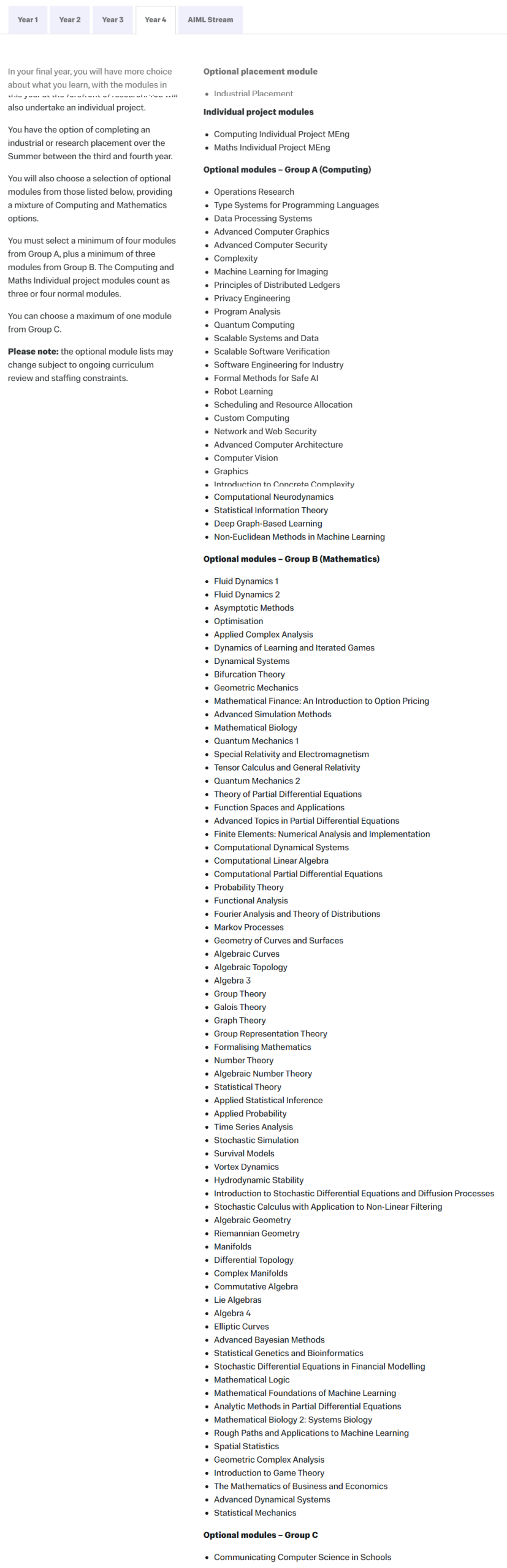
在最后一年,你将拥有更多自主选择学习内容的权利,本年度课程模块均聚焦于前沿研究领域。同时,你还将完成一项个人研究项目。你必须从A组中至少选择四个模块,同时从B组中至少选择三个模块。你最多可从C组中选择一个模块。
可选模块
Industrial Placement
独立项目
Computing Individual Project MEng
Maths Individual Project MEng
可选模块A(计算机)
Operations Research
Type Systems for Programming Languages
Data Processing Systems
Advanced Computer Graphics
Advanced Computer Security
Complexity
Machine Learning for Imaging
Principles of Distributed Ledgers
Privacy Engineering
Program Analysis
Quantum Computing
Scalable Systems and Data
Scalable Software Verification

Software Engineering for Industry
Formal Methods for Safe AI
Robot Learning
Scheduling and Resource Allocation
Custom Computing
Network and Web Security
Advanced Computer Architecture
Computer Vision
Graphics
Introduction to Concrete Complexity
Computational Neurodynamics
Statistical Information Theory
Deep Graph-Based Learning
Non-Euclidean Methods in Machine Learning
可选模块B(数学)
Fluid Dynamics 1
Fluid Dynamics 2
Asymptotic Methods
Optimisation
Applied Complex Analysis
Dynamics of Learning and Iterated Games
Dynamical Systems
Bifurcation Theory
Geometric Mechanics
Mathematical Finance: An Introduction to Option Pricing
Advanced Simulation Methods
Mathematical Biology
Quantum Mechanics 1
Special Relativity and Electromagnetism
Tensor Calculus and General Relativity
Quantum Mechanics 2
Theory of Partial Differential Equations
Function Spaces and Applications
Advanced Topics in Partial Differential Equations
Finite Elements: Numerical Analysis and Implementation
Computational Dynamical Systems
Computational Linear Algebra
Computational Partial Differential Equations
Probability Theory
Functional Analysis
Fourier Analysis and Theory of Distributions
Markov Processes
Geometry of Curves and Surfaces
Algebraic Curves
Algebraic Topology
Algebra 3
Group Theory
Galois Theory
Graph Theory
Group Representation Theory
Formalising Mathematics
Number Theory
Algebraic Number Theory
Statistical Theory
Applied Statistical Inference
Applied Probability
Time Series Analysis
Stochastic Simulation
Survival Models
Vortex Dynamics
Hydrodynamic Stability
Introduction to Stochastic Differential Equations and Diffusion Processes
Stochastic Calculus with Application to Non-Linear Filtering
Algebraic Geometry
Riemannian Geometry
Manifolds
Differential Topology
Complex Manifolds
Commutative Algebra
Lie Algebras
Algebra 4
Elliptic Curves
Advanced Bayesian Methods
Statistical Genetics and Bioinformatics
Stochastic Differential Equations in Financial Modelling
Mathematical Logic
Mathematical Foundations of Machine Learning
Analytic Methods in Partial Differential Equations
Mathematical Biology 2: Systems Biology
Rough Paths and Applications to Machine Learning
Spatial Statistics
Geometric Complex Analysis
Introduction to Game Theory
The Mathematics of Business and Economics
Advanced Dynamical Systems
Statistical Mechanics
可选模块C
Communicating Computer Science in Schools
03IC人工智能的数学与计算机科学专业申请要求是什么?
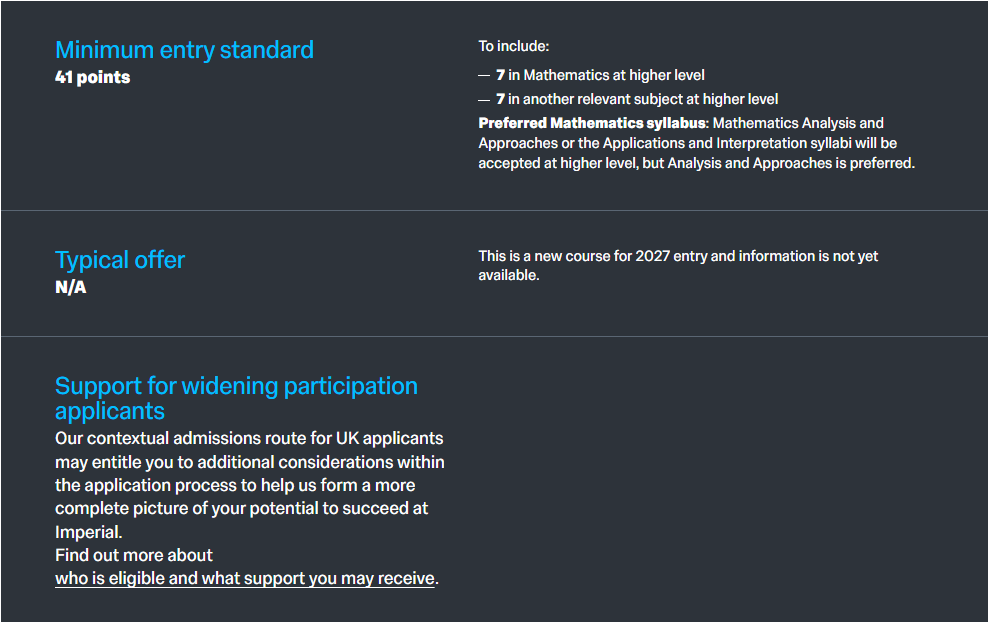
【申请要求来自IC官网】
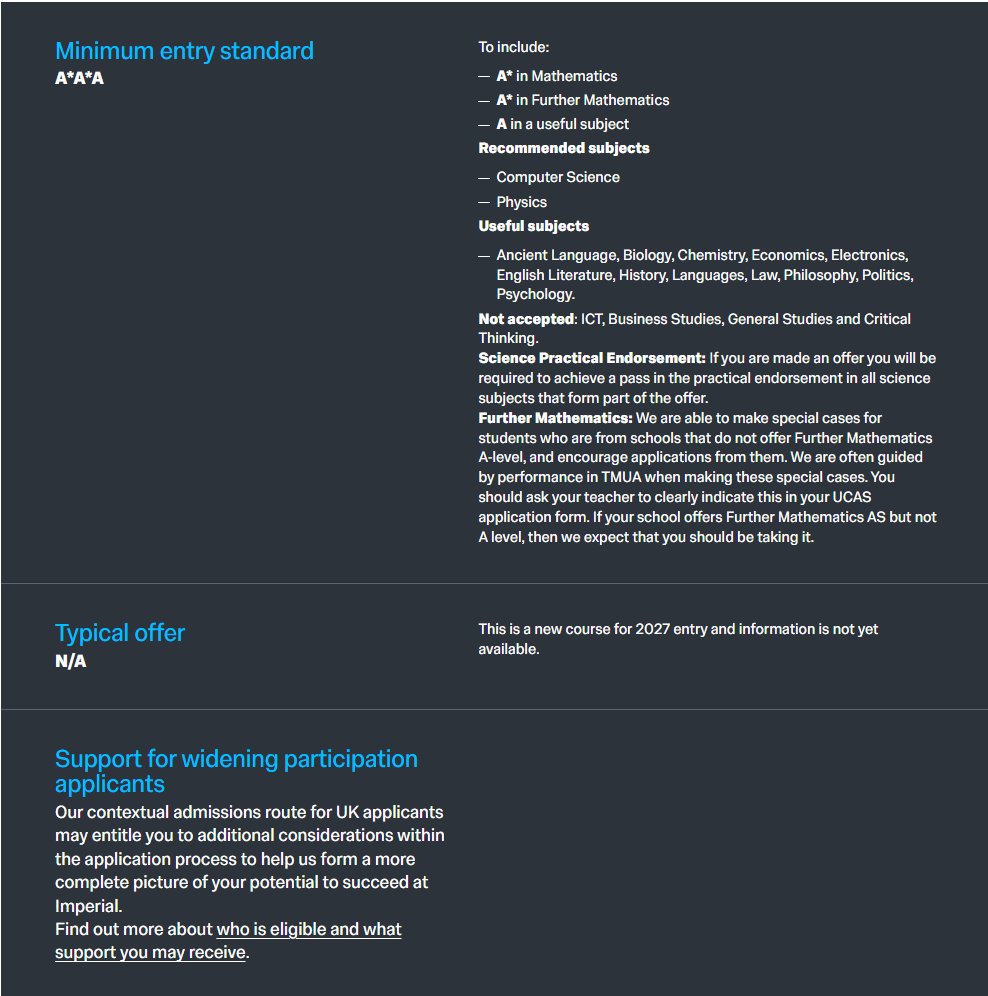
申请人工智能的数学与计算机科学专业的最低入学标准为:
levels:A*A*A,包括数学和进阶数学达到A* ,推荐选择计算机科学或者数学。
IB:41(包括核心分数),进阶数学达到7 ,另外还有一门学科达到7分。
不接受通识教育和批判性思维。
评估申请
招生导师会严格筛选考虑所有可用的材料,学院会标记关键信息,部分申请人可能会以更低或更高的条件录取。
笔试
2027年申请入学该课程申请者必须在申请过程中参加大学入学数学考试(TMUA)
面试
面试并非标准流程,但招生导师可酌情对部分候选人进行面试。
申请本课程的学生不需要ATAS证书。
04就读IC人工智能的数学与计算机科学专业需要多少钱?
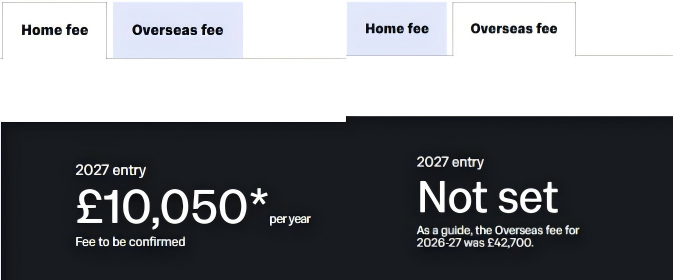
【图片来自官网】
所需支付的国内或海外费用取决于你的费用状态,英国政府会根据你的居住地、国籍或居留身份等评估你的费用状态。家庭学生可以向英国政府申请学费贷款,以支付课程学费。也可以申请赡养费贷款,待经济状况调查通过后,该贷款会帮助学生支付生活费用。平均每年本土学生需支付£10,050,具体费用取决于入学年份,费用的增加与通货膨胀有关。
PART TWO
--医学科学与创新--
01IC医学科学与创新专业概况
医学科学与创新专业所属医学院,位于南肯辛顿。2027年10月入学的学生专业4年全日制,四年本硕连读UCAS学科代号是B980。医学科学与创新专业将带领学生探索全球重大健康问题背后的科学机制,并学习如何通过创新技术和解决方案应对这些挑战。
在四年的学习中,学生将建立扎实的医学科学基础,同时掌握实验技术、编程、数据分析与统计等实用技能,并学习如何识别未被满足的医疗需求、评估科研证据,进而提出新的药物、诊断技术、医疗设备或政策方案等创新解决思路。
课程采用互动式教学方式,如翻转课堂、小组合作与创新挑战项目。在三、四年级阶段,学生将在学术界和行业专家的指导下,以小组形式参与真实的健康挑战项目。毕业时,学生不仅能够积累专业项目成果,还将具备进入科研、医疗健康、政策与创新等领域发展的能力,或继续攻读博士研究。
02IC医学科学与创新专业课程设置是什么?
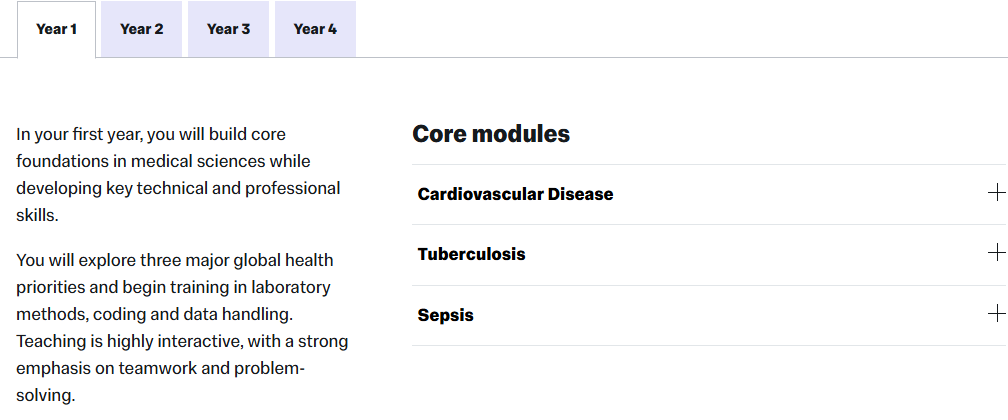
 【课程设置来自IC官网】
第一年
在第一学年期间,你将构建医学科学的核心基础,同时培养关键的技术与专业技能。你将探索三大全球健康重点领域,并开始接受实验室方法、编码及数据处理方面的培训。教学过程具有高度互动性,着重强调团队协作与问题解决能力。
核心模块
Cardiovascular Disease
Tuberculosis
Sepsis
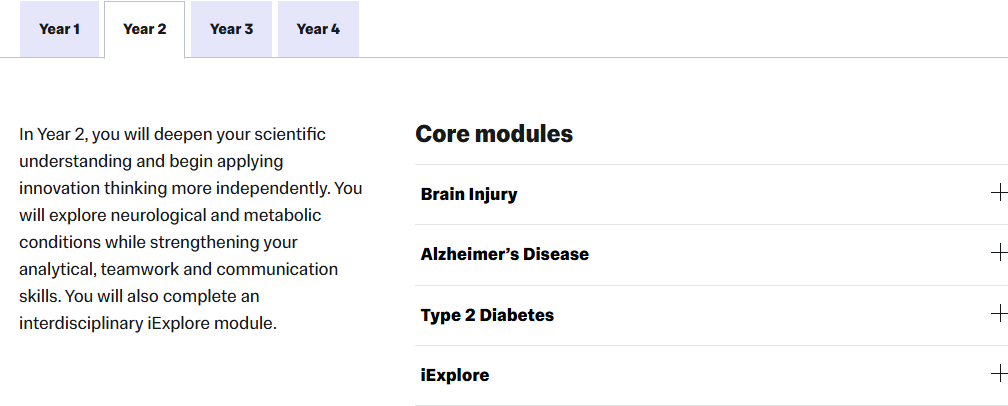
第二年
在第二学年,你将深化科学认知,并开始更独立地运用创新思维。课程内容涵盖神经与代谢疾病研究,同时提升分析能力、团队协作与沟通技巧。此外,你还将完成跨学科I-Explore模块的学习。
核心模块
Brain Injury
Alzheimer’s Disease
Type 2 Diabetes
I-Engage
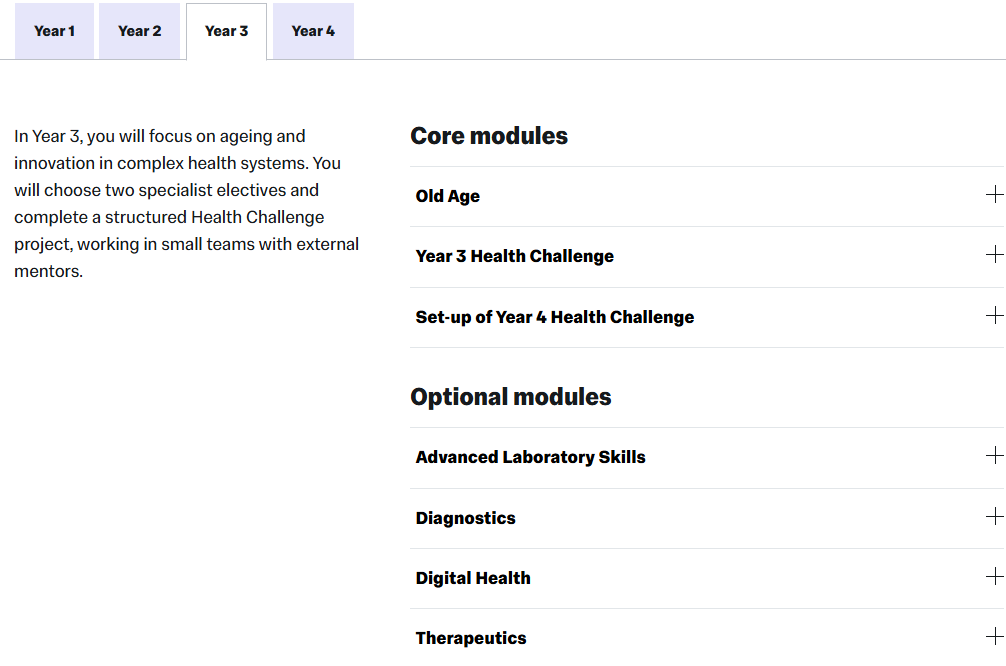
第三年
在第三学年,你将重点研究复杂卫生系统中的老龄化与创新问题。你需选择两门专业选修课程,并在外部导师指导下以小组形式完成结构化健康挑战项目。
核心模块
Old Age
Year 3 Health Challenge
Set-up of Year 4 Health Challenge
可选模块
Advanced Laboratory Skills
Diagnostics
Digital Health
Therapeutics
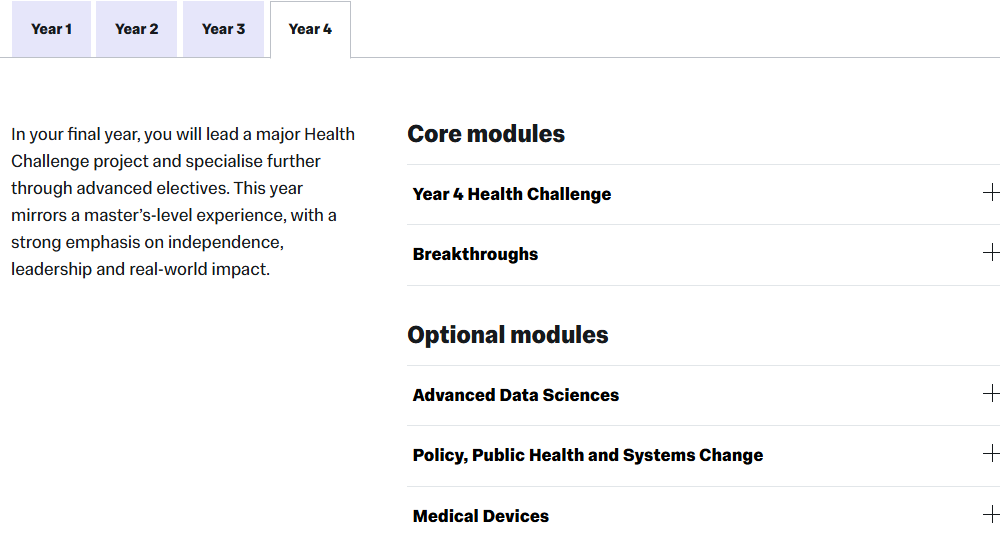
第四年
在最后一年,你将主导一项重大健康挑战项目,并通过高级选修课程进一步深化专业学习。本年度课程设置模拟硕士阶段的学习体验,着重培养独立性、领导力及实际应用能力。
核心模块
Year 4 Health Challenge
Breakthroughs
可选模块
Advanced Data Sciences
Policy, Public Health and Systems Change
Medical Devices
03IC医学科学与创新专业申请要求是什么?
 【申请要求来自IC官网】
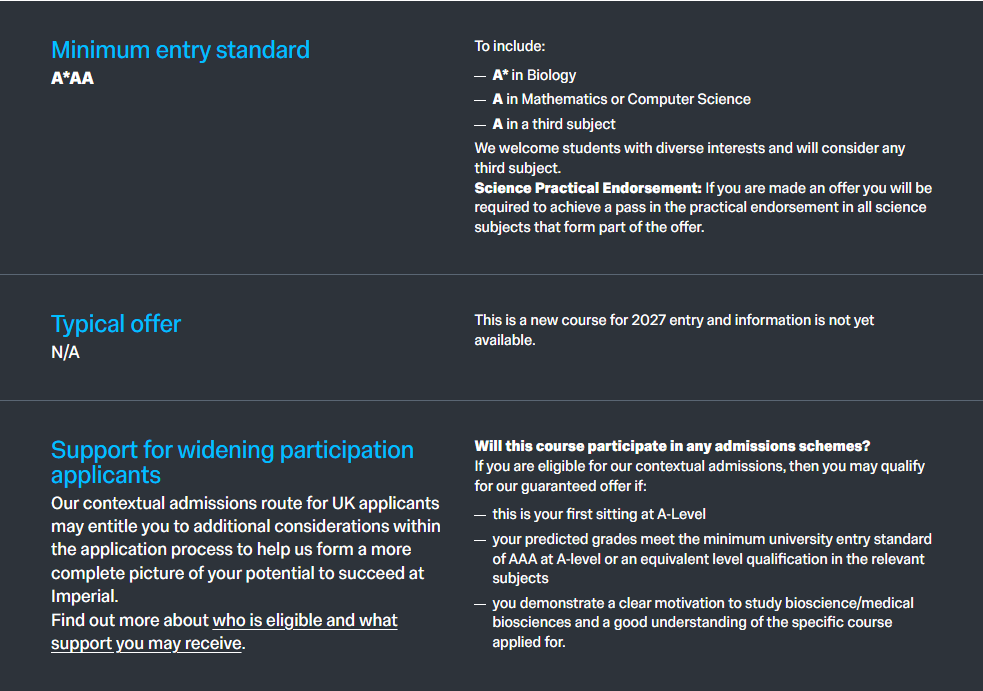
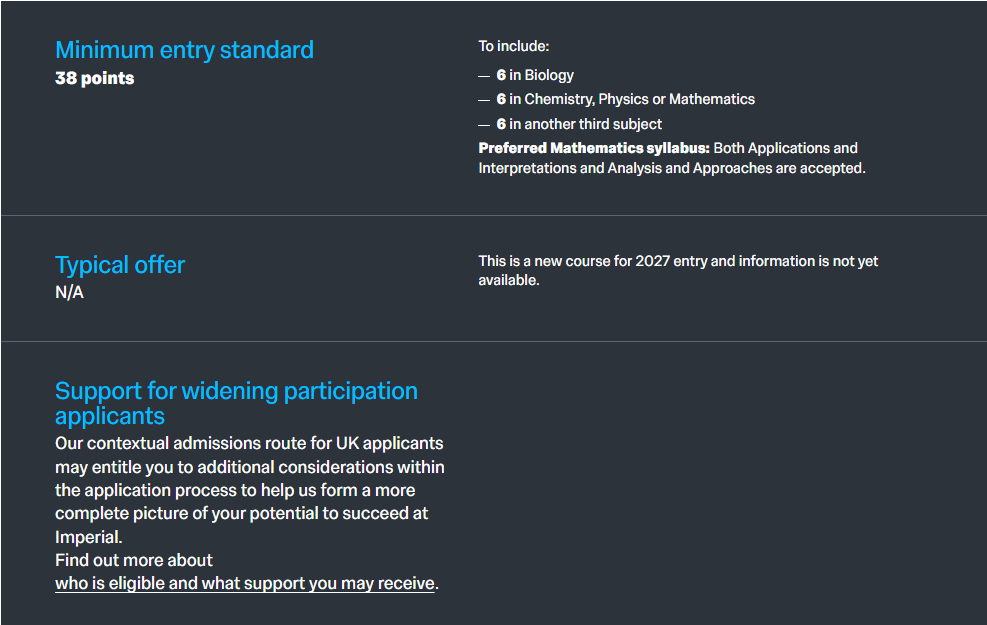
申请医学科学与创新专业的最低入学标准为:
levels:A*AA,包括生物A*,数学或计算机科学A。
IB:38(包括核心分数),HL666,生物达到6分,化学、物理或数学达到6分。
不接受通识教育和批判性思维。
评估申请
招生导师会严格筛选考虑所有可用的材料,学院会标记关键信息,部分申请人可能会以更低或更高的条件录取。该专业不接受重考成绩。申请本课程的学生不需要ATAS证书。
04就读IC医学科学与创新专业需要多少钱?
【图片来自官网】
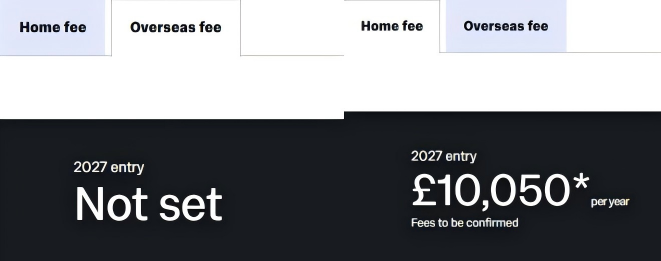
所需支付的国内或海外费用取决于你的费用状态,英国政府会根据你的居住地、国籍或居留身份等评估你的费用状态。家庭学生可以向英国政府申请学费贷款,以支付课程学费。也可以申请赡养费贷款,待经济状况调查通过后,该贷款会帮助学生支付生活费用。平均每年本土学生需支付£10,050,具体费用取决于入学年份,费用的增加与通货膨胀有关。