

如果某一天,人类真的截获了来自外星文明的信号——你会选择回复,还是保持沉默?
这不再是科幻电影的情节。2026年,国际宇航科学院(IAA)正式提出八项地外接触协议,其中最重要的一条就是:未经全球权威机构授权,任何人不得擅自回应外星信号。这意味着,当你按下“发送”键的那一刻,你代表的不是自己,而是整个地球。
然而,谁有权为80亿人做这个决定?
正方认为,未知的风险远大于想象的收益,沉默是对人类最负责任的选择。反方则认为,探索是文明的天性,谨慎的沟通可能开启一个全新的宇宙时代。
本期辩题,我们聚焦一个既遥远又紧迫的问题:人类可以擅自联系外星人吗?辩论现在开始




New York Post,Scientists have outlined a set of protocols for responding to extraterrestrial contact, including a bizarre directive to refrain from answering cosmic correspondence.Adopted by the International Academy of Astronautics (IAA), the eight principles were designed to guide “individuals, institutions and other entities participating in the Search for Extraterrestrial Intelligence (SETI), a scientific field dedicating to scanning the cosmos for radio and laser signals.Originally developed by the IAA and SETI between 2022 and 2025, these guidelines were recently updated and released earlier this month.
In the event of alleged contact, the extraterrestrial signal should be rigorously scrutinized in collaboration with other investigators and verified by multiple independent orgs employing different instruments or methods.
“It is crucial to uphold the highest standards of scientific responsibility and integrity throughout this process,” they write.
据《纽约邮报》(New York Post)报道,近日,国际宇航科学院(IAA)提出了八项应对地外接触的协议,旨在指导参与“搜寻地外文明计划”(SETI)的个人、机构和其他实体。其中规定,研究人员如果探测到疑似外星文明的信号,必须进行严格核查,整个过程必须保持最高标准的学术诚信。如果最终确认信号来源为外星智慧文明,则必须立刻通知全球公众、国际科学界和联合国。最重要的规则之一是,未经咨询相关权威机构,不得擅自回应地外文明信号,这里的相关权威机构指联合国及其他具有广泛代表性的国际机构。
另外,该协议要求保存好原始数据,建立国际合作机制,并严格保护研究人员,确保其免受网络骚扰和人身威胁。同时社交媒体可能是谣言的重要传播平台,各组织必须尽快澄清事实,在谣言扩散前主动发布权威信息。(New York Post)
Debate Discussion
by Coach Jamy
The main clash in this debate is not simply “Are aliens good or bad?” The deeper question is: who has the right to speak for Earth? The Proposition believes that no one should take that risk without global authorization. The Opposition believes that careful communication may be worth trying, because exploration is how human civilization moves forward. A strong debater should make this clash clear:is silence the safest choice, or is communication the first step toward a bigger universe?
这场辩论中的主要冲突并不只是在于“外星人究竟是善是恶?”更深层次的问题是:谁有权代表地球发声?正方认为,未经全球授权任何人都不应冒此风险。而反方则认为,谨慎的沟通或许值得一试,因为探索正是人类文明不断前进的方式。优秀的辩手应能清晰地阐明这一冲突:沉默是否是最安全的选择,抑或沟通才是迈向更广阔宇宙的第一步?
面对这个话题大家有什么想法?让我们一起来看看传言同学们的观点!

Humans shoudn't contact aliens without authorization
人类不应该擅自联系外星人

右滑查看英语原文

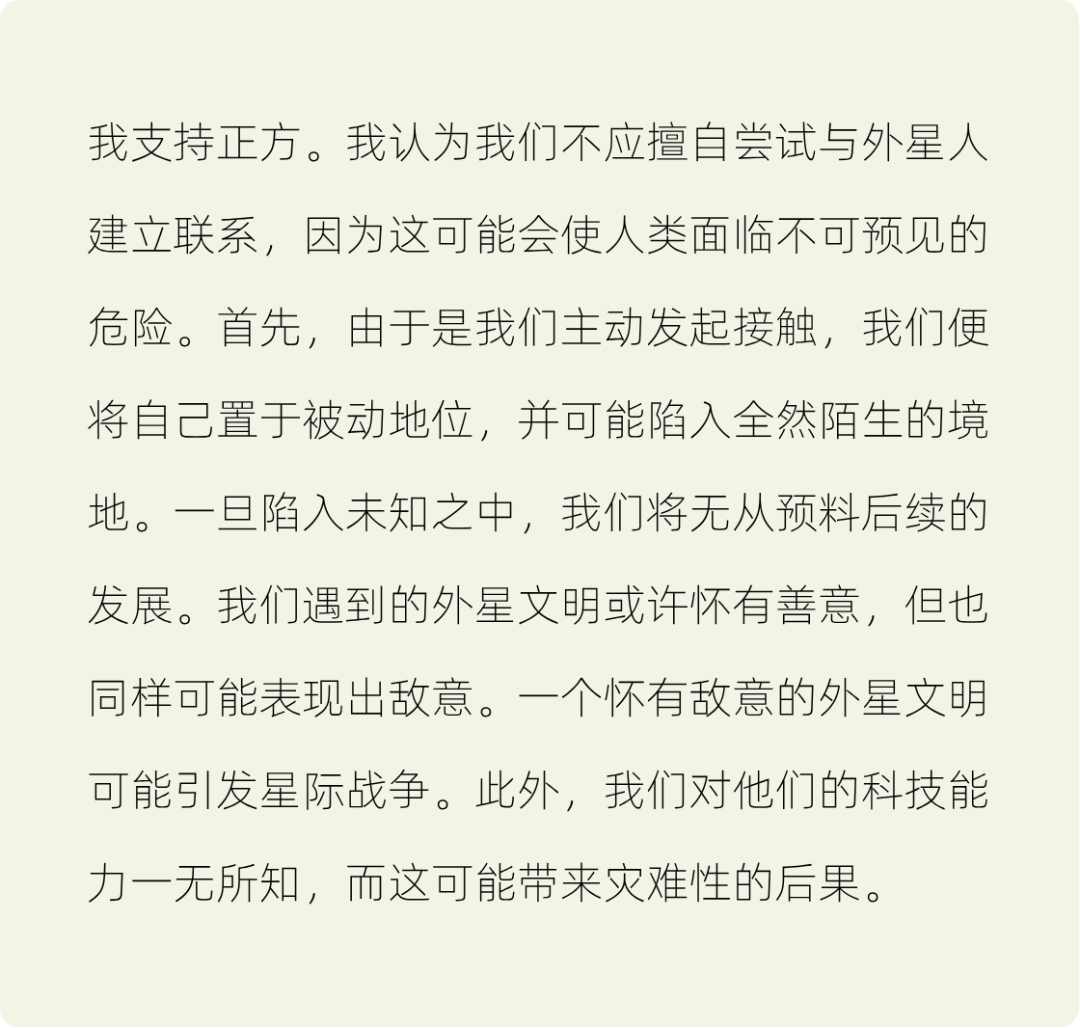
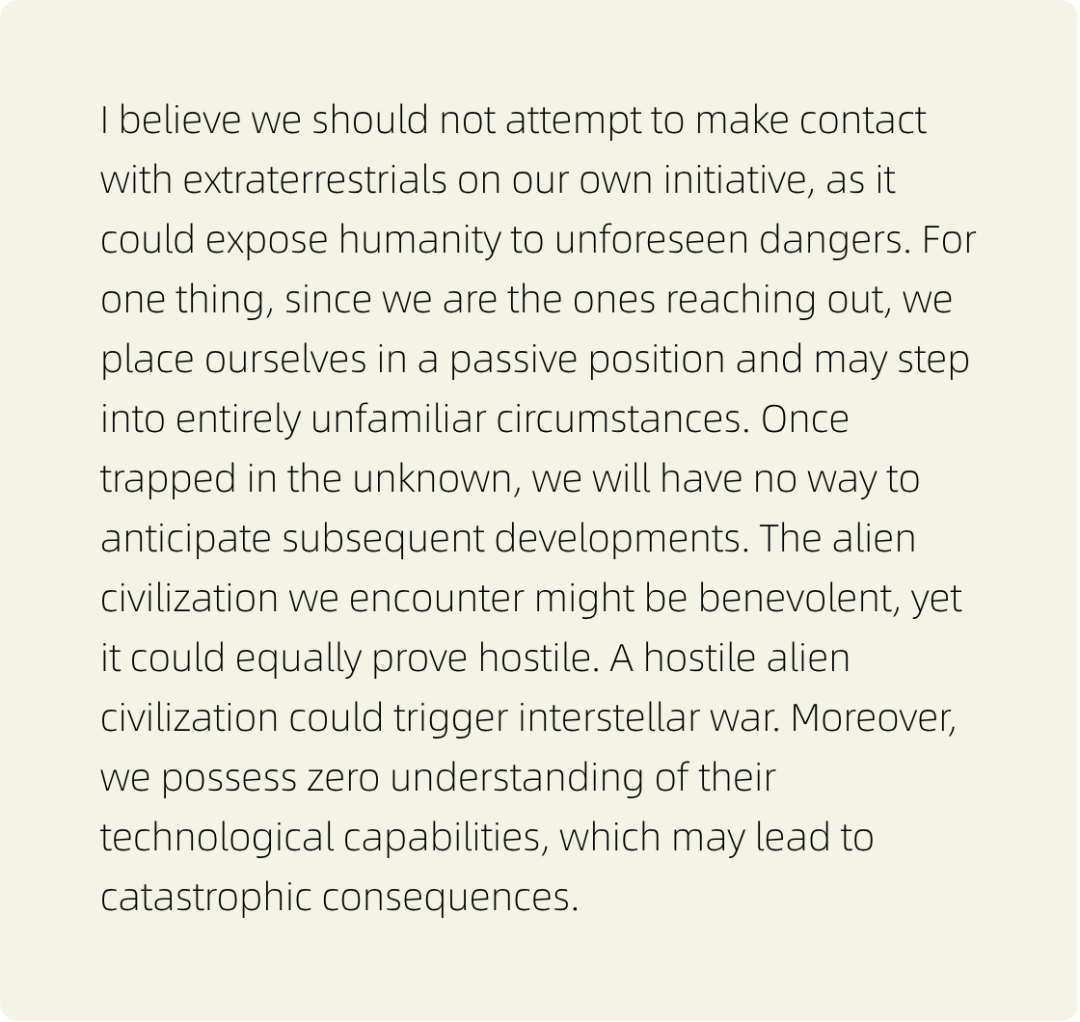
我选择正方。人类不应该擅自联系外星人,因为这关系到全人类安全,而不是个人或某个国家能单独决定的事。霍金曾警告,接触更高级文明可能像哥伦布到达美洲一样给弱势一方带来灾难。2026年国际宇航科学院也提出,若发现外星信号,不应擅自回复,而应经过国际协商。因此,在无法判断外星文明意图和实力前,人类应保持谨慎。

右滑查看英语原文

Humans shoud contact aliens without authorization
人类应该自发联系外星人

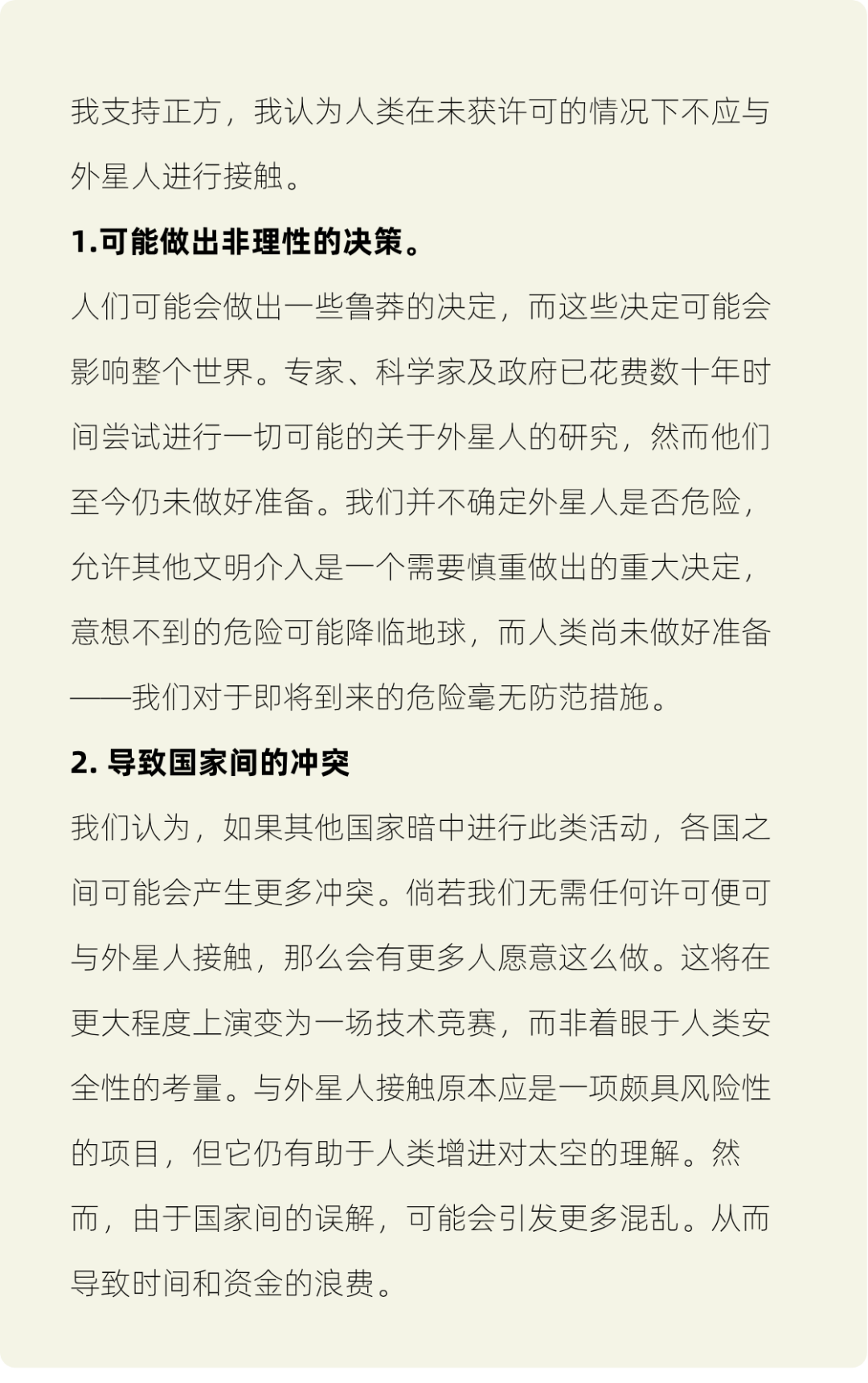
我支持反方。因为等地球上的人们逐渐强大时外星人也会向地球发送信号,而如果不主动联系将来某天也会被联系,因此主动联系不仅表达了诚意也可以更好地探究外星文明及外太空是否有和人类一样聪明的生命存在的问题。
在地球上人类初诞生时,非洲及“新大陆”的人们也不与外界联系,导致了对外界不够全面的理解,因此被屠杀。而此刻我们面临同样的抉择,是主动探索还是保守观察?我认为,主动向外太空那潜在的文明联系并示好是较优的选择。


右滑查看英语原文

右滑查看英语原文
同学们的观点是不是都非常有道理!如果是在比赛中碰到类似的题目你又会如何应对呢?让我们再来看看教练的正反两方辩题解析吧!

The main clash in this debate is not simply “Are aliens good or bad?”
辩论的核心并非是简单的“外星人是好还是坏”
Proposition
正方观点解析

Humans should not contact aliens without authorization. The Proposition can frame the debate this way: contact with aliens is not a personal chat. It is a public safety issue for all humankind. If one scientist, one company, or even one “super confident astronomy fan” replies to an alien signal without authorization, that person is actually making a decision for more than eight billion people. Earth is not their private group chat. No one should casually send out humanity’s location, level of technology, and state of civilization.
First, unauthorized contact may bring unknown risks. We do not know whether an alien civilization is friendly, hostile, or simply impossible for us to understand. We also do not know whether their technology is far more advanced than ours. Even young kids know that they should not give their home address to strangers online. In the same way, humans should not casually give Earth’s “address” to strangers in the universe. Even if aliens do not mean to harm us, the result could still be extremely dangerous for a weaker civilization. After all, humans do not hate ants, but stepping on an ant is still bad news for the ant.
Second, unauthorized replies may damage international fairness. Contact with aliens concerns all countries, all peoples, and all human beings. It is not the private business of one country, one organization, or one excited space fan with a very large radio. If only a small group of people decide what to say, they may quietly include their own values in the message. For example, they might say, “All humans love math,” “All humans love pizza,” or “All humans should listen to me.” Clearly, such messages cannot represent all humankind.
Third, unverified information can easily create chaos. According to the background information, the IAA protocols emphasize that after a possible alien signal is discovered, researchers must carefully verify it, preserve the original data, and inform both the public and the United Nations. This shows that the scientific community is not only worried about aliens. It is also worried about human panic. Once social media starts spreading rumors like “Aliens are coming!” or “Aliens will attack Earth tomorrow!”, the rumors may become scarier than the aliens themselves. For the Proposition, this is the key point: contacting aliens before authoritative verification is not courage. It is cosmic-level recklessness.

With the progress of deep-space technology, private alien contact has become accessible. Unauthorized contact violates global IAA space protocols and disrupts international space cooperation. It wastes limited scientific resources on unreliable false signals. Worst of all, it unilaterally exposes human civilization to irreversible unknown extraterrestrial threats. Therefore, our side firmly opposes unauthorized alien contact.
First, unauthorized alien contact violates official IAA global contact protocols and triggers systematic global legal and institutional punishment. The 2026 IAA extraterrestrial contact code explicitly requires UN-led collective authorization before any reply to alien signals. Any private or individual contact bypasses global unified rules and constitutes irregular space behavior that endangers shared human interests.
The IAA relies entirely on universal observance of its unified contact rules to maintain its cross-national scientific credibility and global coordinating influence. If the IAA fails to publicly condemn and penalize unauthorized interstellar transmission, all participating space agencies, research institutes and private astronomy groups will lose motivation to follow its protocols. To preserve its authority and prevent mass disregard of interstellar communication standards, the IAA holds strong inherent incentives to impose uniform punitive restrictions on any unauthorized actor.
Violators could face mandatory revocation of observation qualifications, permanent loss of international space research funding, and diplomatic sanctions from major space powers. This splits global space cooperation and weakens unified human response mechanisms toward outer space.
Second, unauthorized contact inevitably responds to false signals and causes massive waste of limited scientific resources. Over 95% of suspected alien signals are proven to be human device interference or natural cosmic noise. Without IAA multi-stage strict verification, hasty replies produce zero scientific value and damage academic credibility.
In 2020, the famous Proxima Centauri “alien signal” was globally reported, yet later confirmed to be terrestrial radio interference. If researchers had replied without authorization, the global public would have mistaken reckless speculation for formal science. Public trust in SETI programs collapses, leading governments and private foundations to cut annual astronomy funding. Legitimate deep-space observation projects face budget shortages, slowing human deep-space exploration progress for years.
Third, Unauthorized contact creates irreversible existential risks that no individual has the right to impose on all humanity. Broadcasting Earth’s location, technological features and civilization information is one-way and irreversible. Individual unilateral decisions expose the entire planet to unknown advanced extraterrestrial civilizations with unpredictable intentions.
Global nuclear security systems strictly prohibit single person launch authority, precisely because irreversible planetary risks require collective judgment. Just as no single soldier can trigger a national nuclear crisis, no single scientist can gamble humanity’s future. Once exposed, humans may face potential hostile alien surveillance or invasion. Human civilization could be under unmeasurable survival threats that can never be remedied.
In conclusion, unauthorized contact ruins international space cooperation, drains limited scientific resources, and puts our whole civilization at stake. We must stick to unified global rules to protect mankind’s future.
Opposition
反方观点解析

Humans should be allowed to contact aliens without authorization. The Opposition can tell a very different story: human progress has always been driven by curiosity, courage, and the wish to explore the unknown. If humans wait for perfect safety and perfect agreement every time, we may miss a once-in-history opportunity. Just like the friendship between Stitch and Lilo brought Earth and aliens closer, alien contact may also open a new chapter for human civilization.
First, human civilization has always developed through curiosity. If ancient people had not dared to sail across the oceans, they would not have discovered new lands. If scientists had not dared to study the sky, modern astronomy would not exist. Contacting aliens can also be seen as part of humanity’s exploration of the universe. If we are always afraid of the unknown, humanity may stay forever inside the “small room of Earth” and never dare to knock on the door of the universe.
Second, alien contact may bring huge knowledge benefits. A more advanced civilization may have knowledge about energy, medicine, environmental protection, and the laws of the universe. Perhaps they know how to solve climate problems, cure difficult diseases, or even make math homework disappear automatically. Of course, that last one may be every student’s dream rather than a serious policy plan. The serious argument is that active communication may help human civilization make a major leap forward.
Third, “unauthorized contact” does not necessarily mean reckless contact. Individuals or organizations can send very basic, peaceful, and non-sensitive messages, such as mathematical symbols, music, or cultural greetings from Earth. They do not need to send military technology, private information, or Earth’s exact location. The Opposition does not have to defend careless information sharing. Instead, it can defend limited, peaceful, and reasonable attempts to communicate.
The current official alien contact mechanisms are too rigid, inefficient and resource consuming. Appropriate unauthorized contact improves global space legal systems and fixes institutional loopholes. It rescues transient cosmic signals that official procedures fail to capture. It also fuels public space enthusiasm and accelerates the development of human aerospace technology. Therefore, our side firmly supports unauthorized alien contact.
First, unauthorized rapid response rescues transient alien signals that rigid official procedures will permanently lose. Most extraterrestrial candidate signals are short-lived and non-repeating. Official UN verification and approval processes take months, which guarantees signal loss. Timely independent response is the only feasible way to verify alien civilization’s existence.
The iconic 1977 “Wow! Signal” lasted merely 72 seconds and was never detected again. Strict slow bureaucratic procedures completely eliminated humanity’s only chance to confirm alien communication in decades. Flexible unauthorized response significantly raises the success rate of two-way cosmic communication. Successful alien contact would revolutionize astronomy, astrophysics and human cosmic cognition, bringing unprecedented scientific breakthroughs.
Second, unauthorized civilian contact stimulates public space enthusiasm and drives sustainable growth in global space science. Top-down bureaucratic mechanisms often appear rigid and inefficient. Transparent civilian-led exploration inspires public imagination, attracts social investment, and promotes the popularization of space science.
NASA’s Voyager Golden Record was released without full UN voting approval but became the most influential human space cultural project in history. Similarly, SpaceX’s unauthorized private space breakthroughs broke state monopolies and drastically reduced launch costs. Independent alien exploration boosts global public and private space investment, increases STEM enrollment, and cultivates more aerospace talents. It accelerates the overall development of human deep-space exploration capabilities.
Third, unauthorized contact fixes the legal vacuum of current IAA rules and forces enforceable global systems to be established faster. Current IAA protocols are guiding principles rather than binding laws. Passive waiting for perfect regulations leads to endless delays. Only practical unauthorized exploration exposes regulatory loopholes, creates universal urgency, and forces global institutions to formalize rigid, standardized laws.
Before 1957, no international space governance existed. The USSR’s unilateral, unregulated Sputnik launch revealed massive legal blind spots in outer-space activity. This institutional crisis directly accelerated global negotiations and eventually promoted the landmark 1967 Outer Space Treaty, the foundational binding law for all modern space conduct. Unilateral exploratory behavior could accelerate binding UN alien-contact regulations, eliminate legal loopholes, and provide standardized operating procedures for all future human extraterrestrial communication.
In conclusion, unauthorized contact with aliens fixes legal loopholes, saves lost cosmic evidence, and speeds up space development. We should embrace independent alien contact for humanity’s future progress.
今天我们围绕“人类能否擅自联系外星人”展开了精彩的辩论。正方强调安全与责任,反方主张勇气与探索。无论你支持哪一方,这个辩题都没有标准答案——它关乎我们对未知的态度,也关乎谁有权为全人类做决定。
辩论不止于赛场 思考不应止于课堂
欢迎你的加入
期待大家来到自由辩论plus畅所欲言 亮出你的观点!