

转眼已经到了12月初,备受全世界高校关注的HIEEC哈佛国际经济学论文竞赛于10月28日已公布了2025-2026赛季的题目,这也意味着正式开赛啦!
论文提交截止日期为2026年1月5日(美国东部时间)晚上11:59,留给同学们准备的时间仅剩1个月啦,想要参加的同学需要抓紧时间准备了哦~
下面,老师将在这篇文章中为大家详细介绍一番这项赛事,并给大家列出了今年的题目,对经济、写作感兴趣的小伙伴们可千不要错过哦!
HIEEC哈佛国际经济学论文竞赛
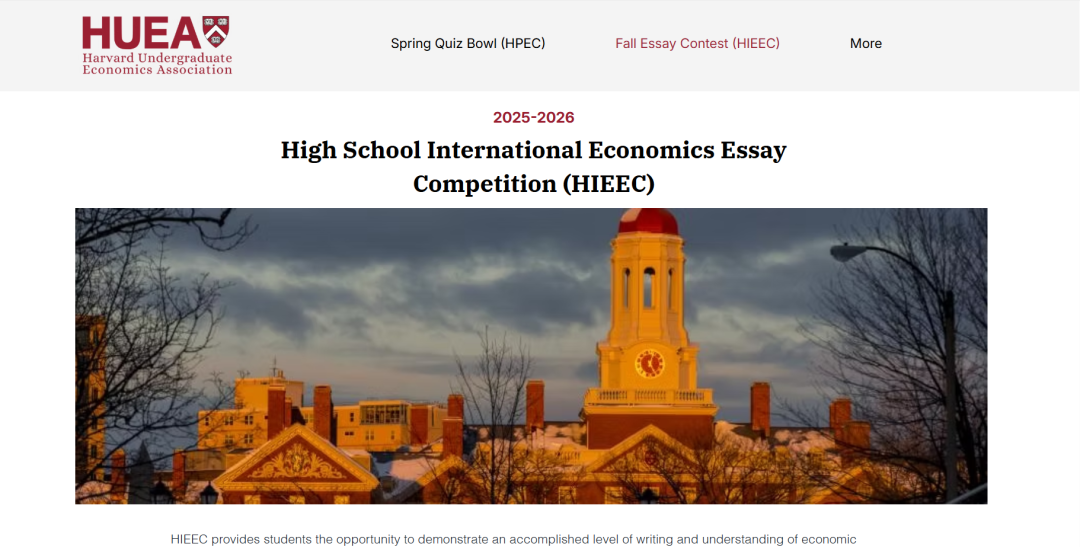
Harvard International Economics Essay Contest哈佛经济学会国际论文竞赛,由哈佛大学本科生经济学协会(HUEA)和《哈佛大学经济评论》(HCER)联合主办,为学生提供展示其写作水平和对经济理论理解的机会。
通过比赛,学生可以磨练自己的学术和专业技能并展示自己的知识。该论文竞赛面向所有年级的高中生,是展示写作水平和对经济理论理解的绝佳机会。
参赛时间节点
2025年10月28日——论文提示发布
2026年1月5日,美国东部时间晚上 11:59 – 论文提交截止日期
2026年3月中旬*– 通知Highly Commended奖和入围者
2026年3月底*– 通知获奖者,在网站上公布结果
2025-2026年题目
1) Environment:As climate change intensifies, governments and corporations are turning to carbon offset markets and nature-based solutions (like reforestation or carbon capture) to meet emission targets. Yet critics argue these mechanisms allow wealthy nations and firms to “buy their way out” of real reductions, while creating new inequities for developing economies.Prompt: Evaluate the economic and environmental effectiveness of carbon offset markets as a tool for reducing global emissions. How might these markets influence international trade, investment, and development? Should countries prioritize direct emission reductions over offset schemes, or can both coexist effectively? Propose economic policies that could enhance the credibility and fairness of global carbon offset systems.
2) Inequality:The rapid rise of generative AI and automation has sparked fears of a “productivity boom without wage growth,” where capital owners capture most of the benefits. Some economists propose implementing a universal basic income (UBI) or data dividend to redistribute the value created by automation.Prompt: Analyze the potential of universal basic income or data dividends as policy responses to technological inequality. What economic trade-offs might arise from decoupling income from labor, and how could these affect long-term growth, innovation, and social cohesion? Consider how different income groups and countries at varying levels of development might respond to such policies
3) Workforce & Education:Hybrid and remote work, accelerated by global digitalization, has reshaped labor markets and urban economies. As geographic proximity becomes less critical, cities face shifting housing demand, changing tax bases, and new infrastructure needs.Prompt: Examine the long-term economic implications of a global shift toward remote and hybrid work. How might this transformation affect productivity, urban inequality, and educational priorities? What role should governments and institutions play in balancing the benefits of flexibility with the risks of labor market fragmentation?
4) Crypto/Finance:Amid rising debt levels and global inflation uncertainty, some governments have explored issuing tokenized sovereign bonds or blockchain-based currencies to improve transparency and accessibility. Yet such innovations raise questions about security, regulation, and the role of private intermediaries.Prompt: Assess the economic and financial stability implications of tokenized government bonds and blockchain-based public finance systems. Could such technologies democratize investment and improve fiscal transparency, or do they introduce new systemic risks? How should central banks and regulators adapt to a financial system increasingly built on distributed ledger technology?
投稿对象面向所有年级的高中生(允许9至12年级);
参赛规则参赛者必须从四个题目中选择一个写出论文,并严格限制在1500字以内。提交必须通过HUEA网站进行,参赛者只能提交一篇论文,只有第一篇提交才会被考虑。

每篇论文提交都会有阅读费,应支付:美国申请人20美元、国际(非美国)申请人30美元;如果这笔费用会给您的家人带来沉重的经济负担,请发送电子邮件至 thehuea@gmail.com,并简要说明任何妨碍您支付阅读提交费的情况。请将电子邮件主题命名为“名字姓氏:HIEEC经济援助请求”。
电子邮件中的名字和姓氏应与您在以下表格中提供的名字和姓氏相匹配。这些论文将由 HUEA 董事会评审,前10名提交的作品将由哈佛大学经济学教授评审。*提交前请务必仔细阅读提交表格中的所有详细信息,因为未能正确完成任何步骤可能会导致您的提交不被考虑。
论文要求必须严格遵守1500字的字数限制。任何超过限制的单词都将被截断。此限制不包括参考文献、脚注、标题、页眉和页脚。论文只能由参赛者撰写。任何外部援助都必须在论文的开头或结尾声明。
只有您的第一次提交才会被接受。任何进一步的提交将不会被阅读。必须包括参考文献,任何抄袭都将导致取消资格。参考文献必须采用芝加哥或APA格式。
唯一接受的文档格式是PDF。不接受任何其他形式,也不向不遵守此规则的人退款。该论文不得参加任何其他比赛,也不得在其他地方发表。不会给予论文的个人反馈。HUEA 在最后一轮裁决中做出的决定是最终决定。所有获奖者都同意在HUEA网站上公布他们的名字。
截止信息
论文提交表格将于2026年1月5日美国东部时间晚上11:59严格关闭。
今年将提交论文的人数限制在 600 篇。
任何超过这些截止时间的论文提交都将不被接受。
比赛结果
前三名获奖论文将发表在官网上(经作者许可)。
最佳提交作品的决赛入围名单将在线发布,并由现实世界的经济学家进行评审。
将获得“高度赞扬”殊荣的名单也将在网上公布。评委的决定是最终决定。
推荐理由
👉1. 哈佛大学背书的权威性,具有高认可度:HIEEC由哈佛大学本科生经济学协会(HUEA)和《哈佛大学经济评论》(HCER)联合主办,具有哈佛大学的权威认可。并且英美顶尖名校对HIEEC都有很高的认可度,是爬藤利器,也是申请牛剑的高质量背提赛事。
👉2. 提升经济学和写作能力,展示学术能力:参赛过程中,学生将不断学习、研究和思考经济理论与实际案例之间的关联,不仅可以加深对经济学原理的理解,还能够提高写作能力。此外,参赛者可以通过比赛展示自己对经济理论的理解和英文学术写作水平,这对于申请大学尤其是经济学相关专业是一个很大的加分项。
👉3. 紧贴经济时事,全球高中生的学术交流平台:HIEEC的题目通常围绕经济、社会时事的主题,参赛者需要运用经济学理论结合现实中的案例撰写论文,这种紧密结合现实的特点使得参赛作品具有更高的社会关注度和实践意义。同时,HIEEC对全球高中生开放,是展示写作水平和对经济理论理解的绝好机会,也是与全球顶尖高中生进行学术交流和竞争的平台。
👉4. 与顶尖专家对话,顶刊发表机会:入围决赛的作品将有机会由诺贝尔经济学奖得主等权威专家亲自评审,这意味着参赛者有机会与诺奖级别的大佬进行隔空对话,并从他们的专业意见和建议中受益。另外,获奖作品将有机会在《哈佛大学经济评论》线上期刊上发表,这不仅是对参赛者研究成果的认可,也为他们提供了在学术领域发表的宝贵机会,有助于在未来升学或职业发展中获得竞争优势。
写在最后
以上就是2025-2026HIEEC哈佛国际经济学论文竞赛的相关内容了,从开题到最后截稿仅剩1个月的时间了,如果想要出产一篇高质量文章,选题、选材、阅读等各个环节都需要花费心思,时间还是比较紧张的,同学们可以根据自己的实际情况做好准备哦!