

WSC Weekly
2026世界学者杯
the World Scholar's Cup
@WSC小学者们!Jerry喊你来看WSC Weekly专栏啦!
2026年度主题
Are We There Yet?
WSC Weekly专栏将精选最新话题内容,助力小学者准备世界学者杯!
让我们怀着永恒的学术精神与信念,探索未来的无限可能吧!
锁定每周WSC Weekly
上期回顾&Quiz答案揭晓
在2026年世界学者杯第13期WSC Weekly栏目中,我们与小学者一起学习了等待叫号为何会令人焦虑的缘由。在上期的趣味Quiz中,你是否找到了正确答案?现在就让我们一起来揭晓吧!
点击查看上期话题
等叫号太焦虑?可能是装修的问题
How the design of waiting rooms influences anxiety
第13期Quiz答案揭晓:
Which of the following waiting rooms is LEAST likely to make patients feel anxious?
下列哪个候诊室最不可能让患者感到焦虑?
A) A room featuring blue walls, spaced-out chairs, and gentle lighting. 一间墙壁涂成蓝色、椅子间距宽敞、灯光柔和的房间。
B) A big, windowless space with bright red walls and lively dance music. 一间宽敞的无窗空间,墙壁是鲜红色,播放着欢快的舞曲。
C) A quiet, gray room featuring rows of tightly packed plastic chairs. 一间安静的灰色房间,里面排列着一排排紧密相连的塑料椅。
D) A crowded, noisy hallway where patients wait with clear schedule updates. 一条拥挤嘈杂的走廊,患者能清楚地看到最新的候诊时间更新。
E) A clean, bright orange room with metal chairs, plants and a big clock. 一间干净明亮的橙色房间,配有金属椅子、绿植和一只大钟。
正确答案: A
Key: A
2026年第14期 Weekly Intro
历史上“盛极一时”的末日预言可谓是层出不穷,难免引起人们的讨论热潮。在本期 Weekly中,老师将带领你探讨末日预言在科学的框架下是如何让人们的意识得以转变的!
2026 No.14
那些盛极一时的末日预言是如何落空的?
Apocalyptic predictions that didn't happen
末日临近是真的吗?
试想一下生活在这样一个时代:人们坚信世界可能会在下周走向终结。有人在建造方舟,有人在抢购生存物资,有人在解读天空中的宗教神启,还有人则在为彗星、计算机或奇特的数学规律陷入恐慌。这听起来可能颇具戏剧性,但在历史上却一次又一次地真实发生。长期以来,人类常常痴迷于“末日临近”的念头,然而同样频繁的是,他们的预言悉数失败。
Imagine living in a time when people are convinced the world may end next week. Some are building arks. Some are buying survival supplies. Some are reading religious signs in the sky, while others are panicking over comets, computers, or strange mathematical patterns. This may sound dramatic, but it has happened again and again throughout history.Humans have long been fascinated by the idea that the end is near—and just as often, they have been wrong.

玛雅末日预言
近代最著名的例子之一是2012 年的玛雅末日预言。许多人声称,2012 年 12 月 21 日将带来全球性的毁灭,因为这一天标志着玛雅长纪历中一个大周期的结束。关于毁灭具体会怎么发生,人们的想象力开始信马由缰。有人预测地球会与一颗名为“尼比鲁”的隐形行星相撞;有人警告称将出现巨型太阳耀斑、灾难性的行星连珠,或是地球自转轴的突然漂移。生存包被一抢而空,甚至有人建造了现代版的诺亚方舟。然而,那一天像往常一样平淡地来临又过去。这种误解完全源于将日历周期的结束错当成了世界本身的终结。
One of the best-known recent examples was the2012 Maya apocalypse. Many people claimed that December 21, 2012, would bring global destruction because it marked the end of a major cycle in the Maya Long Count calendar. From there, imaginations ran wild. Some predicteda collision with an invisible planet called Nibiru. Others warned of giant solar flares, catastrophic planetary alignment, or a sudden shift in Earth's axis.Survival kits were sold, and some even built modern versions of Noah's ark. But the date came and went like any other day. The misunderstanding came fromtreating the end of a calendar cycle as if it meant the end of the world itself.
宗教预言
在那些破产的末日预言中,宗教预言也扮演了重要角色。现代美国传教士哈罗德·坎平曾利用圣经中的数字命理学,多次公开预言世界末日。他最著名的日期之一是 2011 年 5 月 21 日,他声称这一天恰好是圣经大洪水发生 7000 年后。当预言落空时,他只是简单地将日期修正为同年的 10 月。结果,那一天同样风平浪静地过去了。更早时期的一场名为“米勒派”的运动也遵循了类似的模式。在 19 世纪 30 和 40 年代,传教士威廉·米勒宣称在1843 年3月21日世界将毁灭,耶稣基督将复临,并由此吸引了数以万计的追随者。当这一幕没有发生时,他将预测的日期调整到了 1844 年。然而,奇迹依旧没有显现。对许多信徒而言,预言落空带来的情感余波是具有毁灭性的。一位追随者曾写道,自己因为“失望到了极点而病倒”。
Religious prophecy has also played a major role in failed apocalyptic predictions.Harold Camping, a modern American preacher, predicted the end of the world many times using biblical numerology. One of his most famous dates was May 21, 2011, which he claimed was exactly 7,000 years after the biblical flood. When nothing happened, he simply revised the date to October of the same year. That passed quietly as well. A much earlier movement, Millerism, followed a similar pattern. In the 1830s and 1840s, preacher William Miller attracted tens of thousands of followers by declaring that, based on his interpretation of Daniel 8:14, Miller calculated a timeline of 2,300 days/years, concluding that the world would end and Christ would return on March 21, 1843. When that did not happen, the date was adjusted to 1844. Once again, nothing occurred. For many believers, the emotional aftermath was crushing. One follower wrote of being "sick with disappointment."
哈雷彗星
自然现象也经常激发起人们对毁灭的恐惧。1910 年哈雷彗星的回归引发了全球性的焦虑。传言四起,称地球可能会与之相撞,或者彗尾中的有毒气体会抹杀行星上的所有生命。人们争相购买瓶装空气、防毒面具和“彗星丸”。有人加固密封了房间,或者设计了其他绝望的生存计划。但实际上,地球穿过彗尾的一部分时,没有产生任何可察觉的影响。另一个戏剧性的例子是对 1524 年大洪水的预测。德国数学家兼占星家约翰内斯·施特夫勒计算出,在双鱼座中发生的行星连珠将带来一场毁灭世界的洪水。他的警告通过数百份小册子广泛传播,据报道,至少有一位贵族甚至为此建造了一座三层的方舟。然而当指定的日子来临时,天空只下起了绵绵细雨,全球性的大洪水并未现身。
Natural eventshave often inspired fears of destruction as well. In 1910, the return of Halley's Comet caused worldwide anxiety. Rumors spread that the Earth might collide with it, or that poisonous gases in the comet's tail might wipe out all life. People bought bottled air, gas masks, and "comet pills." Some sealed rooms or devised other desperate survival plans. In reality, Earth passed through part of the comet's tail with no noticeable effect. The panic showed how easily scientific language, media sensationalism, and public fear can combine into mass hysteria. Another dramatic example was the prediction of a great flood in 1524. German mathematician and astrologer Johannes Stöffler calculated that a planetary alignment in Pisces, a water sign, would bring a world-ending flood. His warning spread through hundreds of pamphlets, and at least one nobleman reportedly built a three-story ark. When the appointed day arrived, there was only light rain. No global flood came. Yet the panic beforehand had been real.
千年虫
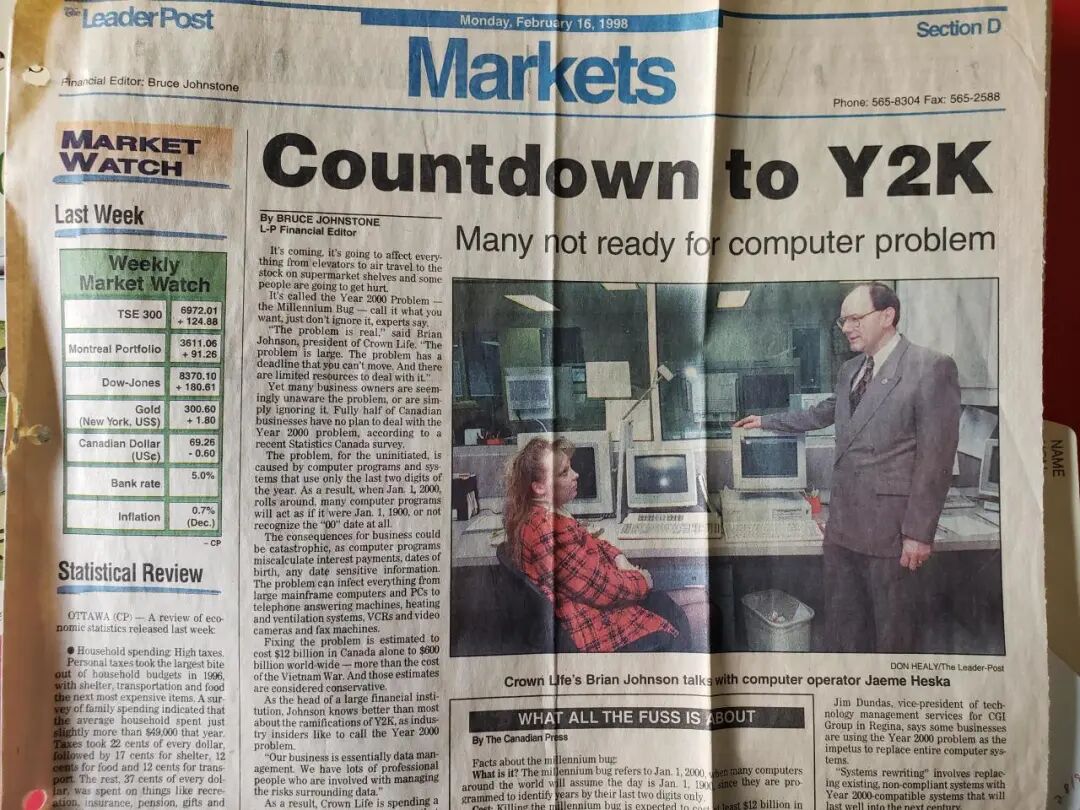
现代的末日预言则往往披上了科学或技术的外衣。著名的例子是“千年虫”危机,灾难的预期来源于人们担心计算机会在年份从 1999 年切换到 2000 年时全面瘫痪。当时专家做出的预测包括经济崩溃、物资匮乏甚至核灾难。最终,跨年过渡大体上波澜不惊,尽管全球为了防范潜在的技术漏洞已经投入了天文数字的资金。甚至连大型强子对撞机(Large Hadron Collider)也曾引发过末日恐慌。一些人担心,机器内部的粒子撞击可能会制造出一个吞噬地球的黑洞。对此物理学家回应道,地球其实一直在不断受到来自宇宙深处高能宇宙射线的轰击,引发的撞击威力甚至高出千万倍,而地球显然完好无损地幸存至今。
Modern fears have often taken a more scientific or technological form. A famous example isY2K, the fear that computers would fail when the year changed from 1999 to 2000. Predictions included economic collapse, shortages, and even nuclear disaster. In the end, the transition was largely uneventful, though huge amounts of money had been spent preparing for possible glitches. Even the Large Hadron Collider inspired apocalyptic fears. Some worried that particle collisions inside the machine might create a black hole that would swallow the Earth. Physicists responded that the planet is constantly struck by cosmic rays, causing even more powerful collisions, and Earth has clearly survived.
保持警惕
纵观所有这些例子,尽管引发恐慌的具体诱因在不断更迭,但人类的心理动机却惊人地相似。人们四处寻觅警告的征兆,将零散的事件拼凑成一个充满戏剧性的故事,将未知的不确定性转化为笃定的恐惧。人类曾无数次确信万物即将终结,但到了第二天,朝阳总是照常升起。尽管每一个时代都认为自己面临的末日危机是绝无仅有且令人信服的,但历史总是在不断提醒着我们,要警惕那种将内心的焦虑错当成命运的预言的冲动。
Looking across all these examples, a pattern becomes clear. The specific causes change, but the human impulse stays remarkably similar. People search for warning signs. They connect scattered events into a dramatic story. They turn uncertainty into prophecy. Again and again, people have been certain that everything was about to end.Again and again, morning came as usual, and the world continued. While every age thinks its own doom is uniquely convincing, history keeps reminding us to resist the urge to mistake anxiety for prophecy.
Weekly 关键词 Key Words
apocalypse 末日预言
所属话题
The End is Nearish
相关阅读
https://www.britannica.com/list/10-failed-doomsday-predictions
https://www.smithsonianmag.com/history/ten-notable-apocalypses-that-obviously-didnt-happen-9126331/
Weekly FUN Quiz
现在,快来参与本期Weekly FUN Quiz👇,告诉老师你的答案吧!
Quiz
A book about how to construct a waterproof granary is most likely to be popular in which year? 关于如何建造防潮粮仓的书,最有可能在哪个年份流行?
A. 1524
B. 1666
C. 1910
D. 1999
E. 2008