


赛程更替,思辩不止!
新赛季信号已吹响!
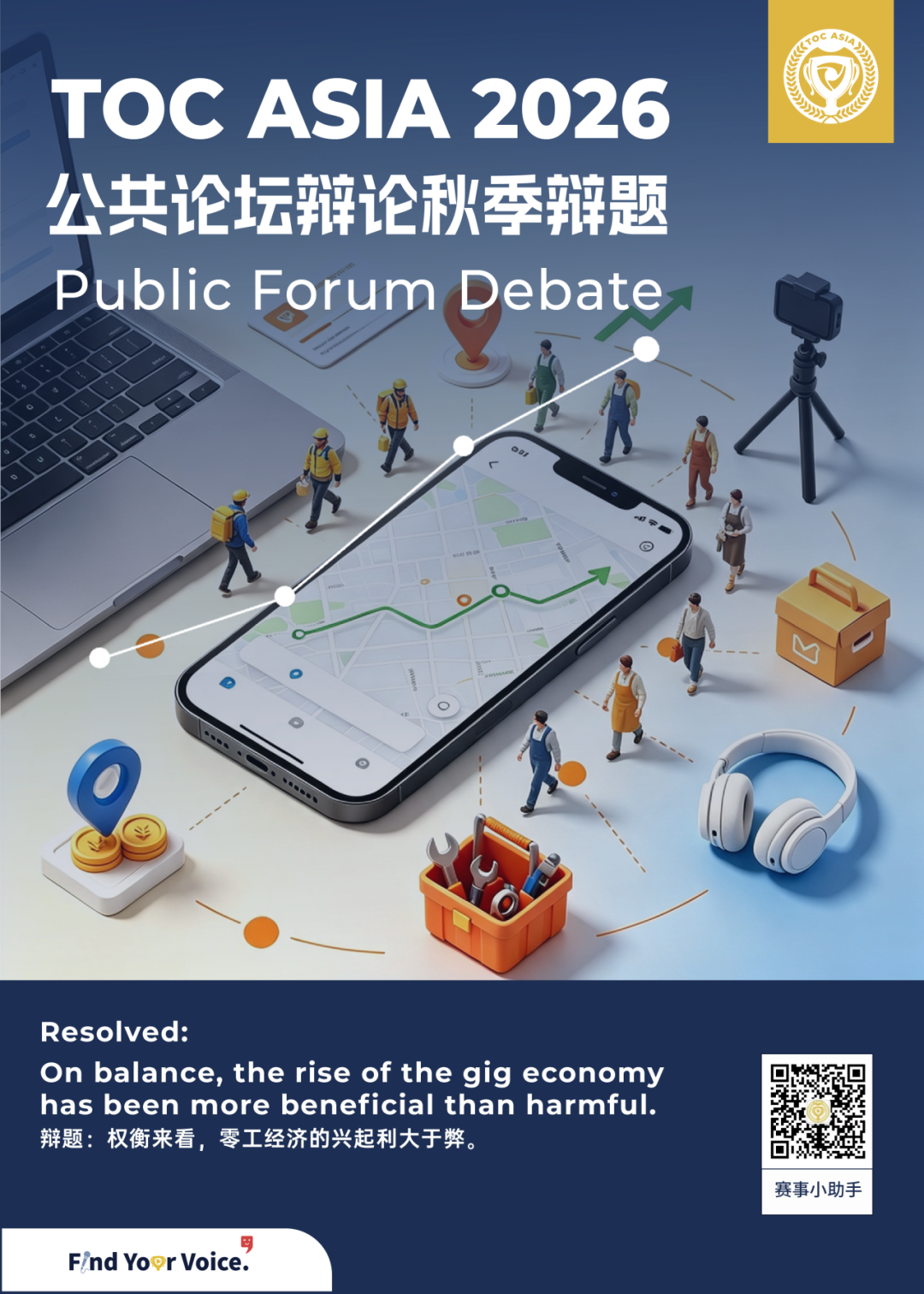
2026 秋季资格赛公共论坛辩论
(Public Forum Debate)辩题正式揭晓!
深耕调研、缜密立论是赛场制胜关键。该如何抢先拆解辩题内核,掌控整场对局节奏?
TOC ASIA 学术总监 Coach Will 将为2026秋季资格赛 PF 辩题提供深度解读与论证框架指导,独家Sample Case,打开立论新思路!
秋季论场已然就绪——静待一场思维的正面交锋!
秋季PF辩题
TOC ASIA 2026 FALL
公共论坛辩论辩题
Public Forum Debate
Resolved: On balance, the rise of the gig economy has been more beneficial than harmful.
辩题:权衡来看,零工经济的兴起利大于弊。
Sample Case
TOC ASIA 2026 FALL
2026 TOC ASIA 秋季资格赛即将开启!
在此,我们将奉上由TOC ASIA学术总监
Will教练精心准备的【Sample Case】
助力选手们快速掌握辩题的核心,
拓宽思考维度,提升备赛效率。
我们期待每一位辩手
都能“踏实深耕辩题,全力以赴赛事”
在辩论赛场中从容应战,展现最佳自我!
公共论坛辩论
Public Forum Debate
Resolved
On balance, the rise of the gig economy has been more beneficial than harmful.
Pro Sample Case
We affirm.
We define the gig economy as short-term or task-based work, usually arranged through digital platforms that connect workers with customers. “On balance” means comparing the major benefits and harms caused by the growth of this system.
Contention 1: Gig work expands access to employment.
Traditional jobs often require fixed schedules, formal qualifications, interviews, or access to a major city. Gig platforms lower these barriers. People can begin earning money using skills, time, or resources they already have. The World Bank reported in 2023 that online gig work may account for as much as 12 percent of the global labor force. Six in ten online gig workers live outside their countries’ largest cities. The report also found that gig work creates important opportunities for young people and that women participate more heavily in online gig work than in the overall labor market. This shows that gig platforms can reach people who are often excluded from traditional employment. The realistic alternative for many workers is unemployment, informal work, or a regular job whose schedule they cannot follow. By giving more people a way to earn income and gain experience, the gig economy expands participation in the labor market.
Contention 2: Gig work flexibility provides financial security during difficult periods.

Gig workers can often choose when to work. This allows them to combine gig work with school, caregiving, another job, or changing family responsibilities. It also gives people a way to begin earning quickly after losing another source of income. Economist Emilie Jackson used American tax records to study workers who lost their jobs. Her 2022 research found that workers with strong access to gig platforms experienced an income drop about $3,000 smaller during the year they became unemployed. The JPMorgan Chase Institute also analyzed financial records from more than 260,000 platform participants. It found that platform earnings helped offset reductions in workers’ income from other sources. This means gig work can serve as a flexible financial safety net when regular earnings fall. A sudden loss of income can force families to miss payments, borrow money, or cut spending on necessities. Gig work does not guarantee long-term financial stability, but it gives people an immediate source of income without requiring them to wait through a lengthy hiring process.
Contention 3: Gig platforms increase economic efficiency.
Workers and customers have always needed to find one another. Digital platforms make this process faster and less expensive by matching available workers with people who need a service. Economists call these search and transaction costs. When platforms reduce these costs, more useful exchanges can take place. An OECD review found that gig platforms help workers and clients find one another more efficiently. It also found positive effects on overall employment, while the effects on traditional employment and wages were small or unclear. This suggests that platforms can create new economic activity instead of simply moving existing work from one group to another. Consumers also receive significant benefits. Using nearly 50 million observations, Cohen and his coauthors estimated that UberX produced $6.8 billion in benefits for American consumers in 2015. In other words, passengers valued the rides much more than the amount they actually paid. These gains spread across the economy. Workers find customers, small businesses gain access to specialized talent, and consumers receive faster and more affordable services.
By expanding access to employment, providing financial support during difficult periods, and making the economy more efficient, the rise of the gig economy does more benefit than harm.
Pro sources
World Bank, “Demand for Online Gig Work Rapidly Rising in Developing Countries,” September 7, 2023.
Peter Cohen, Robert Hahn, Jonathan Hall, Steven Levitt, and Robert Metcalfe, “Using Big Data to Estimate Consumer Surplus: The Case of Uber,” September 2016.
Emilie Jackson, “Availability of the Gig Economy and Long Run Labor Supply Effects for the Unemployed,” November 2022.
Diana Farrell and Fiona Greig, “Paychecks, Paydays, and the Online Platform Economy,” February 2016.
Cyrille Schwellnus, Assaf Geva, Mathilde Pak, and Rafael Veiel, “Gig Economy Platforms: Boon or Bane?” May 21, 2019.
Con Sample Case
We negate.
We define the gig economy as short-term or task-based work, usually arranged through digital platforms that connect workers with customers. The resolution asks whether the growth of this system has improved society overall. An increase in the number of people completing gigs does not necessarily mean that more secure or productive jobs have been created.
Contention 1: Gig pay is low and unpredictable.
Gig workers are usually paid only when tasks are available. Time spent waiting, searching for work, or traveling between tasks may be unpaid. As a result, workers may be unable to predict how much they will earn from one week to the next. The International Labour Organization surveyed 12,000 platform workers across multiple countries and industries. It found that online platform workers earned an average of $4.90 per hour. After unpaid working time was included, their average earnings fell to $3.40 per hour. It also found that 86 percent of online workers and 69 percent of delivery workers wanted more work but could not obtain enough tasks. A 2024 UC Berkeley study analyzed more than 52,000 trips completed by over 1,000 passenger and delivery drivers. After work expenses were subtracted, typical drivers earned less than the local minimum wage in all five metropolitan areas studied. Their employee-equivalent earnings were even lower after accounting for payroll taxes and benefits that employers normally provide. Income volatility creates problems beyond low average pay. Workers who cannot predict their earnings struggle to plan for housing, food, education, and emergencies. Flexibility provides limited freedom when workers must remain available for long periods without knowing whether paid work will appear.
Contention 2: Platforms shift costs and risks onto workers.
Traditional employers share responsibility for equipment, insurance, payroll taxes, sick leave, and workplace protections. Gig companies usually classify workers as independent contractors, leaving individual workers responsible for many of these costs. Drivers must pay for fuel, maintenance, insurance, and vehicle repairs. Online freelancers provide their own technology and spend unpaid time searching and applying for jobs. These expenses make workers’ real earnings much lower than the amount displayed by the platform. The Council of the European Union reported in 2023 that approximately 5.5 million EU platform workers were classified as self-employed even though their actual relationship with the platform resembled employment. These workers could therefore be denied the labor rights and social protections provided to regular employees. The Council also reported that platforms regularly use algorithms to manage workers. Workers often lack information about how important decisions are made, including decisions about their pay, access to work, and account suspension. Workers may control when they log in, but platforms retain enormous control over the conditions of their work. This arrangement gives platforms many of the powers of an employer while transferring the employer’s normal costs and responsibilities onto individual workers.
Contention 3: Gig work replaces more secure employment.
Gog jobs are not evidence of job creation. Gig platforms can reorganize work that already existed, push traditional workers out of the market, or delay workers’ movement into more stable employment. Economists Felix Degenhardt and Jan Sebastian Nimczik used Austrian employment records to study refugees entering the labor market. Gig food-delivery jobs initially helped these workers find employment faster. Two years later gig workers were no more likely to be employed than similar workers without gig opportunities. They were also working in lower-paying and less stable jobs, even after some had left the gig economy. The researchers concluded that gig work did not provide a stepping stone into successful careers. Instead, it often substituted for better-paid and more stable regular employment. A 2024 US Census Bureau working paper found a similar pattern in the driving industry. Ridesharing dramatically increased the number of people entering driving work but it also increased the exit of lower-earning taxi drivers. In cities without limits on the size of taxi fleets, both lower-earning and higher-earning taxi drivers suffered earnings losses after ridesharing entered their markets. These studies show why counting gig workers does not prove that the economy gained new jobs. Some gig opportunities replace existing work or pull workers away from jobs offering better pay, greater stability, and stronger opportunities for career growth.
Gig work’s harms can follow workers for years through unstable income, missing protections, and reduced access to secure employment. Because platforms transfer costs and risks to workers while weakening the quality of work, the rise of the gig economy does more harm than benefit.
Con Sources
International Labour Organization, “World Employment and Social Outlook 2021: The Role of Digital Labour Platforms in Transforming the World of Work,” February 2021.
Ken Jacobs, Michael Reich, Tynan Challenor, and Aida Farmand, “Gig Passenger and Delivery Driver Pay in Five Metro Areas,” May 20, 2024.
Council of the European Union, “Rights for Platform Workers: Council Agrees Its Position,” June 12, 2023.
Felix Degenhardt and Jan Sebastian Nimczik, “Is the Gig Economy a Stepping Stone for Refugees? Evidence from Administrative Data,” May 2025.
Katharine G. Abraham, John C. Haltiwanger, Claire Hou, Kristin Sandusky, and James R. Spletzer, “Driving the Gig Economy,” August 2024.
2026 TOC ASIA
- 秋季资格赛报名即将开启-
秋季赛邀约已至,解锁全新辩题;
以语言博弈,和思想交锋;
新一轮思辨较量,
你准备好了吗?