


自5月1日NHSDLC组委会开启
2026年度冠军赛辩题投票
通道后
许多热爱辩论的同学们以及裁判、教练
都十分积极地参与到了辩题投票中
在此由衷感谢所有人的参与!
经过两周多时间的投票之后
2026 NHSDLC年度冠军赛辩题今日正式揭晓!
经组委会统计,在本次辩题投票中
有效票数为310张
在辩题投票活动发布后
辩题3 [Energy] 始终居于第一
在催促大家投票后
辩题2 [U.S. Politics] 票数迅速攀升
猛追辩题3
但最终还是以6票之差落选
最终,
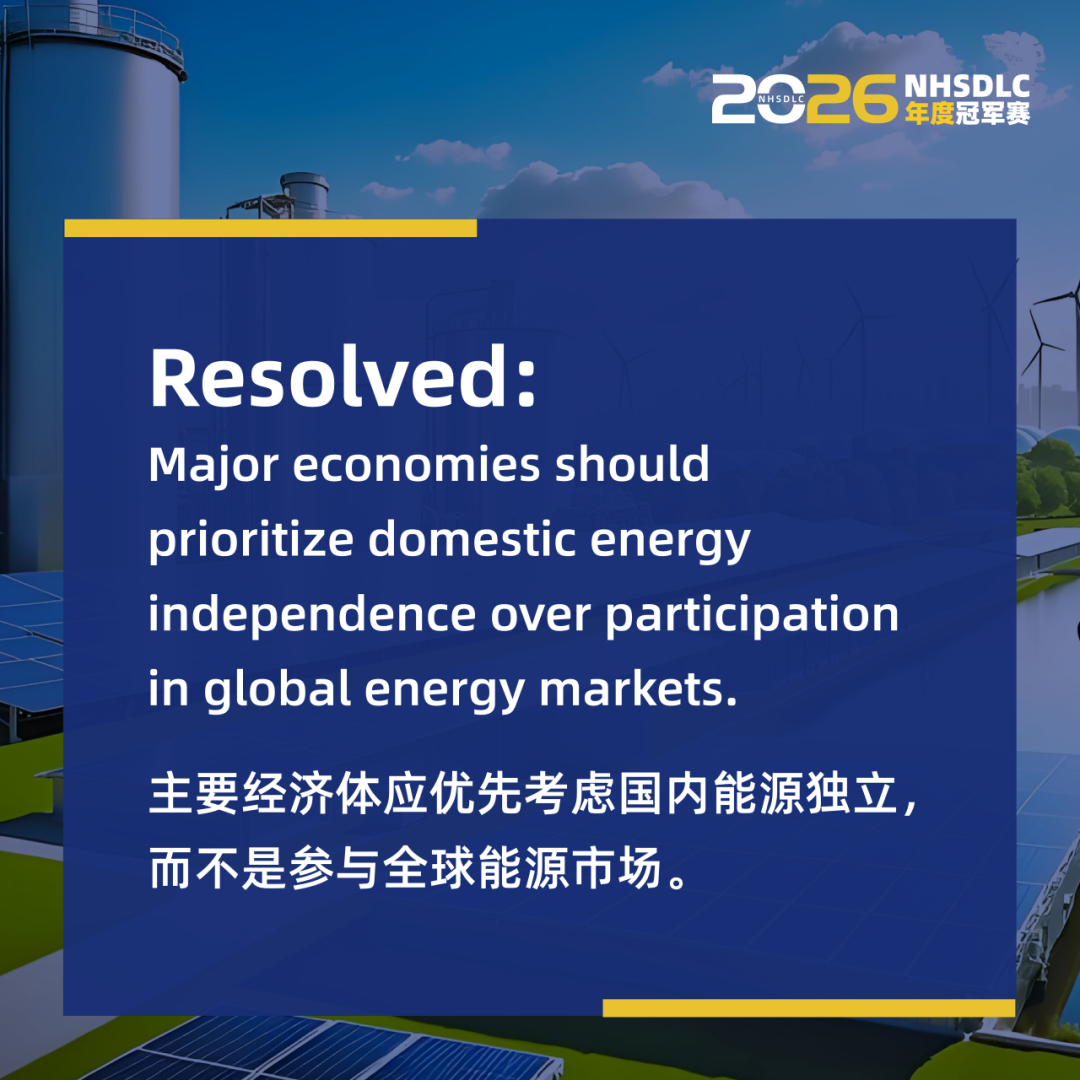
「辩题3:主要经济体应优先考虑国内能源独立,而不是参与全球能源市场。」
票数占总投票数35.2%
当选2026年度冠军赛PF辩题
*线上全国邀请赛与年度冠军赛同辩题
随着气候变化压力加剧
国际能源市场波动性增大
以及供应链安全问题凸显
主要经济体在制定长期能源政策时
普遍面临战略重心上的抉择:
应优先致力于在本国或邻近区域
构建更独立、可控的能源供应体系?
还是应更深入地融入全球能源市场

依托国际合作与贸易来保障能源需求?
在此背景下,哪种战略取向更能促进
主要经济体的长期繁荣与稳定呢?
期待各位辩手
为我们带来各方面的思考和视角!
接下来就先让我们来了解一下
今年的辩题背景吧!
Topic Background
辩题背景

Energy independence involves ensuring that a nation's energy requirements are met mainly through domestic production, energy infrastructure, and logistical support networks. In the case of major economies, this issue has gained relevance over the past years because of the transition of energy from being regarded as a mere economic resource to a matter of national security and policy.
Global energy markets have always provided nations with more affordable fuel resources and the possibility of diversifying their energy sources. Nonetheless, some events, such as global conflicts, fluctuations in oil and gas prices, and concerns about critical minerals and green energy supply chains, have caused governments to question the degree of reliance on global energy systems as a source of their energy supplies.
According to the International Energy Agency, modern energy security covers oil, natural gas, power grids, energy technologies, and critical minerals.

Pro teams advocating for domestic energy independence argue that Major economies should limit their vulnerability to external threats by creating self reliant systems.
In such a view, reliance on international energy markets makes a nation vulnerable to energy shortages, price hikes, economic sanctions, war, and political pressure from energy-exporting nations.
By focusing on the creation of self-sufficient energy supplies using either fossil fuels, nuclear energy, renewables, or domesticaly controlled supply chains, governments would have more control over their nation's future and stability.
Energy independence might also enable countries to develop industries, create jobs, protect their citizens from international market fluctuations, and increase flexibility in the face of economic turmoil.

On the Con side of this debate, prioritizing domestic energy over global energy markets may create more problems than it solves.
This is because, according to critics, global energy trade allows states to access chaeper sources of energy, offset shortages and leverage the competitive advantages offered by other economies. If a state is overly focused on producing all its energy needs domestically, it may end up facing higher costs, delays in energy transition, inefficiencies, and even unnecessary duplication of infrastructure.
Con can also argue that achieving total energy self-sufficiency is a pipe dream (pun intended) , because modern energy systems depend not only on oil and gas, but also on global supply chains for solar panels, batteries, critical minerals, grid technology, and industrial equipment.
According to IEA warnings, future energy transitions will lead to increased demands for lithium, cobalt, nickel, copper, graphite, and rare earth elements among other minerals.

The Summer resolution therefore asks debaters to weigh a fundamental dilemma. Should major economies prioritize control, stability, and national security by redcucing the dependence on global market even at the expense of possibly increasing costs and reducing effecieny? Or should they maintain reliance on energy trade in the international market, accepting some external vulnerability in exchance for affordability?
In essence, this resolution is not about how good domestic energy source production might be or how bad international energy trading might be. Instead, it is about what major economies should value most in an increasingly unstable world: independence and security, or openness and interdependence.
References
1,https://www.iea.org/topics/energy-security
2,https://www.iea.org/reports/global-critical-minerals-outlook-2024
3,https://www.iea.org/reports/the-role-of-critical-minerals-in-clean-energy-transitions
4,https://doi.org/10.1038/nenergy.2016.73
5,https://climate.uchicago.edu/news/the-false-promise-of-energy-independence/
6,https://www.rewiringamerica.org/newsroom/newsletter/exporting-more-energy-than-we-import-energy-independence