

文章目录[隐藏]
- 你为什么想学习这个课程或学科?
- 你的资质和学习如何帮助你准备这门课程或科目?
- 你在教育之外还做了哪些准备工作?这些经历为什么有用?
- 个人陈述评审员的专家反馈
- AI生成的反馈
- Why do you want to study this course or subject?
- How have your qualifications and studies helped you to prepare for this course or subject?
- What else have you done to prepare outside of education, and why are these experiences useful?
为剑桥、伦敦政治经济学院、华威大学、伦敦大学学院和伯明翰大学的大学申请所写。
你为什么想学习这个课程或学科?
自从九年级的历史老师告诉我“繁荣之环”——我们现在更熟悉的乘数效应——我就一直对经济学这个概念着迷。如何引导个人的愿望,使追求个人目标对所有人都有益?此外,如何润滑这一过程,以确保其高效完成?这些基本问题正是吸引我选择GCSE高级经济学课程的原因,希望能达到学位水平。更重要的是,我相信自己有热情和动力去提升对这些问题及其答案的理解,并为围绕它们反复出现的辩论做出贡献。
作为《经济学人》的订阅者,我喜欢慢慢浏览最新一期;看到我在学校和自己的时间学到的理论在现代世界中被切实应用,这让我感到满足。著作和文章如《过度特权》;杨耀的《新的全球交易所》和《布雷顿森林2应当被什么取代?》深刻地拓展了我对全球货币储备及美元作为主要储备货币作用的理解。现在我很清楚,美国从铸币税和国债利息支付减少中获得了不公平的优势。这些因素使得其信用回报率高于负债偿还率,从而出现不可持续的经常账户逆差。
关于一种新的储备货币是否有利甚至可能取代美元,我热切关注这一辩论,正是通过阅读上述文章,想从美元转向的国家所面临的困难变得清晰。我希望大学期间能让我更深入地探讨这些问题,并开始形成我自己如何解决这些问题的想法,可能通过使用黄金等实物资产或此前提出的储备特别抽签权。
我也希望探讨欧元及更广泛的欧洲一体化如何惠及所有成员国。我理解这可能涉及部分成员国的退出和对其他成员国的财政控制权。这只是关于现代金融世界出现的众多问题中的两个,而这些问题正值经济学家的激动人心的时代。
你的资质和学习如何帮助你准备这门课程或科目?
2011年7月,我在埃因霍温的DAF卡车工厂工作。在那里我了解了财务建模和贴现现金流。后者让我觉得这是对我们在A-level所学数学技巧的明显实际应用,也加深了我对经济学中一个极具吸引力的方面:审慎运用数学来评估经济困境和歧义。
通过数学解决问题是一项让我感到非常满足的活动,这也促使我从八年级起代表学校参加每年举办的UKMT团队数学挑战赛。
十年级时,我是冠军辩论队的一员,并当选为地方政府青年议会的副成员。我参加了三届模拟联合国会议,后两次因我对我所在委员会——经济及社会理事会辩论的贡献而获得了奖项和荣誉提名。我觉得参与这些活动让我能够与全国一些最聪明的年轻人交流观点,并为如果有幸在大学学习经济学,我将无疑会遇到的讨论和思想争论做好了极好的准备。
你在教育之外还做了哪些准备工作?这些经历为什么有用?
我喜欢参与非学术活动,完成了所有距离的10 Tors挑战,并且过去十年一直为本地橄榄球俱乐部效力。2010年,我还策划并主持了本地学校校长会议的一小部分。
这些课外经历通过培养我的团队合作、耐力和组织能力,补充了我的学术兴趣,我相信这些在大学及未来都会非常有价值。
个人陈述评审员的专家反馈
- 关于阅读文章和探索兴趣的精彩部分。申请者通过阅读明确表达了兴趣,并希望通过获得课程名额来进一步探索。
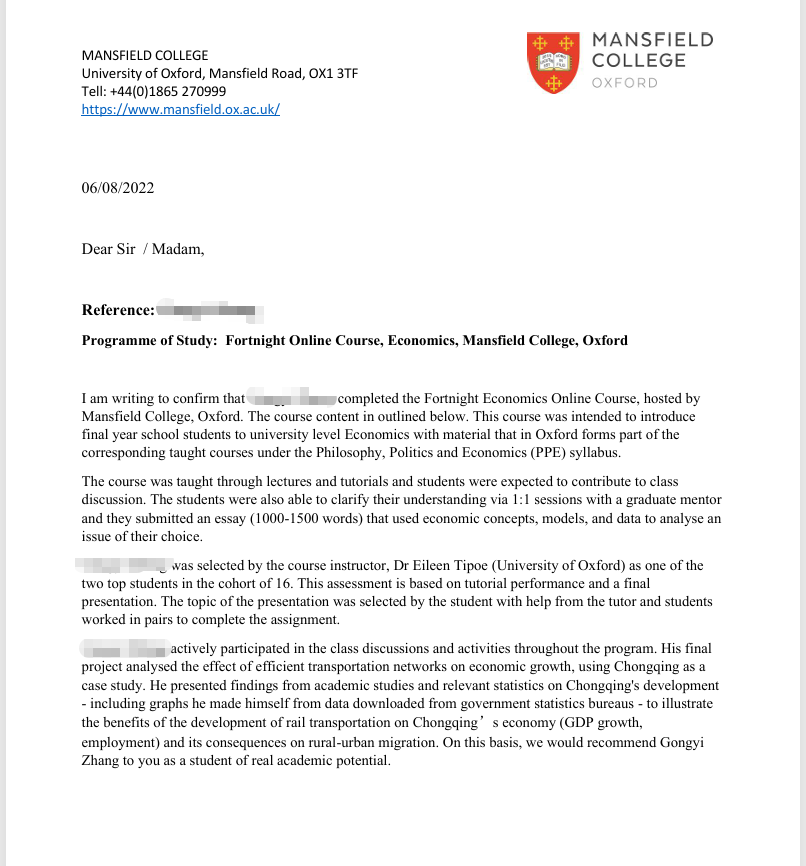
- 工作经验部分非常有力,因为它展示了申请人考虑将所学应用于实际环境。
- 个人陈述的结构有些不足。有些部分可以合并或分开以便清晰。
- 课外活动部分较长;目标是让课外活动占比约20%。
AI生成的反馈
这些反馈由人工智能生成,基于这份个人陈述的文本:

这份个人陈述有效展现了他对经济学的真诚热情,并结合了对当前问题的详细探讨和相关学术阅读。工作经验与理论知识的结合增强了申请者的形象。为了进一步增强影响力,重新组织部分章节以实现更流畅,并压缩课外细节,将提升可读性和重点。此外,明确将课外技能与课程和大学经历联系起来,将突出申请人的整体适配性。保持真实、好奇的语气将继续吸引招生导师。
附上英文
Why do you want to study this course or subject?
Ever since my Year 9 history teacher told me of the "circle of prosperity", a phenomenon we now know better as the multiplier effect, I have been fascinated by the idea of economics. How can the aspirations of individuals be guided so that the pursuit of individual objectives is beneficial for all? How as well, can this process be lubricated to ensure it happens with the utmost efficiency? These basic questions are what drew me into taking economics at GCSE, Advanced and hopefully, degree level. What is more, I believe I have the devotion and drive to improve my own understanding of these questions and their answers, and to contribute to the recurring debate surrounding them.
As a subscriber to The Economist I enjoy winding my way through the latest issue; taking satisfaction from seeing where theories I learn in school and my own time are tangibly applied in the modern world. Books and articles such as "Exorbitant Privilege"; "A new global exchange" and "What should replace Bretton Woods 2?" by Yang Yao have deeply augmented my understanding of global currency reserves and the dollar's role as a primary reserve currency. It is now clear to me that the US gains an unfair advantage from the seigniorage and the reduced interest payments on treasury bonds. These lead to it being able to achieve a higher return rate on its credit than it pays on its liabilities and subsequently run a current account deficit that would otherwise be unsustainable.
The debate about whether it would be beneficial or even possible for a new reserve currency to usurp the dollar is one which I eagerly pursue and it is through reading articles such as those mentioned that the difficulties faced by countries wanting to switch from the dollar have become clear. I hope that my time at university will allow me to delve deeper into these issues and enable me to begin to formulate my own ideas for how I would see them solved, possibly through the use of physical assets such as gold or the previously proposed special drawing rights to hold reserves.
I also hope to investigate how the euro and the wider integration of Europe can be made to benefit all member countries. I understand that this may involve the departure of some member states and the assumption of greater fiscal control over others. These are but two of a number of questions regarding the modern financial world that are arising in what is an exciting time to be an economist.
How have your qualifications and studies helped you to prepare for this course or subject?
In July 2011 I spent time working at the DAF Trucks plant in Eindhoven. Here I learned about financial modelling and discounted cash flows. The latter of these struck me as an obvious practical application of the mathematical techniques we learn at A-level and deepened my intrigue into an aspect of economics that appeals to me greatly: the prudent use of mathematics to assess economic dilemmas and ambiguities.
The solving of problems through the use of maths is an activity which I find deeply satisfying, leading me to represent my school at the yearly UKMT team maths challenge since year 8.
In year 10 I was part of a champion debating team and have been elected a deputy member of Youth Parliament for my local authority. I have taken part in the three Model United Nations conferences the latter two of which led to me being presented with an award and given an honourable mention for my contribution to the debates held by my committee, the Economic and Social Council. I feel that my participation in these activities has allowed me to contest views with some of the brightest young people in the country and gives me a superb preparation for the discussions and intellectual disputes I will undoubtedly encounter should I be lucky enough to study economics at university.
What else have you done to prepare outside of education, and why are these experiences useful?
I enjoy engaging in non-academic activities having completed the 10 Tors challenge at all distances and played for my local rugby club for the last ten years. In 2010 I also planned and ran a small section of the head teachers' conference for schools in my area.
These extracurricular experiences complement my academic interests by developing my teamwork, endurance, and organisational skills, all of which I believe will be valuable in university and beyond.