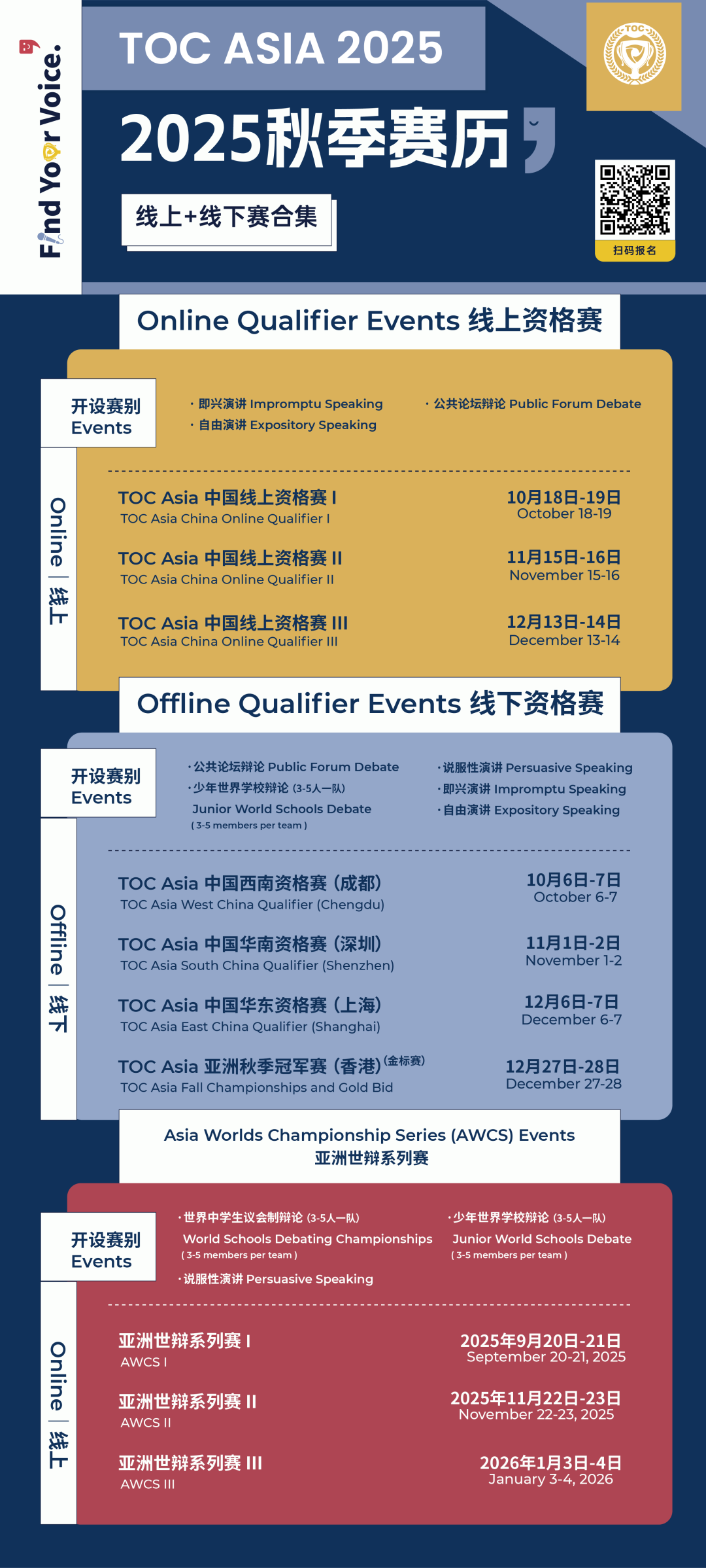


赛季更迭,思辩不息!当秋季赛程迈向高潮,2026冬季邀请赛已进入视野。
我们在此抢先聚焦两大辩论赛别冬季辩题
少年世界学校辩论(Junior WSD)1v1 即席辩论(Extemporaneous Debate)
新赛场烽火已燃,思维的深度与速度即是你的武器。如何抢先破解辩题,赢得先手?
本次,TOC ASIA 学术总监Coach Will 将为冬季辩题带来深度解读与论证框架解析,独家Sample Case 同步解锁,助你突破常规思路,构筑坚实论点。
现在,正是开启你的冬季备赛征程之时!
冬季邀请赛辩题
2026 TOC Asia Winter Invitational
少年世界学校辩论备稿辩题
Junior World Schools Debate
Prep Motion 1
This House opposes the rise of stories that humanize villains in media. (e.g. The Joker, Maleficent)
备稿辩题1:本院反对媒体中“将反派人性化”的故事越来越多的趋势。(例如:《小丑》和《沉睡魔咒》中的玛琳菲森)
Prep Motion 2
This House supports academic streaming.
Infoslide:Academic streaming is the act of separating students into classes based on ability and skills.
备稿辩题2:本院支持学术分流制度。
信息补充:学术分流(academic streaming)指根据学生的能力和技能将其分入不同班级的做法。
📅 比赛时间:2026年2月21-22日(AWCS IV)
2026 TOC ASIA Winter Invitational Online
Extemporaneous Debate: 1v1
📅 Feb 20, 2026
Junior WSD: 3-5 members per team
📅 Feb 21-22, 2026
即席辩论辩题
1v1 Extemporaneous Debate
Resolved: Keeping pets is good for children.
辩题:养宠物对孩子有益。
📅 比赛时间:2026年2月20日(KYFO)
Sample Case
2026 TOC Asia Winter Invitational
2026 TOC ASIA 冬季邀请赛即将开启!
在此,我们将奉上由 TOC ASIA 学术总监 Will 教练精心准备的
【Sample Case】
助力选手们迅速掌握辩题的核心,激发思考并提升备赛效率。
我们期待每一位辩手都能“吃透辩题,勤勉以赴”,
深入理解辩题,在比赛中游刃有余,展现最佳自我。
少年世界学校辩论
Junior World Schools Debate
Prep Motion 1
This House opposes the rise of stories that humanize villains in media. (e.g. The Joker, Maleficent)
Sample Pro Case
Proposition:Oppose the rise of stories that humanize villains
Framing, definition, and team line
Honorable judge, this debate is about what kind of stories become common in movies, TV, and books. By “stories that humanize villains,” we mean stories that put the villain in the main role, focus on their pain and sad backstory, and invite the audience to feel sorry for them or even cheer for them, like in many versions of The Joker or Maleficent. By “rise,” we mean that these stories are becoming more and more popular and common in mainstream media. To “oppose” this rise does not mean banning them. It means critics, parents, schools, and platforms should clearly push back and prefer other kinds of stories where wrong actions are not centered or made attractive. We will argue that this trend blurs moral lines for young audiences and makes harmful behavior seem attractive or understandable in the wrong way.
Roadmap:I will give two substantive arguments. First, these stories confuse right and wrong for young people. Second, they make harmful behavior look cool or deep, which can shape attitudes in a risky way. Our second speaker will defend and extend with how we still teach empathy without centering villains, and will answer Opposition’s points.
- Blurring the line between right and wrong for young viewers
When a story spends most of its time on the villain’s sad childhood, unfair treatment, or lonely feelings, audiences start to see the villain mainly as a victim. The story may show the harm they do, but it also says “look how understandable this is.” For younger or less experienced viewers, it becomes harder to separate “I understand their feelings” from “their actions are still clearly wrong.” For example, a movie might show a character being bullied at school, then later hurting many people, while the camera focuses on their tears and dramatic music. A teenager watching this can come away thinking, “If people are mean to me, then of course I might explode too.” In terms of impact, the magnitude is large, because these movies and shows reach millions of students around the world and get shared on social media again and again. The risk is medium to high that some viewers mix up understanding with forgiving, since they do not have a teacher sitting beside them to explain every scene. The timeframe is short, because each hit movie or series affects viewers immediately, and the effect grows over a few years as more and more stories follow this pattern.
- Making harmful behavior look stylish and attractive
Humanizing villain stories often give the villain the best costumes, the most interesting speeches, and the coolest music. The hero can seem boring, while the villain appears creative, brave, or “real.” When we keep making these characters the center, we risk turning violence, revenge, or cruelty into something that feels artistic or powerful. For example, some movies turn a clown like the Joker into a symbol of rebellion, with slow motion shots, strong soundtracks, and fans dressing up as him at events. People may not copy the crimes, but they can start to admire the attitude: “I do not care about rules, I only care about my own pain.” The magnitude here is again large, because fan culture spreads through posters, cosplay, and online edits that celebrate the villain’s image. The risk is medium that this attitude leaks into school life, where students justify bullying or exclusion by saying they were “pushed too far” like the character. The timeframe is short to medium, because trends and fan edits appear right after a show releases and can influence peer culture over one to three school years.
Why we win
In our world, we still have complex characters, but we do not keep raising stories that ask us to root for those who cause harm. We can tell stories about healing, forgiveness, and understanding without centering the villain and making them the most attractive person in the room. That keeps moral lines clearer for young people and reduces the chance that harmful behavior is treated as deep or cool. For these reasons, we are proud to propose.
Sample Con Case
Opposition:Do not oppose the rise of stories that humanize villains
Framing, definition, and team line

We agree that hurting others is wrong, and we agree that media influences people. The question is whether stories that humanize villains are mostly dangerous, or whether they can actually help us understand causes of harm and build empathy and critical thinking. We accept the same definition of humanizing villain stories, but on our side, we believe these stories do not have to excuse villains. They can show that people who do bad things often come from complex situations, and that understanding reasons is different from saying it is okay. We will argue that humanizing villains, when done with clear consequences, teaches viewers to think more deeply about choices and systems, and can even discourage harm.
Roadmap:I will give two substantive arguments. First, these stories help us see the causes of harm instead of just saying “evil is random.” Second, they train critical thinking and empathy, which can reduce harsh judgment and bullying in real life. Then I will briefly answer Proposition’s claims.
- Showing causes helps us prevent harm
Simple stories that say “the villain is just evil” may feel safe, but they hide the real reasons people hurt each other, such as loneliness, injustice, or bad role models. Humanizing stories show feelings and pressures that build up before the villain makes the wrong choice. This does not excuse them, especially when the story still shows clear consequences like prison, loss, or regret. For example, a movie might show a powerful character who once tried to do the right thing but was ignored, and only later turns to harmful methods. A thoughtful viewer can ask, “How could people around them have acted earlier to stop this?” In impact terms, the magnitude is large, because many students watch these films and discuss them in class or online. The risk that everyone suddenly thinks “villains are fine” is low, especially if teachers, parents, or reviewers highlight that the actions are still wrong. The timeframe is medium, as repeated exposure over a few years builds the habit of asking “why did this happen” instead of just “that person is bad,” which is useful for dealing with conflicts in schools and communities.
- Building empathy and critical thinking in everyday life
When stories show villains as fully human, with feelings, mistakes, and sometimes chances to change, they teach viewers that people are not just one label. This can help students be slower to judge classmates and quicker to listen. They learn that someone who is rude might be going through stress, and that solving problems means combining accountability with understanding. For example, a class watches a series about a character who bullies others but later reveals family problems. The students can discuss why the bullying was wrong, but also how support and firm boundaries could help. The magnitude is wide, because these discussions can happen in media classes, literature lessons, and at home. The risk that empathy turns into “anything goes” is medium to low if adults guide conversation and if stories still show harm and consequences. The timeframe is short, because even one strong story can spark better class conversations this year, and long, because students carry these habits into future relationships.
Refutation of Proposition
First, on “blurring right and wrong.” This only happens if stories forget to show harm and consequences. We support humanizing villains, but we also support clear endings where damage is visible and the villain is not rewarded for cruelty. In that world, viewers can separate “I understand how they got there” from “I still know this was wrong.” Second, on “making bad behavior look stylish.” Many stories already mix cool design with hero characters. The solution is to teach media literacy, not to avoid complex villains. Classes can discuss why a costume and music are attractive, but the choices are not. That is a better long term safeguard than trying to keep stories simple forever.
Why we win
Our world keeps space for complex, thoughtful stories that help young people understand where harm comes from and how to respond with both firmness and empathy. We believe that teaching students to think deeply about human behavior is safer and more useful than only giving them simple, one dimensional villains. For these reasons, we are proud to oppose.
Prep Motion 2
This House supports academic streaming.
Infoslide: Academic streaming is the act of separating students into classes based on ability and skills.
Sample Pro Case
Proposition:This House supports academic streaming
Framing, definition, and team line
Honorable judge, this debate is about how we organize classes in schools. Academic streaming means putting students into different classes based on their current ability and skills, for example a higher level math class and a support level math class. On side Proposition, we think schools should use streaming carefully and fairly. We will argue that streaming lets teachers match lessons to student needs, which helps both stronger and struggling students learn better and feel less frustrated.
Roadmap:I will give two substantive arguments. First, streaming lets teachers teach at the right pace and level. Second, it supports different kinds of progress in a more honest way. Our second speaker will defend and explain how to design streaming fairly, and will answer Opposition.
- Right pace, right level, better learning
In mixed classes, some students understand very quickly and feel bored, while others are lost and embarrassed to ask for help. Teachers must choose a middle pace that does not really fit anyone. Streaming allows one class to move faster and go deeper, and another class to slow down, review basics, and use more practice. For example, in an English class, the advanced group can read a full short story and write creative responses, while the support group works on sentence building and reading smaller sections with more help. Both groups are doing real work, but at a level that matches them. The impact is large in magnitude, because this affects every streamed subject, such as math, languages, and science, across many grade levels. The risk that students learn less is low if teachers plan carefully, because each group is getting lessons that meet them where they are. The timeframe is short to medium. Within one term, many students will feel less bored or lost, and within one to two years they can make stronger progress because they are not stuck at the wrong pace.
- Honest support and clear goals for different students
Streaming also allows schools to be honest about what each student needs. Instead of pretending everyone is at the same level, teachers can set clear goals for each group. Students who are strong in a subject get more challenge and may prepare for competitions or advanced exams. Students who struggle get extra explanation, smaller homework steps, and more chances to ask questions without feeling they are slowing everyone down. Imagine a student who has trouble with fractions. In a mixed class, the teacher has already moved to algebra, and this student quietly gives up. In a streamed support class, the teacher can spend a full week on fractions, use concrete examples with pizza or blocks, and give that student a chance to finally understand. The impact is big in magnitude, because many students have at least one subject where they need extra support. The risk that students stay stuck forever is lower if schools also allow movement between streams after tests or teacher recommendations. The timeframe is medium. It may take a semester or a year for a student to catch up enough to move stream, but that progress is much more likely in a class that actually teaches at their level.
Why we win
In our world, classes are not about “good students” and “bad students.” They are about matching teaching to real needs. Streaming, done with clear rules and movement options, helps fast learners grow and gives struggling students a real chance to catch up. That makes school more effective and less frustrating for everyone. We are proud to propose.
Sample Con Case
Opposition:This House does not support academic streaming
Framing, definition, and team line
We accept the same definition of academic streaming. We also care about good learning. The difference is that we think streaming brings serious side effects: it labels children too early, hurts confidence, and can turn small differences into big gaps over time. We will argue that mixed ability classes with smart support are better, because they protect self esteem, keep opportunities open, and still allow extra help and extra challenge inside one classroom.
Roadmap:I will give two substantive arguments. First, streaming harms confidence and creates fixed labels. Second, it can make gaps between students bigger and more unfair. Then I will briefly answer Proposition.
- Labels and low expectations hurt students
When a school divides students into “high,” “middle,” and “low” groups, students quickly learn these labels, even if teachers use nice names like “A, B, C” or “Green, Blue, Red.” Many students in the lower stream start to believe they are “the slow ones” and can never change. Teachers may also lower expectations without meaning to. They give easier work, call on these students less, and expect fewer questions. For example, a student who had one bad exam and is placed in the support math stream might actually be able to improve quickly. But after classmates whisper “that is the weak class,” the student stops trying, feels ashamed, and begins to hate the subject. The magnitude is large, because every streamed school will have many students in lower groups. The risk that labels affect self image and effort is high, especially in cultures where academic ranking is very important. The timeframe is short to medium. These feelings can start in the very first term and can shape a student’s attitude for years.
- Streaming can turn small gaps into big unfair gaps
At the beginning, differences in ability can be quite small, based on different primary schools, home support, or health. When we stream early, the higher class often gets the best teachers, the most resources, and extra chances like contests and special events, while lower streams focus only on basics. Over time, this means the top group keeps going up and the bottom group falls behind, even if many in the bottom group had similar potential. Imagine two students who are almost equal in reading. One just had more practice with long books at home. They get placed in the higher stream and meet a teacher who loves literature, assigns creative projects, and pushes them. The other goes to the lower stream, gets only short worksheets, and rarely writes essays. After three years, the first student is truly far ahead, not only because of talent, but because of the opportunities they received. The magnitude of this effect is wide, because it shapes future exam levels, school recommendations, and sometimes even university chances. The risk that streaming makes the system less fair is medium to high when schools have limited strong teachers and choose to assign them mainly to top streams. The timeframe is medium to long. The biggest damage appears over several years, when record cards and placement histories matter.
Refutation of Proposition
Proposition says streaming lets teachers match pace and level. But mixed classes can also use flexible groups inside the classroom, extra worksheets for fast finishers, peer tutoring, and after school support for those who need it, without fixed labels. They also say streaming is “honest” about differences. We agree that students have different needs, but honesty should not mean locking them into tracks that are hard to escape. It is better to keep everyone in mixed classes and add targeted help, so students can grow without carrying a class label.
Why we win
Our world still supports students at different levels, but it avoids stamping them as “high” or “low” in a lasting way. That protects confidence, keeps doors open, and reduces the risk that early differences turn into permanent unfair gaps. For these reasons, we are proud to oppose.
即席辩论
Extemporaneous Debate
Resolved
Keeping pets is good for children.
Sample Pro Case
Honorable judge, ladies and gentlemen, today I strongly believe that keeping pets is good for children.
First, pets help children learn to care for others. When a child feeds a dog, cleans a cage, or changes a water bowl, they are learning responsibility. They cannot just play and forget. They have to remember, “My pet is hungry” or “My pet needs a clean home.” For example, if a child has a goldfish, they must feed it the right amount every day. If they forget, they see the result and learn that their actions matter. This teaches them to be kind and careful, not only to animals, but also to family and friends.
Second, pets give children emotional support and reduce stress. Sometimes school is hard. Children may feel lonely, worried, or tired. A pet can listen without judging. Stroking a cat, hugging a dog, or watching a hamster run in its wheel can make a child feel calm and happy again. For example, after a difficult exam, a child can come home, talk to their pet, and feel less alone. This can protect their mental health and make home feel like a safe, warm place.
In conclusion, keeping pets is good for children because it teaches responsibility and gives emotional support. Pets help children grow into kinder, more caring, and more confident people. For these reasons, I believe keeping pets is good for children.
Sample Con Case
Honorable judge, ladies and gentlemen, while pets can be cute, I believe keeping pets is not always good for children.
First, pets are a big responsibility that many children cannot handle alone. Pets need food, water, exercise, and a clean place to live every single day. Many children are busy with school and homework. They may forget to feed the pet, change the water, or clean up. In the end, parents often do the work. This makes children think they have responsibility, but actually the adults are doing everything. If no one can keep up, the pet’s health can suffer, which is unfair to the animal.
Second, pets can cause health and safety problems. Some children are allergic to fur, which can lead to sneezing, red eyes, or trouble breathing. Pets can also scratch or bite if they feel scared or stressed. Even a small scratch from a cat or dog can need medicine or a trip to the doctor. For example, if a young child pulls a dog’s tail, the dog might snap. This is dangerous and can scare the child for a long time.
Finally, pets cost money and time that some families simply do not have. Food, cages, toys, vet visits, and medicine are expensive. If a family spends too much on pets, there may be less money for books, school trips, or health care. That does not help children in the long run.
In conclusion, keeping pets is not always good for children. The responsibility is often too big, there can be health and safety risks, and the cost can be heavy for families. For these reasons, I believe we should be very careful before saying that keeping pets is good for children.
2026 TOC ASIA冬季邀请赛新赛季·新征程
2025 秋季联赛火热进行中
- 期待大家在新赛季中的表现 -
秋季赛火热报名中
* 秋季冠军赛报名截止日期:2025年12月15日

👈扫码咨询